• Hey Guest!
    British Car Forum has been supporting enthusiasts for over 25 years by providing a great place to share our love for British cars. You can support our efforts by upgrading your membership for less than the dues of most car clubs. There are some perks with a member upgrade!

    **Upgrade Now**
    (PS: Upgraded members don't see this banner, nor will you see the Google ads that appear on the site.)
Tips
Tips

Oil pan torque

M

Member 10617

Guest
Guest
Offline
I have finally gotten around and mustered the courage) to remove my leaking oil pan. I did this with the very helpful instructions from forum members that I received back in June.

I removed the pan, cleaned off the old gasket, cleaned everything, flattened any dimples, spray painted the exterior of the pan, etc., etc.

Tonight I'll put the new gasket on the pan, set it on a glass base, and leave it overnight.

Tomorrow I'll reinstall the pan (using George's ingenious suggestion of two sawed off bolts as guides.

One crucial question remains: what is the best torque to use on the bolts? The manual says 12 to 15 ft. lbs. Another good source says 7 to 10 ft. lbs. I want to give myself a fighting chance to stop the leak, so I don't want to over-torque the thing. What seems to work best?
 
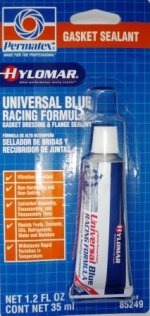
Give it a coat with Hylomar on the gasket and the mating surface... let it dry then install the pan.
 

Attachments

  • 26213.jpg
    26213.jpg
    35.8 KB · Views: 331
I'd be wary of over-tightening those bolts. If you have the surfaces well prepped the lower torques should be about right. I use 100"/lbs which is about 8 ft/lbs.
 
i've rebuilt chevys- triumphs and i've only put the bolts in snug and never had a leak ever.
 
DNK said:
Well something evaporates

It depends on the version. Some have acetone or other volatiles included, and do indeed firm up (and quite quickly). Other formulations don't seem to change, even after years.
 
<span style="font-weight: bold">Instructions for use </span>
<span style="font-style: italic">Hylomar RF should be applied to clean dry surfaces. If in doubt the surfaces can be prepared using Hylomar Rally Wipes.

Apply a thin film or bead to both surfaces. <span style="color: #FF0000">Once applied, sufficient time must be allowed for the solvent to evaporate. Failure to allow the solvent to evaporate could lead to reduced product performance and in extreme cases seal failure. </span>The unlimited assembly time characteristic of Hylomar Universal Blue allows precise alignment of joints to be made. In addition, due to the dilatant nature of the product, re-torquing of assembled parts may be required.

Hylomar RF can be removed from dismantling components by rubbing with a cloth soaked with Hylomar Cleaning Fluid or alternatively use Hylomar Gasket Remover. No scraping is necessary. </span>
 
Many thanks. Since one of the recommendations was 7 to 10 ft. lbs., I will go with 8 ft. lbs.

I meant to say let the let the sealant "cure" overnight, and not dry.

As for the sealant, I am planning to use Permatex Ultra Black. Technically, it is a "gasket maker," but I have been told that I can use it with a gasket (According to the Permatex Company, "All of the gasket-makers ... can be used as sealers.... It is imperative to use just a minimum of material -- of either gasket maker or gasket sealer -- on a cut-to-size gasket. Too much can cause oozing or even worse, provide a lubricity which would cause the basket to slip out of position when torqued to specs. Just a thin film is adequate.")

Any thoughts?
 
I only use RTV type sealant (I used Ultra Copper but Black should be okay too) on the pan side of the gasket, then weight the gasket down with a sheet of glass to create a dead level surface. I have used Hylomar there but found that my oil pan surface was simply too irregular (dimples & that groove/indentation) for the Hylomar despite using a hammer and dolly to flatten around the holes.

Do make sure the gasket holes are properly lined up with the pan holes before going to bed.

On the gasket-to-block side Hylomar is great -- will let you easily remove the gasket from the block when that day comes. Because you're presenting a very flat gasket to a machined surface Hylomar works well.

BTW -- I put Hylomar on both the gasket & the block with particular attention to surrounding each bolt hole.
 
make sure you dont over tighten the front pan bolts that go into that aluminum sealing block in the front, although they could already be stripped out. and while you have the pan off check your thrust washer clearances, its a lot easier to do underneath with the pan off.

Hondo
 
Looks like I may have stumbled into a good solution.

I have used the Ultra Black gasket maker on the pan side of the gasket. It seems to fill any irregularities that I haven't been able to flatten completely and it makes a great seal. I let the pan sit, gasket down, overnight on a piece of glass, and the result has been very satisfactory.

I will use a gasket sealant for the block side of the gasket, which will make it easier to remove the pan if I need to.

Thanks for the cautions about over-tightening and lining up the holes. I am giving this extra attention in order to get it right. I don't think anything has been stripped out at this point, but I will be very careful.

I don't know anything about thrust washers or clearances. Can you educate me so I can perform this check. Would greatly appreciate guidance.
 
If your going to use the black again on the other side of the gasket, which I recommend, install the pan and just barely snug the bolts. Allow the sealant to set up over night, then go back and do a final torque on the bolts. If you try to torque the bolts while the sealant is still wet, it will act like a lubricant and squish the gasket out. Should seal up like a fish tank.
 
Thrust washer check
first you need a dial indicator, magnetic base is preferable, harbor freight will do

while under the car attach the magnetic base on the block at the machined area where the pan goes.
using a large flat blade screwdriver against the crankshaft wedge the crankshaft toward the rear of the car.

put the dial indicator on the crank shaft, anywhere on a flat area, counterweight will do, zero the dial gauge, now move the crankshaft forward and check the movement, do this several times to make sure you are getting a corret reading( page 108 in the bentley manual) the clearance is .006 to .008 thou. if you are over .008 usually installing STD thrust washers will bring it back in to spec.

pretty easy, if you have to replace them they are located on the rear side of main bearing number 4, just take the main bearing cap off, note the orientation of the cap, the bottom half thrust washer will be in the bearing cap, if memory serves me correctly, the upper half can be replaced with the new one by rotating the new one into place the old one will rotate out, put the bearing cap back on with new bottom half thrust washer, (note the grooves in the thrust washers) and torque to proper spec, and your done then recheck the clearance as noted above
 
Those instructions are of course for a TR6. Particularly this one...

hondo402000 said:
...pretty easy, if you have to replace them they are located on the rear side of main bearing number 4, just take the main bearing cap off...

I don't think there is anything 'pretty easy' about pulling the rear main on the TRactor engine -- but I also think those engines are not prone to the thrust bearing issues that TR6s encounter.

Ed, if you don't feel like doing anything with this right now... know that the thrust bearings (float) can also be measured later with the engine all closed up.
 
Tr8Todd,


I applied the Ultra Black gasket maker to the pan side of the gasket last night and let it sit on a pane of glass overnight. In the morning, the gasket was solidly fixed in place. About midday, today, I spread a very thin layer of Ultra Black gasket maker on the block side of the gasket and slowly tightened the bolts -- hand-tightened snug, first, them a little more, and finally torqued at 8 to 9 ft. lbs.

This was done before I received your email. Because the gasket was solidly affixed to the pan this morning, and because I used only a smear of Ultra Black on the block side, I don't think torquing it before it was completely dry squished the gasket out of place. At least I am hoping this is the case. Saw no evidence of it.

If I ever have to do this messy job again, I'll follow your instructions for the block side of the gasket.

Hondo and George,

Having completely cleaned, treated, and painted the chassis of the car over the past three or four weeks (no lift --just crawled under the car for a month), and having spent a couple of days removing, cleaning, and reinstalling the oil pan, I ran out of steam and did not pursue the thrust bearing issue. I wimped out! But having learned how to remove the pan, and how really easy it is to do (thanks to all your guidance), I can do this in the future when I have more energy for it. Thanks for all the advice and guidance.
 
Startech47,

That sounds easy enough. I'll have to learn more about this and how to do it.
 
Ed,

And as Geo mentioned, the TR 4-cylnder engine is not as prone to issues in this area as is the TR 6-cylinder. Didn't you mention that this engine had been rebuilt as well?

Scott
 
Back
Top