• Hey Guest!
    British Car Forum has been supporting enthusiasts for over 25 years by providing a great place to share our love for British cars. You can support our efforts by upgrading your membership for less than the dues of most car clubs. There are some perks with a member upgrade!

    **Upgrade Now**
    (PS: Upgraded members don't see this banner, nor will you see the Google ads that appear on the site.)
Tips
Tips

Oil light is on

Dennis __

Take out the gauge and clean the frigging thing!!
Blow carb cleaner thru the pipe.

d
 
If you still have the original plastic pipe, you may be heading for trouble if it's going soft.

And don't forget the TINY leather washer at the back of the gauge where the line and fitting bolt together.
 
poolboy said:
2wrench said:
maybe plunger, huh?
Not much can go wrong with the oil pressure relief valve,except the spring loosing tension AND the sealing surface of the plunger being worn somehow uneven and not seating completely. That I 've heard of.

Pool: I examined the plunger and it did look a bit pitted and/or scored on a side. Thought
about hitting it with something to clean it up, but figured I could make it worse. Just
gotta order the parts and install. Probably take me a week or so. Sucks. It'll be
raining.
 
Dennis- it is very easy to swap wires by mistake
when you are doing the wiring yourself.

Go to your oil pressure switch and follow the
white/brown wire with your fingers and your eyes.

Make a 100% sure identification the dash light that
you believe to be your oil pressure light is in fact
connected to the white/brown wire.

PS: If your engine is properly tuned, you do not need
the anti-runon gizzmo. Also, having to "stall" your
car to make it shut off is a lazy man's way to get around
properly tuning the car.

I know this how???
Once tuned, my engine quits instantly.

dale
 
I don't wish to enter the third page of this thread with messages contrary to what's been said above but I do want to offer a few comments.

Pressure relief valves (when working properly) do not help with your hot idle oil pressure IF there is wear in components like bearings and rockers. The fact that you saw no improvement in the idle oil pressure when you fit the washer under the spring indicates that the valve is working and the oil pressure really may be low at idle. Try a new oil pressure gauge. It doesn't have to be from a TR, go the the auto parts store and buy a Sunpro or Actron or similar. Any 2-1/16" gauge will do. While you're there, buy the generic 1/8" copper gauge line kit for another $10. Replace any old nylon gauge tubing with the copper.

Use the aftermarket gauge to determine if you feel comfortable with your Smiths gauge and its readings. While the Smiths gauge is out, use carb cleaner to flush the sintered filter that's usually present on the inlet hole of the Smiths gauge. (Be careful to NOT let carb cleaner work its way into the gauge... use the carb cleaner spray tube and spray "up" into the threaded gauge stem).

If you replace nylon tubing with copper, you may or may not have a pipe fitting to attach the 1/8" tube to the Smiths gauge. The copper line kit will come with new 1/8 NPT fittings while Smiths uses 1/8 BSPP. Not to worry. A wrap or two of Teflon tape on the stem of the Smiths gauge will allow you to use the new 1/8NPT fittings on your Smiths gauge. Save the old Smiths fitting and the flat washer mentioned above for use later if you want to put things back the way they were.

Not wishing to be the voice of doom and gloom, I suggest trying the generic gauge and new tubing to see if you still show oil pressure below 25 PSI at idle. If you get the same readings with the new gauge you will have to determine whether you are concerned enough to begin some level of engine work to restore the oil pressure. Resolving the switch and the warning light issue should be secondary to knowing what your oil pressure really is.
 
FWIW,
My oil light has always done that, even after a blueprint. If you don't hear the rods knocken... my idle is at 900 to 950, and the light goes off by 1050 or so and goes to 60 at 3500 where you can see the relief valve open.

The relief valve has no purpose in life when the pressure is below it's opening pressure.

My oil cooler made it worse, because of the additional demands on oil flow specially after it's hot.

I gotta fried chicken tv dinner that the current crop of main bearing shells is narrower than originals, I don't have any to check, but that's why the oil pressure drops at idle.

Steve Spangler
71 MKIV "Jehu"
Lancaster PA
"Actually it's a buck and a quarter quarter staff, but don't tell him that."
 
What Doug says is true.

Now I didn't get a chance to ask the first time. Which oil filter are you using?? Is it a spin on? If so I hope not a Purolator.. I have had several pressure problems with them..

If the actual pressure is too low for you. Then I would recommend as a first step is to go through the oilpump, and check the rod bearing inserts. Lots of guys rebuild the engine but forget to replace/rebuild the oil pump...
 
Hmmm. I'm using a, I think, 1516 Napa Gold. When I purchased it, the
guy selling it said this thing has a spring in it and wondered if it
would cause any problems. That's interesting. Something to consider.
Problem was, the numbers given to me to cross over to other filters
didn't jive. The Napa Gold was actually one letter off.....like
an A and shoulda been a B or vice versa, something like that.

Was the right size and threads, though, so I went with it. Also, thought
it might have been mentioned by guys here as one they have used.
 
Also, after I put the washer in the oil pressure relief valve, I noted
a difference in that the oil pressure came right up to 75 pounds on
startup, as opposed to before when the gauge seemed to kind of stick
and be a bit irratic.

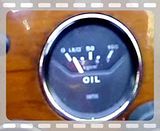
Check out how smooth it moved up:


Pressure seemed to slip, after 10 miles or so, but I am encouraged to
replace these parts at the change.
 
Hey Dennis! That rise up on start up looks kinda
normal to me but consider the source.

My pressure also falls a bit after the engine is at running temperature. As the oil gets hot, it thins out and flows better. Less pressure. After warmup, my car idles at 50 psi.

Just my thoughts anyway. I'm sure Randall will chime
in an explain what is REALLY happening.

d

<span style="color: #990000">Dennis, I got to thinking more about your situation.
You've spent a fortune fixing your busted engine. I've spent a fortune
fixing my busted everything. I've purchased lots of testing equipment
I'll never use again. An oil pressure gauge was one I bought and used once
or twice to check the accuracy of my OEM. I think I paid like $40 for it.
Go buy an oil pressure gauge and ease your mind.

d</span>
 
That last picture prompted an uncontrollable "Oh my" from me. If that's your hot idle reading it's lower than I have in the Spitfire... and I'm concerned about the Spit's oil pressure.

As before, consider temporarily fitting an aftermarket pressure gauge to see if the Smiths is believable. If the pressures you're measuring are accurate, I think the topic needs to change completely away from the light and switch to how to improve the oil pressure (main and rod bearings, new pump, oil cooler?)

EDIT: When I bench calibrated my Smiths gauge, the approximate position of your gauge needle corresponded to about 10 PSI. I was told most TR oil pressure switches change state around 7 PSI (but of course... there is a tolerance to that). For those interested, the 50 PSI scale mark is obvious, the next scale marking down is not 25 PSI but 30, the next mark "up" is 70.
 
Doug-

I think the video Dennis put up was starting his car
from cold(gauge at zero). My engine does the same thing
and then drops and holds at 50 psi once warmed up.

d
 
Tinster said:
Doug-

I think the video Dennis put up was starting his car
from cold(gauge at zero). My engine does the same thing
and then drops and holds at 50 psi once warmed up.

d

Correct, Dale. This was a cold start from nothing.
First look at gauge, the engine is not even running.

I think Doug's right that it's time to start a new
thread with a different title. My light is going out;
the real issue is maintaining the oil pressure.
 
Oh, further clarification, the needle had already started to move a bit
when I turned on the camera.

I apologize to everyone if I've lead astray with the title of this
thread. Originally, my oil light signalling low oil pressure was
my first alarm and concern. Since then, it has taken a turn to low
pressure at idle or pressure that seems to be moving down more and more,
slowly, the longer the car runs.

I have taken it for 10 mile drives, but put it in the garage promptly
for oil pressure that seems to be declining to a low level of concern.

For a while, it seems quite good, especially when revving the engine;
makes one feel you're good as long as driving at 2500 rpm's or so,
but then it seems to slowly slip and when coming to a stop at idle,
you know it's time to head for the garage.

 
Dennis- How about a vid @ warm idle and blip the throttle so we can see the needle movement and returning to normal?
Can you add sound?
 
Sorry about misunderstanding the image above. I'm at work and the bit-police don't allow us to stream anything. I could only see the still image (picture) in the link above.
 
Tinster said:
My pressure also falls a bit after the engine is at running temperature. As the oil gets hot, it thins out and flows better. Less pressure. After warmup, my car idles at 50 psi.
Just so. How much volume the pump moves is pretty much independant of the oil's viscosity; but how much "leaks" through the bearings and so on is directly dependent on viscosity and pressure. As the oil warms up, it thins out (this is true even of "multi-viscosity" oils like 20W50) and so the pressure goes down.

It's also perfectly normal for the idle pressure to be below the relief valve setting.

But, it's not normal for the idle pressure to be so low it doesn't register on the gauge or turn the oil light out. While it's not necessarily "time for a tow truck", it probably should be attended to sooner rather than later.

<div class="ubbcode-block"><div class="ubbcode-header">Quote:] <span style="color: #990000">An oil pressure gauge was one I bought and used once
or twice to check the accuracy of my OEM. I think I paid like $40 for it.
Go buy an oil pressure gauge and ease your mind.
</span> [/QUOTE]I agree entirely. Paid about $20 for mine, used it maybe 6 times in 15 years (also useful for fuel pressure on cars with port fuel injection); well worth the price. The original dash gauges are notoriously inaccurate ... I can change the reading of the one in my TR3A by over 20 psi just by how I tighten the fitting.
 
Back
Top