

-
 Hey Guest!
British Car Forum has been supporting enthusiasts for over 25 years by providing a great place to share our love for British cars. You can support our efforts by upgrading your membership for less than the dues of most car clubs. There are some perks with a member upgrade!**Upgrade Now**
(PS: Upgraded members don't see this banner, nor will you see the Google ads that appear on the site.)

Tips
- We have a special forum called "Member Articles" where you can submit actual articles for consideration for publication. Learn More
- Don't have an Avatar? If not, your avatar will default to the 1st character in your username. Go into "Account Details" to change your Avatar.
- Some basic forum navigation info: click
 Hey - did you know if you click on the title of a thread it will take you to the first unread post since you last visited that thread?
- Hey Guest - Is your British Car Club in our Clubs database? If not, send me a PM - Basil

- Looking for a local club? Click the "Clubs" tab above and browse hundreds of clubs world-wide.
- Add Android or iPhone APP: click
- Did you know - any picture or video you add in your posts in any marque-specific forum will also get added to the Media Gallery automatically.
- A few more tips about posting and replying: click
- Hey there Guest - be sure to keep your profile page up to date with interesting info about yourself: learn more
- More tips and tricks on Posting and Replying: click
 but were afraid to ask:
  STOP!! Never post your email address in open forums. Bots can "harvest" your email! If you must share your email use a Private Message or use the
  smilie in place of the real @
- Want to mention another member in a post & get their attention? WATCH THIS

- So, you created a "Group" here at BCF and would like to invite other members to join? Watch this!
- Hey Guest - A post a day keeps Basil from visiting you in the small hours and putting a bat up your nightdress!
- Hey Guest - do you know of an upcoming British car event?
 Pretty Please - add it to our Events forum(s) and add to the calendar! >> Here's How <<
- Hey Guest - you be stylin' Change the look and feel of the forum to fit your taste. Check it out
- If you run across an inappropriate post, for example a post that breaks our rules or looks like it might be spam, you can report the post to the moderators: Learn More
- If you would like to try some different "looks" or styles for the site, scroll to the very bottom, on the left and click the Style Selector.
You are using an out of date browser. It may not display this or other websites correctly.
You should upgrade or use an alternative browser.
You should upgrade or use an alternative browser.
Oil light is on
- Thread starter 2wrench
- Start date

poolboy
Yoda

Offline
There is a relationship (electrically speaking) between the oil pressure switch and the PDWA. Make sure you have the terminals on the oil pressure switch connected to the proper wires and you have a good connection there and at the PDWA.
If that's as good as it's supposed to be then, yes, I guess the next step would be to suspect the switch itself.
If that's as good as it's supposed to be then, yes, I guess the next step would be to suspect the switch itself.

OP

2wrench
Luke Skywalker
Offline
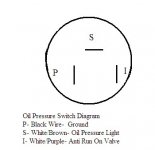
Thanks, Paul. I transferred the wires per this schematic. Seemed to help
at first; then, back to the same old stuff.
Actually, seems okay at first, then not so hot after warm-up.
Another possibility: Oil pressure relief valve. What do you think?
Machine shop said when I picked up my car engine parts re the oil
pressure relief valve: "I set it (relief valve,) and don't touch it. Just
install it."
Wonder if the setting ain't so hot and once it warms up, the valve starts
to blow off some of the pressure?
at first; then, back to the same old stuff.
Actually, seems okay at first, then not so hot after warm-up.
Another possibility: Oil pressure relief valve. What do you think?
Machine shop said when I picked up my car engine parts re the oil
pressure relief valve: "I set it (relief valve,) and don't touch it. Just
install it."
Wonder if the setting ain't so hot and once it warms up, the valve starts
to blow off some of the pressure?

TR3driver
Great Pumpkin - R.I.P
Offline
You said the gauge shows 50 psi; while the switch should operate at under 10 psi. Gotta be either the switch, or some other wiring problem.
I've seen switches act that. Light goes off when you first start the engine, then later comes back on and will go off again if you rev it up. Generally means the switch is leaking oil internally, through the diaphragm but not through the plastic housing. Which presents at least the possibility that the plastic housing will fail suddenly and start dumping oil on the ground.
I'd replace it sooner rather than later.
I've seen switches act that. Light goes off when you first start the engine, then later comes back on and will go off again if you rev it up. Generally means the switch is leaking oil internally, through the diaphragm but not through the plastic housing. Which presents at least the possibility that the plastic housing will fail suddenly and start dumping oil on the ground.
I'd replace it sooner rather than later.
TR3driver
Great Pumpkin - R.I.P
Offline
Worth noting, perhaps, that if you don't plan to use the anti-runon solenoid; you can use the less expensive single terminal oil pressure switch. About $5 instead of $20 for the 3-prong. Just tape off the white/brown wire and leave the black disconnected (the single terminal switch grounds through the mounting).
OP
2wrench
Luke Skywalker
Offline
TR3driver said:Worth noting, perhaps, that if you don't plan to use the anti-runon solenoid; you can use the less expensive single terminal oil pressure switch. About $5 instead of $20 for the 3-prong. Just tape off the white/brown wire and leave the black disconnected (the single terminal switch grounds through the mounting).
Randall, while on the subject, I did hook up my anti-runon solenoid that had been
disconnected by the previous owner. Tell me more about this part. What is its function?
You make it sound rather optional. Why have it?
TR3driver
Great Pumpkin - R.I.P
Offline
It's purpose is to make sure the engine stops running when you turn off the key. You can accomplish the same thing by letting out the clutch with your foot on the brake.
I'm not saying you <span style="font-weight: bold">should </span>remove or disconnect it, but many people chose to do so.
I'm not saying you <span style="font-weight: bold">should </span>remove or disconnect it, but many people chose to do so.
poolboy
Yoda
Offline
2wrench, the ARV is a solenoid (electromagmetic) valve. It only opens when you turn the ignition key to off. Then the valve gate opens allowing the vacuum present in the intake manifold at the brake servo banjo fitting to be transfered thru the ARV, the Carbon Canister and finally the float chamber vents on the upper front left side of your carbs. This vacuum prevents gas from being drawn up the jets as the engine is shutting down and prevents Run-on.
The valve returns to the closed position when the oil pressure drops and the circuit is broken by the oil pressure switch.
If you'd like to read an "official explanation" you'll find it in the Haynes Manual, Chapter 13/ Supplement. Look under the description of the "Evaporative emission control system" paragraphs 10 thru 12.
The valve returns to the closed position when the oil pressure drops and the circuit is broken by the oil pressure switch.
If you'd like to read an "official explanation" you'll find it in the Haynes Manual, Chapter 13/ Supplement. Look under the description of the "Evaporative emission control system" paragraphs 10 thru 12.

poolboy
Yoda
Offline
Somebody been doing a little experimenting ?Brosky said:And it doesn't matter which of the two wires goes where on the switch.
T
Tinster
Guest
Guest
Offline
2wrench Randall said:<span style="color: #000099">Dennis, my car does not have an anti-runon device. My car used to runon
when I turned off the key and DPO Pedro told me the same thing.
"Stall the car in gear." I always felt that concept was lame.
I found that with proper timing, properly adjusted carbs and high test
gasoline- my car engine stops instantly when I shut it down.
Just my two cents worth.
d</span>

tomshobby
Yoda
Offline
The switch is cheap and easy to replace. I once had one go bad and the center parts actually blew out of the metal casing. Transformed the engine to a solid mass of metal. The good thing was it was not a Triumph, the bad thing was that it was a really nice '65 Corvair.
Shirley called and said she did not know what was wrong but that she was passing a car and could not figure why the car kept loosing power.
For the run-on try lowering the idle some. Especially if you notice that the run-on does not always happen if you blip the throttle before turning off the ignition. It might be running just fast enough to be just out of the idle stage of the carbs.
Shirley called and said she did not know what was wrong but that she was passing a car and could not figure why the car kept loosing power.
For the run-on try lowering the idle some. Especially if you notice that the run-on does not always happen if you blip the throttle before turning off the ignition. It might be running just fast enough to be just out of the idle stage of the carbs.