• Hey Guest!
    British Car Forum has been supporting enthusiasts for over 25 years by providing a great place to share our love for British cars. You can support our efforts by upgrading your membership for less than the dues of most car clubs. There are some perks with a member upgrade!

    **Upgrade Now**
    (PS: Upgraded members don't see this banner, nor will you see the Google ads that appear on the site.)
Tips
Tips

Octane Rating

Burrell22

Freshman Member
Offline
So i'm back again about the 63' TR4. We got everything buttoned up suspension wise and got toe set :smile:. Been driving it got 200 miles on it in the last 2 days.

Anyway we pulled the timing up to top dead center and put about 8 degrees advance in it. However i was reading about new alcohol based gases. I DONT LIKE THEM and never have. Regarding Lead, some reading i did said that this gas was developed because of spark knock ( which we have around 2300 rpms right where is starts pulling good ). It reduces the tendancy for detonation. The car is running around 12:1 compression ratio, more around 11.5 maybe. Anybody use led substitutes with hardened valve seats and see that it reduces spark knock?

P.S. It supposedly raises the octane in some strange way to prevent detonation. Using racing fuel it no longer runs of after shut down and will pur like a kitten up all hills.
 
Not so sure about the lead issue but I do know Lucas Oil makes an additive to deal with the ehanol in the gasoline as it wreaks havoc on the rubber seals and gaskets in the fuel system.
 
That is also a concern,But this car should have the capability to run at atleast 14 degrees advance timing. With racing fuel (112 octane) its perfect at about 20 degrees and will haul but. so 12 and it should run just fine at 2500-4500 rpms
 
I've just started running Redline lead substitute mixed with oxygenated pump gas in my relatively stock TR3 motor. Too soon to say if it helps with VSR, but it didn't seem to have any impact on how much timing I could run. If anything, it might be just a bit more apt to ping (which I get only when underhood temps are way high) than the same fuel without.

Here in CA we've been getting oxygenated fuel for a long time. It does take some getting used to, those vintage "rubber" parts will have to be replaced with more modern nitrile rubber (eg Buna-N). But it's not going away, and in fact the EPA has even been making noises about increasing the blend. Might as well just replace the inadequate parts and get on with it. The original parts should have been replaced every 10 years or so anyway, so they're probably due.

I'd be interested in the report on the Lucas "rubber protectant", as I'm inclined to believe that is impossible unless the additive is actually combining with the ethanol (which would likely mean you need an awful lot of additive). It sounds like snake oil to me.
 
I'm not sure whether the timing you reference is static, at idle or at speed.

Possibly 'at speed' since 14° was the stock timing 'all in'. It is a steep curve as total advance is achieved at 1200 RPM.

All that is with the stock 9:1 CR -- I expect a 12:1 is going to be a challenge with pump gas.

It is my understanding that 'octane boosters' have a very small effect on octane (e.g. if they claim it raises octane '4 points' I think they are really saying an increase of 0.4).

I got hardened seats but only after a long fast runs (many hours at speed) finally caused noticeable recession. Not something I choose to do before it was needed. Don't see how it could affect pinging in any case.

<span style="font-style: italic">Oops, of course stock timing was 24° -- I was menatally mixing static (4° crank) and centrifugal (10° dizzy).</span>
 
Here's my take on the timing game. High CR and lower octane makes a mixture easier to light thus requiring less timing lead. You need more advance w/ higher octane simply because it's harder to light. That why you use high octane to begine with, so you can run more compression and make more power.

That's lots of timing and compression to try to run on pump gas. Dial back your timing till it doesn't ping or knock and you should be good. You don't need a lot of advance to light the cheaper stuff.

Whatever the stuff you use, you need it all to burn completly before a given point. Higher octane just needs more time to burn thus requiring more lead. You don't want it still buring on the way down and definatly not while it's still on it's way up while another flame front is traveling towards it in the other direction.

You can't make more power with the engine trying to beat itself to death.

Less is more in this case. If you insist on trying to use pump gas you'll need a lot less timing. Get the thought out of your head that more timing = more power. In this case on pump gas it doesn't.

If you put the good stuff in it then yes, more timing = more power. It just doesn't apply to ditch water.

Here's something weird. The Javelin I just bought is supposed to be 10.2 to 1. I've been running 87 w/ 10% ethanol and it doesn't knock. I have no idea where the timing is but it screams. I would think that 10.2 would knock on 87 but it doesn't. Maybe it's not really 10.2 but it sure does run great.
 
The problem is you cannot run anything less than 93 octane or it knocks so bad your afraid your going to crack a piston. And im talking about timing at idle, its set from the chain at top dead center then adjusted as we drive it with the dial on the distributor.
 
Burrell22 said:
The problem is you cannot run anything less than 93 octane or it knocks so bad your afraid your going to crack a piston.

That doesn't surprise me in the least bit.

I'd start at 0 and work my way up. It doesn't take very much for a very short period to break something.

If you are serious about running it on thr street on pump gas I'd look into a different head that the chambers have been opened up a little.
 
kellysguy said:
Here's something weird. The Javelin I just bought is supposed to be 10.2 to 1. I've been running 87 w/ 10% ethanol and it doesn't knock. I have no idea where the timing is but it screams. I would think that 10.2 would knock on 87 but it doesn't. Maybe it's not really 10.2 but it sure does run great.

That's excluding modern cars with fancy electronic fuel and ignition controls right? My 2004 Mazda 6s with a 3.0 liter V6 specifies 87 octane with 10.0:1 compression for example. It only has 220HP though.

Scott
 
kellysguy said:
Here's something weird. The Javelin I just bought is supposed to be 10.2 to 1. I've been running 87 w/ 10% ethanol and it doesn't knock.
Lots of other things affect octane requirement, like combustion chamber shape, cam design and so on. Even humidity and charge temperature play a role.

I've always wanted to try water injection, which can supposedly decrease octane requirement by a great deal. The military was using it even before WWII, to get more power from airplane engines, so there must be something to it. Those were supercharged engines, but it is supposed to also work for naturally aspirated.

Somewhere I've got an old Edelbrock injection system, with a sensor that matches water flow to engine rpm & load. But the nozzle system I built fell apart (and got sucked into the intake) before I got the rest of it hooked up, and the whole project got postponed. Maybe someday ...
 
With the compression ratio up where you have it, I really wouldn't trust it to pump gas at all, you should be running around 100 octane with that CR, and without knock detection systems and EFI in these older engines you really shoiuld be around 110 octane to prevent detonation. I hope you live near a track, or an NHRA fuel supplier.

I dont believe you can even legally buy TEL for adding to your fuel anymore in the US, and I dont know how any of the 'alternative lead additives' for fuel will work for increasing the octane, since they're primarily for valve seat wear in the use of older vehicles rather than for high compression ratio engines.
 
We live near an exxon that sells racing fuel, but it is very expensive, i think e have figured it out, just lowet timing on distrib.
 
When I used to buy C110 racing fuel for the formula car, it was really expensive too. ISTR I paid nearly $5/gallon! lol
 
Something else you might try, is finding an "octane booster" additive that contains MMT. It won't do anything for your valve seats, but I found it to be very effective at controlling detonation. It leaves deposits that also seem to help, so your need for it may go down over time.

Unfortunately the brand I used is no longer available, but there should be others. You can tell if it really contains significant amounts of MMT, because it leaves funny pink colored deposits on the plugs. They won't hurt anything, unless they pile up high enough to foul the plug (in which case clean them and maybe back off a bit on how much additive).
 

Attachments

  • 28060.jpg
    28060.jpg
    20.8 KB · Views: 206
Burrell22 said:
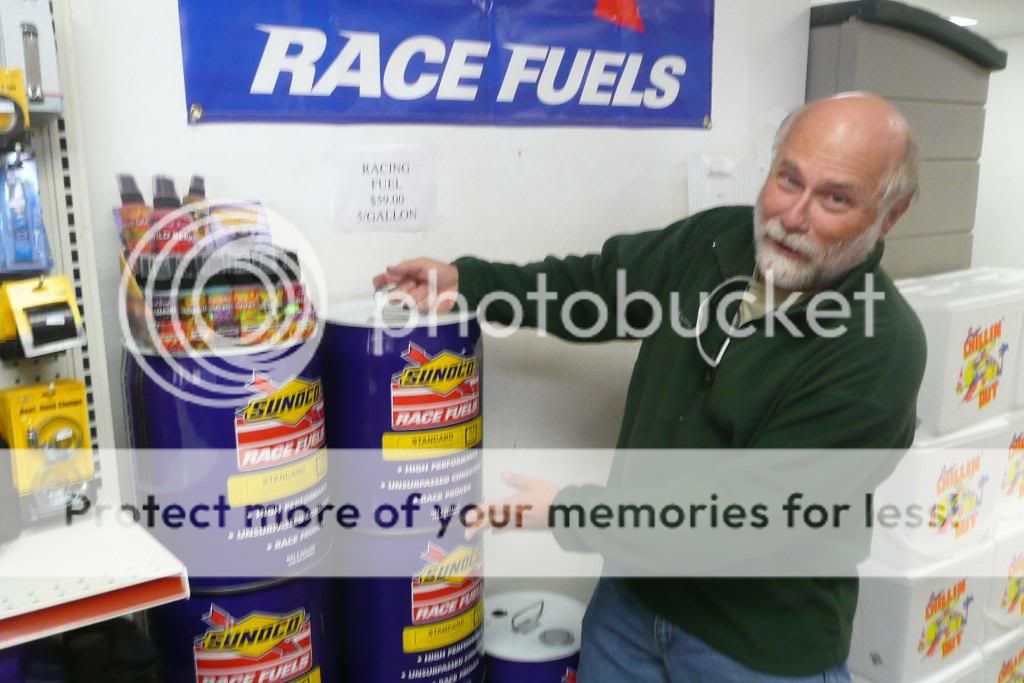
We live near an exxon that sells racing fuel, but it is very expensive...

Take home a 6-pack...

wSunoco.jpg


One approach to timing is to adjust it with a timing light at high RPMs and let timing at idle be wherever that puts it. I think the theory is that detonation at high RPMs is the real killer.
 
HerronScott said:
kellysguy said:
Here's something weird. The Javelin I just bought is supposed to be 10.2 to 1. I've been running 87 w/ 10% ethanol and it doesn't knock. I have no idea where the timing is but it screams. I would think that 10.2 would knock on 87 but it doesn't. Maybe it's not really 10.2 but it sure does run great.

That's excluding modern cars with fancy electronic fuel and ignition controls right? My 2004 Mazda 6s with a 3.0 liter V6 specifies 87 octane with 10.0:1 compression for example. It only has 220HP though.

Scott

Correct. The newer stuff is better designed. From what I understand aluminum heads enable you to go up 1 full point in compression also.

My Hyundai is 10.3 and I run it off of 87. The Jav really surprised me on 87.
 
I run a very high output H-D - it will not run on todays excuse for gas - I have tried several fuel additives to boost octane - only one works - OCTANE SUPREME 130, KEMCO INDUSTRIES, LLC, 1374 East Main, Lehi, Utah 84043 - I have had excellent results with this product - I can achieve 100 octane with 4 oz/gal, running premium pump gas - Miles
 
Wow! I had no idea you could buy TEL (active ingredient in Octane Supreme 130) over the counter. I wonder if it can be shipped into CA?

Should also work to reduce valve seat recession.

But at close to $.65/oz, running 4 oz per gallon is sure going to add up in a hurry on the street.
 
Thanks for all the advice guys.I pulled the timing up to 12, put racing fuel in it, 114 octane with lead( the real stuff ) in it i could tune it up to 15 degrees advance. So i ran the pee out of it, preformed great and it shut off :laugh:.Then i ran it out until it quit and put 93 bp in it. Tuned it down to 12 advance and it runs fine for now.
 
HerronScott said:
That's excluding modern cars with fancy electronic fuel and ignition controls right? My 2004 Mazda 6s with a 3.0 liter V6 specifies 87 octane with 10.0:1 compression for example.
Almost certainly, it also has a knock sensor, so it can back off the timing "on the fly".
 
Back
Top