• Hey Guest!
    British Car Forum has been supporting enthusiasts for over 25 years by providing a great place to share our love for British cars. You can support our efforts by upgrading your membership for less than the dues of most car clubs. There are some perks with a member upgrade!

    **Upgrade Now**
    (PS: Upgraded members don't see this banner, nor will you see the Google ads that appear on the site.)
Tips
Tips

New Drums.. New Shoes.. there a shoe horn?

DrinkingWhisky

Freshman Member
Offline
Hey everyone.

Just completing a refresh install from the original drum brakes to replacement parts. It's been a long process of cleaning & PB blaster to ensure nothing breaks. It's a TR4A that spent most of it's life in a barn after 6 years in Ohio winters with salt in the early 70's.

Anyways. I've installed the following new items:
* shoes
* wheel cylinders
* drum hardware (springs, hold downs, etc)

My question comes on the drums. The drum adjuster (forget the real name) is 100% backed off. (I should take a picture of this in the event that the adjuster screw is rusted a bit)

The one drum fits on, but it was a bit tight. And for not adjusting the adjuster, it has some drag. The other side will not go on. I've been using my drum brake measuring tool (measures the outer diameter of the shoes to the inner diameter of the drum) and the shoes are just slightly larger in diameter.

Should I get the drums machined? Anyone have any advice on this? Do you specify the desired diameter to the machinist? The drums feel smooth without a lip on the outer edge.

Thanks from the newbie mechanic. :smile:
 
Are you sure both adjusters are fully backed off and that all the bits are completely free to move (i.e., the wedges fully retracted when the screw was backed off all the way)? Also, keep in mind that the adjuster actually "works" in quarter-turn increments. If you look at the "pyramid" shape of the business end of the adjuster screw, you'll understand why there has to be quarter-turns of the screw.

By the way, it will be very much to your benefit (since you imply that the adjusters are a bit rusty) to remove the adjusters, disassemble and clean them, and reassemble with some dabs of a white lithium grease or similar so that they turn freely and will continue to do so. Note that in doing so, you'll be far less likely to miss "feeling" the quarter-turn increments as you adjust.

It's possible the new shoes are a bit too big (lining too thick), but assuming that the new wheel cylinders are also lightly lubricated where they go through the backing plate (so they slide properly), I'm guessing your problem is still in the adjuster(s).
 
:iagree:

However, reducing the shoe lining thickness slightly used to be a common operation. If Andy's suggestions don't work out, try calling around for a shop that can "arc" the shoes (which means the surface is ground to match the drum face exactly).
 
Andrew Mace said:
new wheel cylinders are also lightly lubricated where they go through the backing plate (so they slide properly)

Hmm.. this could be my problem. With the 3 shims, the cylinder gets pretty tight in there. I might need to put a little more grease there too. There a trick for getting those shims out? They were a pain to get out and in. In fact, I removed the old ones by just snapping the rusted metal.

Thanks guys for the help.
 
They don't need to slide easily; if you can tap the cylinder around with a (brass) hammer, then it slides "properly" IMO.

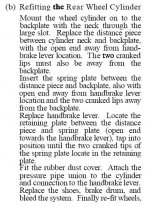
To remove the lock plates (assuming they were installed properly, many of the books show them wrong), stick a screwdriver or small wedge between the two inner plates (so the middle plate clears the tabs on the innermost plate) and then tap the middle plate out with a hammer and screwdriver. That should give enough clearance to pull the handbrake lever out, and then you can remove the inner and outer plates.

The inner and outer plates should both be installed with the open end away from the handbrake lever (meaning they are more or less trapped in place by the lever). Only the middle plate is installed the other way, with its open end towards the handbrake lever.
 

Attachments

  • 25286.jpg
    25286.jpg
    71.5 KB · Views: 289
TR3driver said:
They don't need to slide easily; if you can tap the cylinder around with a (brass) hammer, then it slides "properly" IMO.

I believe the move around via a rubber mallet, but I'll double check. That could be the missing link in the puzzle. I hope it is at least.

Also, thanks for posting the instructions on the lock plates. VERY appreciated!
 
Andrew Mace said:
it will be very much to your benefit (since you imply that the adjusters are a bit rusty) to remove the adjusters, disassemble and clean them

After banging my head.. I took everything apart on both sides again. It turns out the adjusters were gunked up pretty good. That was preventing the one side from retracting. Lesson learned.

Thanks all.
 
Back
Top