• Hi Guest!
    If you appreciate British Car Forum and our 25 years of supporting British car enthusiasts with technical and anicdotal information, collected from our thousands of great members, please support us with a low-cost subscription. You can become a supporting member for less than the dues of most car clubs.

    There are some perks with a member upgrade!
    **Upgrade Now**
    (PS: Subscribers don't see this gawd-aweful banner
Tips
Tips

new CV half shafts

hondo402000

Darth Vader
Offline
well getting ready to bite the gold coin and get me some new CV joint Half shaft in prep for my engine rebuild this fall that will produce 160 hp at the flywheel

hondo
 
Yep goodparts, yes the original diff, but I had it rebuild last year thats why I am sticking with it.
 
Just ordered my CV halfshafts from Goodparts, should be here in a couple of days, maybe next weekend I will install them also with new set of nylatron trailing arm bushings too. Looking at Pauls website looks to be a fairly straight forward installation, hopefully all the studs are ok

Hondo
 
Now is the time to do the trailing arm studs, with the inserts.
 
:iagree: I installed the 3/8" stud.
 
is there any reason to do them if I have none of the originals stripped out

Richard Said if not stripped leave them alone and dont try taking the studs out if not loose or I could just start a problem

Hondo
 
A couple of my studs were loose upon inspection. As long as I was going to take care of the loose ones, I just did all of them.
 
Hondo,

I trust Richard's judgment and knowledge, so no disrespect meant here in any way with what I'll say. I took all of my studs out when I had the chassis parts all powder coated. They just turned right out with no real effort. After the P/C work, I cleaned the threads with a chaser and installed NEW studs back in with LocTite and we assembled than chassis.

About 2,500 miles later I decided to do the axles and once again, the studs turned right out. I know how to use LocTite, as I've probably used more than any 10 people here combined over the years, but those being so easy to remove bothered me. I decided that since the easy permanent fix was available, it was going in once and for all. Maybe you'll never have a problem if you leave them alone, but I bet my ranch on going with the inserts.
 
Hondo,
Both Paul and I have done the CVJs and used Rick Patton's TA Repair Kit. All the pictures of the installation process are of me doing my car. This is a forever after fix and you'll never have to worry about the studs stripping in the aluminum TA. Using his kit is idiot proof.........I say this because I'm the idiot who gave Rick the first drawings for the kit which he improved on so even I could do the install with just a drill and a tap.

My concern with 3/8" studs is that once you drill and tap for that size stud, you're SOL if you should ever strip the stud in the TA. You've already used up all of the meat in the TA and there's not enough left to drill and tap again for an insert.

If you need any more pictures of a CVJ installation, I put them in my car almost 2 years ago when he came out with the new design. Between Paul's site and mine it should answer most of your questions.

And you will love the CVJs!
 
so I sent paul a pm , either want to pass along the tools or rent it out plus shipping back and forth

Hondo
 
If I'm careful, methodical, and typically worrisome, how long would it take to meticulously drill out those TA stud holes and install the helicoils or other inserts?

Use Patton's kit? What then is the expected or correct torque?

By the way, what is a die grinder and flap wheel, and why was that needed?

Finally, if 3/8 is too big, what size is recommended, 5/16? And for that, what size drill bit?

thx
 
Just ordered the parts from McMasters
92070a337 keenserts 4, and tool
92070a250 additionl keenserts, I got 12
1413k42 aluminum cutting fluid
2521a644 7/16-14 TPI bottom tap
30595a56 X size(0.3970) drill bit for drilling out Trailing arms stud holes

Hondo
 
KVH said:
If I'm careful, methodical, and typically worrisome, how long would it take to meticulously drill out those TA stud holes and install the helicoils or other inserts?

Use Patton's kit? What then is the expected or correct torque?

By the way, what is a die grinder and flap wheel, and why was that needed?

Finally, if 3/8 is too big, what size is recommended, 5/16? And for that, what size drill bit?

thx
I did one stud hole by hand by step drilling it with about 5 different drill sizes to get to the "X" drill size that the Keen-Serts specify. At that point I decided that there was no way I could do all of them with any precision and still get everything back on. I'm sure there's guys in here who have done it that way but I wasn't going to take the risk. That's when I sketched out my idea and sent it to Rick who re-designed it to the final product. Well actually after I did the first install, the tolerances of the jig were so tight/perfect that Rick had to "open" them up a little bit.

Once you get everything apart and the old studs out, it will take you maybe an hour to drill, tap, install Keen-Sert and stud. As far as torque goes, Rick sticks with the 16-18 lbs that Triumph states though I did a very unscientific test that found you will shear the bolt head before striping the Keen-Sert out of the aluminum.

I used the grinder and flap wheel to clean up the inside of my TA to make sure nothing interfered with the CVJ hub. It really wasn't necessary but I wasn't taking any chances.

The drill bit & tap size is specified by Keen-Sert or Heli-Coil and doesn't go by the normal drill/tap size standards.

If you belong to a club you might want to check with them as quite a few clubs have bought Rick's kit for both Keen-Serts and Heli-Coils to share among members.
 
I pulled the left rear wheel and Erik pulled the backing plate away, while I got the tools laid out. He began drilling, while I pulled the other wheel, took pictures and removed the other backing plate. By the time I had the other plate off, he was installing the studs and I had to quit taking things apart to keep up with the pictures, so I agree with Bob. An hour tops, using just the "X" drill and taking your time.
 
update
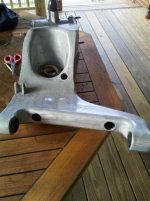
I pulled the drivers side trailing arm off, I see why they crack in certain areas, working for an engineering firm for 15 years and the knowledge gained I used it to blend the trailing arm, FYI all casting flash should be removed from the trailing arm, all sharp corners should be rounded and smoothed, all nick blended so i went over the whole trailing arm and blended, smoothed all sharp corners and angles were converted to smooth rounded surfaces, any nicks were blended out, after that the holes for the new nylatron bushings were honed out per goodparts directions, holes drilled and tapped for zirk fitting to grease the bushings. And the hole trailing arm then soda blasted and then clear coated, next drilling the studs for keen serts and then re installing the drivers side with the new CV axle, \\\

HOndo
 

Attachments

  • 22800.jpg
    22800.jpg
    63.8 KB · Views: 391
That is why racing blocks are "polished" (De-Burred) inside and cranks/rods are polished. To eliminate the stress crack areas.

Looking great so far. Keep the pics coming!!

Did you get new rubber plugs for the arms, or were the old ones OK?
 
the old plugs seemed fine so I reused them, actually in the box of parts I got from the PO I might have some new ones, Drivers side is finished, I did use a smaller drill bit for the keenserts, 25/64(0.390) which is about .007 smaller than the X size(0.397) but the serts screwed in and nice and snug and then set the tangs, and used locktite, when I put the studs back in I started to torque the studs with the double nut trick and I did tight them a little more than finger tight but realized after that that they should be snugged and the nuts get the 16-20 foot pounds, but nothing budged or felt like it was pulling out so I think I am ok on the Drivers side, I will post more pics of the passinger side

Hondo
 
I got the passinger side trailing arm off last night, drilled, tapped and installed the keenserts, found out one stud alread had a helicoil in it so glad I did the repair cleaned up the casting and got all the sharp edges rounded, and blended smooth, polished up the ID bore where the CV will set, Soda blased the whole thing and clear coated with 2 part dupont paint, so tonight will be putting it back together and test drive, Passinger side went faster now that I know the sequence of the process. if anyone else does this I would suggest using the 25/64 drill bit instead of the X(.397) the 25/64 is .007 smaller which gives you deeper threads and the inserts are really snug but still screw in by hand.

pics comming tonight

Hondo
 
Back
Top

