• Hey Guest!
    British Car Forum has been supporting enthusiasts for over 25 years by providing a great place to share our love for British cars. You can support our efforts by upgrading your membership for less than the dues of most car clubs. There are some perks with a member upgrade!

    **Upgrade Now**
    (PS: Upgraded members don't see this banner, nor will you see the Google ads that appear on the site.)
Tips
Tips

Need help with horn/turn signal unit

M

Member 10617

Guest
Guest
Offline
Got in my car to take a ride today and found that the center piece on the steering wheel that holds the horn button and the turn signal turned freely when I turned the steering wheel. I can turn the entire unit back in place by hand, but each time I turn the steering wheel -- in either direction -- the entire unit rotates.

Ride postponed!

There are three small screws behind the unit ("grub screws"), but they don't seem to have anything to do with this problem.

Any suggestions on how to repair this?
 
Sounds like the tube inside the shaft has a problem.If the jamb nut at the lower end is loose this will be the solution.If it is tight, then the tube is sheared at the top where the signal unit slots into it. I hope it is the easy fix....
MD(mad dog)
 
A common problem with TR3 trafficators. As Mike said, look at the front of the steering box. Have someone turn the steering wheel. Hopefully you will see the tube ( with wiring coming out) turn. Just tighten that jam nut. More than likely the same small tube is broken up at the steering wheel. The trafficator has a tube at the of it the slides over the steering tube that locks it in place and keeps it stationary. That is a weak spot on the tube. Most times you have to pull the trafficator and replace the tube.

Marv
 
If the stator tube is broken (which as Marv says is most likely), then IMO you should also service or replace the control head. The base of the slot is a weak point, but it should be strong enough if the cancelling mechanism doesn't bind. If the mechanism does bind, though, the tube breaks so you can turn the wheel.

Last I heard, Macy's Garage was the only source for replacement stator tubes.
https://macysgarage.com/myweb6/Parts/other_tr2_3_parts.htm#TR2/3%20Stator%20Tube
 
Thanks to all. This fix is beyond me, so I will take it into the shop and have it looked at, along with a couple of other things.
 
I took a look at the jam nut and it is tight. So the tube must be sheared at the top.

The control head is new. It was installed two years ago (properly... I don't know). As far as I can tell, mechanism binding has not been a problem... but it has never properly self cancelled.
 
On more question.... How much damage is done by driving around for awhile with the stator tube broken, while I wait to have it repaired? Damage to wires within?
 
There will be some twisting and chaffing on the wire insulation but you probably are okay. I drove one like that for several years before I knew what I was doing to it. If you need to or want to drive it as is, I suggest disconnecting the green power wire, you won't have signals but you won't have a powered short in the wiring.

Marv
 
Marv,

I probably won't be driving the car except up to the shop (about 45 miles from here), and I will try to hold the control head steady whenever I turn, so I hope it won't be a problem. Thanks for the good advice.
 
Marv,

I probably won't be driving the car except up to the shop (about 45 miles from here), and I will try to hold the control head steady whenever I turn, so I hope it won't be a problem. Thanks for the good advice.


BTW: I thought I had "fixed" it for a moment. I tightened the grub screws a little more and the control head held steady as I turned the wheels while parked. But as soon as I went out on the road and made a turn, the control head swiveled with the steering wheel. No such luck...
 
Get thyself a replacement stator tube from Mark Macy.... I paid over twice what he charges for a USED replacement over 4 years ago and was thrilled to find one. His are stainless I believe and bullitproof... will outlive all of us. A great replacement.
Gordon

PS This is a repair you can do yourself!!! You will need to disconnect the wiring coming out of the stator tube, I think it's only 3 or 4 wires. Take the nut off, pull the control head and tube out from inside (after loosening the grub screws) and Voila!! replace old with new, run wires down the new tube, re tighten everything, FILL THE STEERING BOX AGAIN, and you are in business. Buy a new "olive" gasket for the box, some Penrite oil to refill, and a new wiring harness from Mark, do it yourself, and you'll still save lot's of $$ You can do it !
 
Gordon,

Thanks for the confidence in what I could do, but I'm completely in the dark here. For instance, when you say "disconnect the wiring coming out of the stator tube," I have no idea where those wires come out and where to disconnect them.

When you say "take the nut off," I don't know what nut you are talking about.

I know where the grub (set) screws are -- just about all that I know.

If I run wires down the tube, they must attach somewhere in the steering column, but I don't know where. Manual pictures are no help here.

I cannot get to the steering box without taking the car apart. Typical Triumph design...

Sorry to be so negative... but without a kind of step-by-step, illustrated guide to doing this, I would be lost.

Like to save lots of $$, but hesitant to get into somethng I know nothing about.

But, thanks very much for your help.
 
Ed,

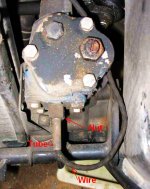
You don't need to take the car apart, the front of the steering box is accessible if you raise the front of the car a bit, either jack & jackstands or ramps. The nut Gordon is talking about is the big compression (aka gland) nut on the front of the steering box where the stator tube sticks out. The control head harness runs completely through the stator tube, out the end, up the inner fender and has connectors behind the LH horn. Just trace it with your hands to find the 4 bullets that have to be undone. You can use some masking tape to mark the connection points. You may have to remove it from a clip on the inner fender, so you can lay it out straight in front of the steering box (to make it easier to pull out through the steering column along with the tube).

(photo originally by Don Elliott, annotation by me)
 

Attachments

  • 29938.jpg
    29938.jpg
    91.8 KB · Views: 207
Randall,

Many thanks for the photo.

I drove up to Waynesboro, VA, yesterday (not in the Triumph) to talk with my mechanic and he showed me where to access the nut on the stator tube. He said he doubted that the stator tube was broken and advised me to check the nut on the stator tube.

I was confused a bit by what Marv wrote me earlier when he said that I should check the "jam nut" in that vicinity. Not knowing much about this part of the car, I checked the Moss catalog and it showed the "jam nut" on top of the steering box. I checked it and found that it was tight... and that's what I reported in my posting.

Obviously, turns out that I was looking at the wrong nut. When I returned home last night, I checked the "stator tube gland nut." It was "tight" but could be tightened a little more. I worked on it a bit (hope I didn't make it too tight) and manually checked the control head. It did not swivel! Perhaps I have fixed it...

Later today, when it warms up a bit, I'll take the car out and see if all is well. So far, however, so good... I'm hoping I won't have to replace the stator tube, but apparently it is not a big job if I have to.

Many thanks for all the good help.
 
Hi, Marv,

No problem... thanks very much for your advice.


Although the little nut on the end of the stator tube seemed tight to me, it could be tightened a little bit more... and that did the trick. I'm glad it didn't involve installing a new stator tube!

So... from this little incident, I hope others who encounter this problem will benefit.

As always, thanks to all for your help.
 
BTW -- for what is may be worth. I replaced the grub (set) screws in my steering wheel today because previous owners had done a job on the slots with ill-fitting screwdrivers. The new screws don't have a slot for a screw driver; they are made for a small allen (hex) wrench. I think this is a great improvement.
 
Of course the next owner will curse you as a DPO (it's practically impossible to see down the hole to know to use an Allen wrench instead of the 'proper' flat blade screwdriver); but as long as you are happy, that's what is important.

Personally I stuck with slots, as I tend to forget which car is which as the decades pass.
 
Randall,

I thought of that and was surprized when the Allen wrench screws arrived. But the other screws were in such bad shape, that I really didn't have much choice but to replace them with the new ones. The Allen wrench screws came from Moss.... Perhaps someone else will have the flat blade screws.

BTW: the new screws are about twice the length of the old ones. They fit well into the holes, but are high enough up that you can readily see that they are Allen wrench type and not flat blade type.

I'm afraid that I left the "proper" path long ago when I installed a new high-torque starter, a new generator, a spin-on oil filter, and an aluminum radiator.
 
Back
Top