• Hi Guest!
    If you appreciate British Car Forum and our 25 years of supporting British car enthusiasts with technical and anicdotal information, collected from our thousands of great members, please support us with a low-cost subscription. You can become a supporting member for less than the dues of most car clubs.

    There are some perks with a member upgrade!
    **Upgrade Now**
    (PS: Subscribers don't see this gawd-aweful banner
Tips
Tips

Spitfire My Spitfire - this spring

Basil

Administrator
Boss
Offline
Ok, this spring I am going to turn some attention to my lovely little Spitfire which I have been neglecting these past winter months. For one thing I am going to remove one of the two Weber carbs (two is just too much carb for that motor). I will probably sell the other carb on ebay (or here on the forum?) Anyway, one problem I have always had with this car ever since I installed the new pistons and the hotter cam and Weber carbs is oil coming from the rear seal area, especially when I turn the car off. I have replaced the rear seal twice to no avail.

Could this problem be due to too much crank case pressure? Has anyone run across a similar problem? If it is Crank Case pressure causing the oil to be forced out the back end, what can I do about it?

Basil
 
Hey Basil,
I would look at the crank surface & check to see if the rear seal is centered when installed. It's easy to tighten the rear cover off center.
If it's excessive crankcase pressure the cause would most likely be from blow-by (worn rings) or worn valve guides & seats. A compression test would be the first step to determan where to start.
Try venting your valve cover to the atmosphere to relieve the pressure as a test to see if the leak persists.
If it is an over pressure condition you should notice oil coming out fron the dip stick tube as well.
 
What year Spitfire? Is it supposed to have an emission control valve? When I bought my '67 TR-4A it had no emission control valve. The valve cover pipe was plugged. There was so much oil coming out of the rear seal that the previous owner had a paint roller pan tied up under the rear of the engine. I installed the valve, never did change the rear seal. It's been nine years and I have a leak about the size of a quarter after sitting all winter.
 
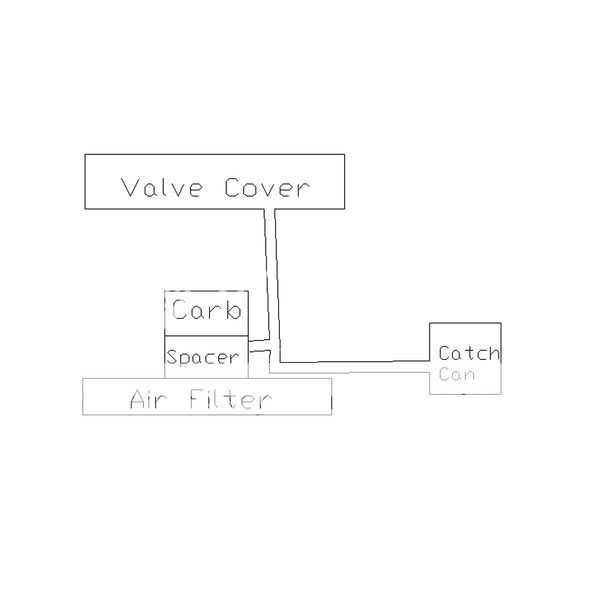
I found that my racer (with the same 1500 engine as your car) was blowing oil until I rigged up a simple "PVC" system. Actually there is no valve involved; I just used a 1/2" copper "T", some heater hose and a spacer (between the carb and air filter) made from PVC pipe (in my case, it was 2" plastic pipe). I also added a catch can to the other end of the "T" fitting. The catch can sits about 18" lower than the carb.
The schematic below gives the general layout. I used 1/2" heater hose to connect from the valve cover to the "T" and from the "T" to the catch can. The "T" is connected to the spacer using a short piece of copper pipe and some RTV sealer. There is no other vent to the crankcase, so it is running under a very light vacuum.
I have run the car for 3 hours in a race, rarely dropping below 4500 RPM without loosing a drop of oil. Before I added this, the catch can would collect almost a pint in 30 minutes and the rear seal would be dripping. The spacer is about 2" thick, so you'd need longer air filter bolts. With a single Weber, you might need to fashion a more rectangular shaped spacer (or get some 4" PVC pipe and heat it and squeeze it into a more rectangular shape).

carb-vent-1500.jpg
 
After I fixed the oil leaks on my 1500, I was blowing oil out of the dip stick tube. I made a similar T set up to what Nial built, down to the brass T and heater hose. I haven't had a problem with crank case pressure since. It was alot easier than my original idea which was to cut a hole in the block and make a simple down tube to relieve pressure. Bas, how much you looking to get out of your weber?
 
Back
Top