

-
 Hey Guest!
British Car Forum has been supporting enthusiasts for over 25 years by providing a great place to share our love for British cars. You can support our efforts by upgrading your membership for less than the dues of most car clubs. There are some perks with a member upgrade!**Upgrade Now**
(PS: Upgraded members don't see this banner, nor will you see the Google ads that appear on the site.)
You are using an out of date browser. It may not display this or other websites correctly.
You should upgrade or use an alternative browser.
You should upgrade or use an alternative browser.
More Plane Stuff 2
- Thread starter DNK
- Start date


Offline
Don - my take: early engines often had too little horsepower to lift the aircraft. So more "lift" was needed. Without lots of development on planiforms and other wing design issues, you added wings to add lift. Lots of lift = altitude, but lower speeds. As engine and airframe design progressed, you didn't need all the wings.
But not all early fliers had multiple wings. Here's one of Bleriot's aircraft in 1909:

But not all early fliers had multiple wings. Here's one of Bleriot's aircraft in 1909:
BustedKnuckles
Jedi Knight
Offline
Actually, with no way to test airfoil shapes, aircraft designers of the early 20th century used logic rather than science to design wings, The accepted practice was to build thin wings to keep drag to a minimum. The thin cross sections of the wings made them both weak and inefficient. Thus large surface area and external bracing were the norm.Always wondered about this...
Why did the early planes have 2 wings?
Was it that they flew so slow they had to have that much more surface area for lift?
As aerodynamic science progressed engineers began to understand the value of thicker airfoils in terms of both strength and efficiency. The Fokker D-8 is a good example of that early transition to the use of a thicker unbraced wing with less surface area than had been used ever before. My Peican Sport 600C in my avatar has a wing that is almost twice as thick as that of the fighter planes of early WW1.
Early monoplanes like the Bleriot XI pictured above, were modeled mostly after the aerodynamics of soaring birds with large broad wings and under-cambered airfoils. They were nothing more than powered gliders as the designers were more interested in staying above the ground than they were in the speed and maneuverability needed later in the fighter aircraft of WW 1.
Last edited:


Offline
The great benefit of the biplane was that it offered the designer the ability to combine strength with a lot of lift but with a very short wingspan. The two wings of the biplane effectively form a box, which, with struts and bracing wires, can be made to be very strong. But, just as importantly, because all the struts and wires are 'inside' the box they tend to be self compensating - when a force, say lift, acts to tension one set of wires the other set have the strain on them reduced.
Also, (remember that flaps weren't around in the early days) generally speaking biplanes had a lower take-off and landing speed, and per foot of wingspan generated more lift and less drag than an equivalent monoplane design.
Monoplane designs only really began to surpass biplanes when new materials became available to build wings that could be braced internally and the power out put of new engines meant that the drag caused by all the wires and struts of a biplane posed too great a penalty in terms of the aircraft's performance.
My old Stearman shown in the first photo, was a later example of Bi planes, which the military used for trainers due to their ability to take tremendous abuse prior and during WW-II. The Stearman could take 10 Gs of force up or down, yet be gentle to fly! Today Bi planes are still built for aerobatic purposes as they can be made smaller but still remain very strong and they look pretty cool also! PJ
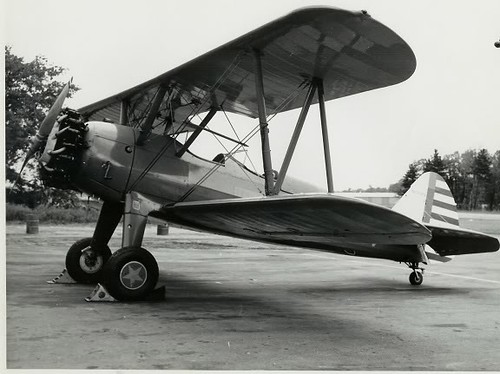
Today a modern Bi plane designed for aerobatics.

Also, (remember that flaps weren't around in the early days) generally speaking biplanes had a lower take-off and landing speed, and per foot of wingspan generated more lift and less drag than an equivalent monoplane design.
Monoplane designs only really began to surpass biplanes when new materials became available to build wings that could be braced internally and the power out put of new engines meant that the drag caused by all the wires and struts of a biplane posed too great a penalty in terms of the aircraft's performance.
My old Stearman shown in the first photo, was a later example of Bi planes, which the military used for trainers due to their ability to take tremendous abuse prior and during WW-II. The Stearman could take 10 Gs of force up or down, yet be gentle to fly! Today Bi planes are still built for aerobatic purposes as they can be made smaller but still remain very strong and they look pretty cool also! PJ
Today a modern Bi plane designed for aerobatics.

BustedKnuckles
Jedi Knight
Offline
With 750 HP i don't think it would even need wings.
G
Guest
Guest
Guest
Offline
Actually, with no way to test airfoil shapes, aircraft designers of the early 20th century used logic rather than science to design wings.
Sure there was. Ever seen the footage of where they pushed stuff off'a cliff?

Offline
"No way to test airfoil shapes" ?
Well, actually the Wrights developed a wind tunnel to test airfoil designs back in 1901. They were frustrated that wings they built based on the calculations of Lilienthal didn't live up to Lilienthal's theories. You can play around with the Wright wind tunnel and various airfoils here:
https://wright.nasa.gov/airplane/tunnlint.html
Here's a reconstruction of their first wind tunnel, on display at the Museum of the Air Force:

And the balance used to measure lift:
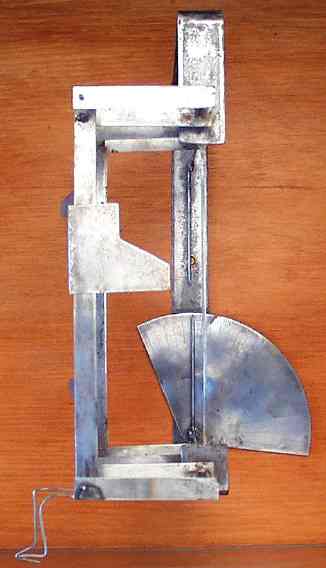
Well, actually the Wrights developed a wind tunnel to test airfoil designs back in 1901. They were frustrated that wings they built based on the calculations of Lilienthal didn't live up to Lilienthal's theories. You can play around with the Wright wind tunnel and various airfoils here:
https://wright.nasa.gov/airplane/tunnlint.html
Here's a reconstruction of their first wind tunnel, on display at the Museum of the Air Force:
And the balance used to measure lift:

aeronca65t
Great Pumpkin
Offline
With 750 HP i don't think it would even need wings.
I'm pretty sure that if you strapped that 750 HP turbine onto my MGB it could fly. Probably my garden shed would too. :highly_amused:
OP

DNK
Great Pumpkin
Offline
Let's find out!I'm pretty sure that if you strapped that 750 HP turbine onto my MGB it could fly. Probably my garden shed would too. :highly_amused:
OK, Face it . I'm not the only guy to think that
G
Guest
Guest
Guest
Offline
"No way to test airfoil shapes" ?
Well, actually the Wrights developed a wind tunnel to test airfoil designs back in 1901.
Yeah but not near as much fun as a cliff. Just ask the Road Runner. :highly_amused:
Offline
Yeah but not near as much fun as a cliff. Just ask the Road Runner. :highly_amused:
Airfoil test!
