

-
 Hey Guest!
British Car Forum has been supporting enthusiasts for over 25 years by providing a great place to share our love for British cars. You can support our efforts by upgrading your membership for less than the dues of most car clubs. There are some perks with a member upgrade!**Upgrade Now**
(PS: Upgraded members don't see this banner, nor will you see the Google ads that appear on the site.)
You are using an out of date browser. It may not display this or other websites correctly.
You should upgrade or use an alternative browser.
You should upgrade or use an alternative browser.
TR2/3/3A More on setting the timing...
- Thread starter karls59tr
- Start date


martx-5
Yoda
Offline
martx-5
Yoda
Offline
So how do I get around this to set the timing???
You have to set it statically. Here's a rather lengthy description from Macy's Garage...
https://www.macysgarage.com/myweb6/ign-timing.htm

Geo Hahn
Yoda
Offline
Or you could try setting it at high RPM (say 3000) and let it be whatever it wants to be at idle.
Or you can set it by 'ear' at idle -- move it about until you get maximum RPM then back it off (retard it) until RPMs drop by 100.
As I recall Karl has a Pertronix which may complicate static setting of timing.
Whatever method you choose - I usually do a final adjustment by the side of the road after I see what pinging occurs in use (e.g. low speed, 4th gear, try to accelerate).
Or you can set it by 'ear' at idle -- move it about until you get maximum RPM then back it off (retard it) until RPMs drop by 100.
As I recall Karl has a Pertronix which may complicate static setting of timing.
Whatever method you choose - I usually do a final adjustment by the side of the road after I see what pinging occurs in use (e.g. low speed, 4th gear, try to accelerate).
You have to set it statically. Here's a rather lengthy description from Macy's Garage...
https://www.macysgarage.com/myweb6/ign-timing.htm
The last time I set the timing it seems i had the vernier scale cranked in all the way to one side. If I want set the vernier scale on the center mark so it will be easier to road time it later, do I have to pull the distributor out first or can I just turn the scale to center with dist in place and then set the timing?
2liter4cyl
Senior Member
Offline
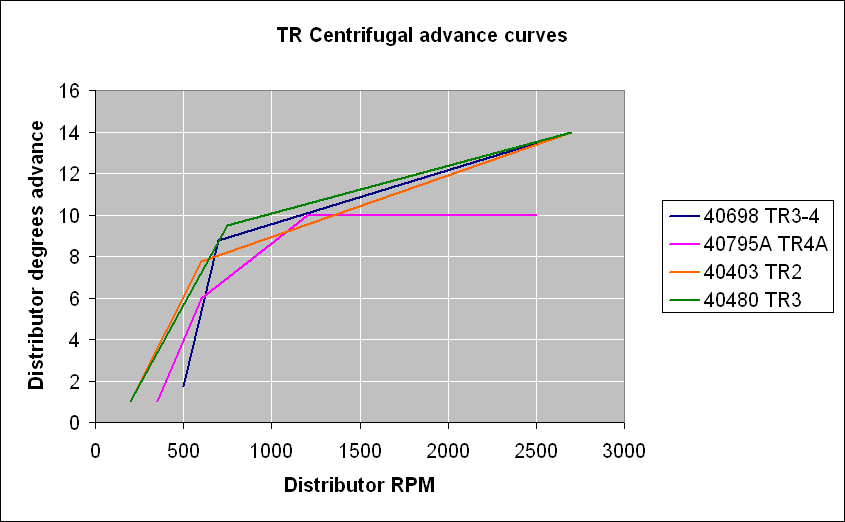
Curious: the chart shows distributor RPM. Is that 1/2 of crank RPM? What is idle on your chart. Le.
Or you could try setting it at high RPM (say 3000) and let it be whatever it wants to be at idle.
Or you can set it by 'ear' at idle -- move it about until you get maximum RPM then back it off (retard it) until RPMs drop by 100.
As I recall Karl has a Pertronix which may complicate static setting of timing.
Whatever method you choose - I usually do a final adjustment by the side of the road after I see what pinging occurs in use (e.g. low speed, 4th gear, try to accelerate).
Geo I got rid of the Pertronix after it burned out so I'm back on points. I read in the British Leyland Performance manual that for better performance you set the timing at 8* BTDC. Any thoughts on this?
martx-5
Yoda
Offline
Curious: the chart shows distributor RPM. Is that 1/2 of crank RPM? What is idle on your chart. Le.
That's a good question. Everything that I've read is that the mechanical advance starts anywhere between 450-800 engine rpm. I'd have to think that that is a misprint on that chart. I've always used the static method followed by road adjustments for ping.
Geo Hahn
Yoda
Offline
The last time I set the timing it seems i had the vernier scale cranked in all the way to one side...
More than one way to use the vernier - but I generally start with the timing at 4° BTDC and the vernier on the big mark. Then further adjust advance if needed using the thumb-wheel where (IIRC) each mark is 2°.
The advantage of this approach is that I always know where I am. Even months later I can look at the vernier marks and see what timing I am running.
Also useful if you get into a gas situation where you need to retard timing for a tankful or two then return to your usual setting.
Since you know longer have Pertronix then static timing should get you where you want to be.
As for whether 8° is better for you -- this will depend on engine condition (compression, carbon build-up etc), octane of fuel used, altitude where you drive and other factors.
TexasKnucklehead
Jedi Knight
Offline
That's a good question. Everything that I've read is that the mechanical advance starts anywhere between 450-800 engine rpm. I'd have to think that that is a misprint on that chart. I've always used the static method followed by road adjustments for ping.
I am pretty sure that is not a misprint. The TR3 manual shows almost the same curve as the TR4 manual -both are given in "Distributor RPM", which is 1/2 crank RPM. When we talk about 'engine RPM', most people think we are talking about what the tachometer shows (which is actually the cam/distributor speed -and why the tach is marked RPM X100 2:1).
The tach is showing the engine RPMs of the crank shaft. The chart shows distributor RPM, or camshaft RPMs. If you wanted to use a timing light, and had marks on your crank pulley like most American cars used to have, you would need to double the Distributor RPM as well as the mechanical advance for a given point -and you would also add the initial static 4 degrees. (At 2000 RPM, between 20 and 24 degrees.)
Since the TR3 was expected to be started with a hand crank, the advance starts very much below the idle speed. It is also key to note the difference between the 4 distributors of the chart at 500 (crank 1,000) -that works out to be a variance of about 8 crank degrees. At that idle speed, 8 degrees added or subtracted will also change the idle speed by several hundred RPMs.
I remember my uncle setting the timing with a timing light on my dads 1968 Chevy (327ci). He spent a lot of time getting the idle speed exact, the proper vacuum lines plugged, and the reading of the timing light at exactly the spot indicated in the book. Then he'd drive the car and set the timing to where it ran best.

poolboy
Yoda
Offline
Then he'd drive the car and set the timing to where it ran best.
Scroll down to Page 22 "TIMING:FINAL ADJUSTMENT" and you'll read pretty much the same thing.
https://mgaguru.com/mgtech/books/lts_otcc/Session3_CoilIgnition.pdf