• Hey Guest!
    British Car Forum has been supporting enthusiasts for over 25 years by providing a great place to share our love for British cars. You can support our efforts by upgrading your membership for less than the dues of most car clubs. There are some perks with a member upgrade!

    **Upgrade Now**
    (PS: Upgraded members don't see this banner, nor will you see the Google ads that appear on the site.)
Tips
Tips

Missing grease nipple on clutch mechanism?

tdskip

Yoda
Country flag
Offline
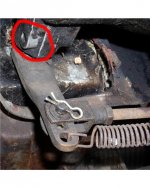
Based on the Bentley book I think I am missing the Clutch Cross Shaft Bearing grease nipple.

This is for a TR4A CT 5xxxxx

I've circled where I think the missing grease nipple is supposed to be.

Do I need to simply replace the nipple and then make sure it is properly greased?
 

Attachments

  • 150493-Missinggreasenipple.jpg
    150493-Missinggreasenipple.jpg
    119.6 KB · Views: 155
Re: Am I missing an important nipple?

There should be one right in the end of the cross shaft, but I don't think one goes there.
Don't let Jaybird see that post heading! /ubbthreads/images/graemlins/shocked.gif
 
Re: Am I missing an important nipple?

[ QUOTE ]
There should be one right in the end of the cross shaft, but I don't think one goes there.
Don't let Jaybird see that post heading! /ubbthreads/images/graemlins/shocked.gif

[/ QUOTE ]

She won't - she doesn't hang out with us "Rumphies"!

Mickey
 
Sorry - misguided attempt at being funny. I'll edit it right now. Can I delete the post and delete the thread at the same time?

I didn't mean to offend anyone. That sort of play on words is pretty common over at the mgbexperience.com and I brought that norm over here.

Sorry all.
 
Skip, I think Banjo was pointing out that if Jaybird saw the title, she would have taken it and ran!/ubbthreads/images/graemlins/grin.gif
Jeff
 
Certianly, tdskip. No offense taken. bugeye58s got the idea. Jaybird would swoop in and want to show you her "hooters" (see her post titled that about her horns)
Sorry to have gotten you concerned, I should have added a /ubbthreads/images/graemlins/grin.gif on the end.
By all means change the title back if you like, I got a chuckle out of it.
BTW have you gotten an answer to weather or not that hole is supposed to have a fitting? Personally I'm thinking no.
I just looked in both of my factory Triumph manuals. It shows the nipples on both ends of the shaft itsself, but nothing in that hole.
Then I went out to the shop and looked at the TR3 tranny I have half dismantled. The clutch shaft is out and I can look in there.
That hole seems to run all the way through the case intersecting the shaft hole, but the bushing is right there and there are no holes in the bushing that would allow any grease to get to where you'd need it,
so putting that all togeather, I really don't think theres supposed to be one there, just on the shaft ends.
 
Hi,

Banjo is right.

The hole in your photo is for a retaining bolt, that prevents the clutch cross shaft from backing out of the gearbox. You'll find the same hole on each side of the bellhousing, but *only one* will have a bolt in it to retain the shaft. The other is left empty. Keep in mind that this gearbox casing was used on various car models over the years, besides TRs, so the setup might be different on others, and on LH/RH drive versions for that matter.

Zerks (a nice way to say nipple!) are in the ends of the shaft only, and only on earlier cars (not sure of the change point without looking it up, sometime during 4A production, I think). In your photo it appears you have an adjustable clutch slave cyl. pushrod with the external return spring. If so, I would expect to find the zerks in the ends of the shaft itself, too, unless it was replaced with the greaseless version at some point.

Greasable shafts *can* be fitted to the later cars, along with the longer, bearings in the bellhousing. Personally, I think both mods are a really good idea , a squirt of grease in there once every 12,000 mi., say two pumps on the typical grease gun, will help keep things working smoothly, help shaft and its bushings last a long, long time and the longer bushing provides better support for the shaft.

/ubbthreads/images/graemlins/cheers.gif
 
Thanks folks - let me do some more digging and see what I find. Looks like it is a greaseless version at this point.
 
BTW -- I notice you have the clutch pushrod mounted to the top hole (of 3). I think the usual set-up for the TRs is the middle hole.
 
[ QUOTE ]
BTW -- I notice you have the clutch pushrod mounted to the top hole (of 3). I think the usual set-up for the TRs is the middle hole.

[/ QUOTE ]

Good catch Geo! You're right!

All TRs use the middle hole in the shaft lever. I would think using that top hole makes the pedal heavier than it needs to be and might risk overextending the TO bearing carrier.

While we're picking on TDSkip /ubbthreads/images/graemlins/wink.gif to me the return spring looks heavier than usual, or is a different spring or perhaps is in backwards, and is not connected in the usual manner. It shouldn't be connected directly to the lever like that. There should be a little tab/washer with a hole for the spring end, that fits under the clevis pin (part #58 at this Moss illustration ).

I mention the spring and it's mounting because, if the clevis pin were relocated to the center hole, it looks to me like the spring might foul or rub against the rest of the mechanism.

One other picky little thing... personally, I'd prefer to see a standard cotter pin used to hold it all together, as was originally done. Those "hair clips" are quick and easy to use when servicing the car, but have a nasty habit of popping off at the worst possible times.

Since you have the greaseless version of the shaft, so long as it has no significant side to side play, I'd suggest living with it until the car needs a clutch replacement. Then, when that's done, if you wish you could upgrade to the greasable shaft ($10 more than the non-grease one) and use the longer, better greasable bearings in the bell housing. A couple pumps of grease in each zerk every 12K miles, the frequency the clevis should be adjusted too, will keep those parts working well and they will probably last as long as you own the car.

One other thing, if you should ever need to replace the clutch and find the original Laycock release plate/cover is in there, it's a very good idea to have it rebuilt rather than buying the new replacments that are available. That will cost more, but I think you will find it far outlasts any clutch fitted with the current replacement Laycock (2nd best choice), B&B (3rd choice, but only if it's the *correct* one, marked with a blue dot, *never* a green dot) or AP (4th choice). Should it ever come up, before replacing a clutch be sure to search here for other important tips on improving the security of the release fork on the shaft, replacing the fork pins, properly installing the throwout bearing and carefully re-aligning the gearbox to the engine. Done right, it will likely be good for 50K-100K miles. Done wrong, too many folks find themselves pulling it apart and rebuilding *again* within just 5K, 10K, 20K miles!

/ubbthreads/images/graemlins/cheers.gif

 
I'm curious about the return spring. My TR6 does not have it but I read in an article in the now-inaccessible VTR Maintenance Handbook a while back about adding a spring. There were actually two applications- one to pull the clutch operating shaft away from the slave cylinder to reduce pressure required to push in the clutch, and the other as shown in TDSkips photo. I currently stand in need of the latter as sometimes when I take pressure off of the clutch nothing happens until I have very little pressure on it at all and then WHOMP! it lets out all at once. Not fun in stop and go traffic. Would the addition of the spring help this or am I looking at a different problem altogether? (clutch/TO replaced 2 years ago) Would the spring put too much pressure on the clutch hydraulics?
 
[ QUOTE ]
Skip, I think Banjo was pointing out that if Jaybird saw the title, she would have taken it and ran!/ubbthreads/images/graemlins/grin.gif
Jeff

[/ QUOTE ]

I don't think this is a problem; Jaybird is in the Pub in the midst of fruit cake and spotted dick.
 
Wellsir, a look at the Moss site confirms no slave return spring on a TR6. The TR3s at least will work w/o one -- mine has been missing for 25 years or more. I put one on there once and the slave returned too far and the susquent movement failed to disengage the clutch -- possibly I have a broken fork pin that still works due a ragged break but doesn't prevent the operating arm from rotating to far upon the return.

Your problem sounds more like a sticky TOB to me.
 
I am not sure about a tr6, but on a tr3 I once saw a master cylinder that would returned slowly creating the problem you have described. The clutch pedal would come back, however, the actually operating mechanism in the master cylinder would travel slower maybe two or three seconds then the car would move out. Rebuilding the master cylinder fixed the problem.

Sp53
 
Hi folks - I'm back. Very annoying when work gets in the way of the cars.

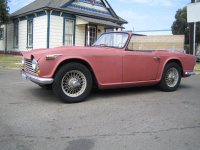
So here is the deal - when I picked the car up last week the clutch/gear change was totally hosed up. It was basically an on-off switch with almost zero pedal travel. I think the DPO rigged this up to help postpone a clutch replacement.

With some help, I got it to a point where it is drivable now and shifts cleanly. Effort is high, and take up short, but it is servicable. That is good enough as I'm going to start working on the some panel repair and major systems.

When the replacement comes around I'm going to bring it back to stock but I really like the idea of upgrading to a greasable shaft when a new clutch goes in.

I've found several DPO items like this, but so far they have been more annoying than servious problems.

I'm dreading getting the primer off her as I'm expecting to find more shortcuts....
 

Attachments

  • 151045-side.jpg
    151045-side.jpg
    117.9 KB · Views: 88
[ QUOTE ]
I'm curious about the return spring. My TR6 does not have it but I read in an article in the now-inaccessible VTR Maintenance Handbook a while back about adding a spring. There were actually two applications- one to pull the clutch operating shaft away from the slave cylinder to reduce pressure required to push in the clutch, and the other as shown in TDSkips photo. I currently stand in need of the latter as sometimes when I take pressure off of the clutch nothing happens until I have very little pressure on it at all and then WHOMP! it lets out all at once. Not fun in stop and go traffic. Would the addition of the spring help this or am I looking at a different problem altogether? (clutch/TO replaced 2 years ago) Would the spring put too much pressure on the clutch hydraulics?

[/ QUOTE ]

Hi,

TR6 don't have the external return spring. Triumph made a number of small changes to the clutch mechanism, mostly to reduce servicing, perhaps lower cost of manufacture, and to "lighten up" the pedal in response to owner feedback. However, personally I think the changes took the margin out of the mechanism, meaning that all the individual items must be in top working order with no wear and tear, and, as a whole, make for the clutch problems we so commonly see today in those cars.

One change was to a smaller master cylinder. Another to the non-greasable shaft and narrower bushings in the bellhousing (actually in mid-TR4A production). Also, the slave pushrod was changed to non-adjustable and the external spring was removed. Without looking at the service manual, ISTR the TR6 either has an internal return spring in the slave or just relies upon hydraulics in combination with the pedal return spring to return the piston.

There have been several articles and books addressing problems with TR6 clutches that have called for installing a spring and adjustable clevis, sort of a retro-fit of the TR4/4A arrangement, which was almost trouble-free with the early coil spring release plate (TR4) and far less problematic with the later diaphragm clutch (TR4A). I believe the most recent to recommend this is Kas Kastner's latest, but I haven't got a copy yet.

If (when) I have a TR6, you can bet that first opportunity I'll be retro-fitting it with: .75" diameter master cylinder, TR4/4A style slave with external return spring and adjustable clevis, greasable cross shaft and wider cross shaft bushings. IMHO, one thing to avoid especially on the 6 cylinder cars is a clutch release plate with heavier than stock pressure. These cars have enough problems with faster wearing crankshaft thrust bearings, without adding a heavy clutch to the mix. A heavy "racing" clutch will wear them very rapidly, unless modifications are made to beef up the thrust bearings themselves.

It sounds to me like your car has some wear on the driven plate, and the "self-adjusting" clutch slave cyl. is insufficient to compensate. The good news is that this is the opposite symptom of the the usual, broken cross shaft pin.

First things are: see if you are getting a minimum of 5/8" travel out of the slave cyl. pushrod when the pedal is pressed (if not, either MC or SC are worn), check that the clevis pin and lever have no slop due to wear, and confirm that the clevis pin is installed in the center hole in the lever.

If those are okay, next I think you would be wise to get the return spring and the adjustable clevis/pushrod. There have been some sellers on eBay, and I think TRF or Moss might now be stocking a kit now.

My best guess, you may have had some clutch slippage, possibly due to a slow returning slave cyl. that might have accelerated wear. There is no way to adjust to prevent the wear or to compensate for any wear that has occured, with the stock TR6 setup. So this would be the most cost efficient external attempt to fix it.

The next step logical would be to get a .75" master cylinder, which will make the clutch pedal a little heavier to operate.

The ultimate fix, in additon to the above, would be to pull the gearbox and replace at least the driven disk. But, you might get by for a couple years before needing to do that, if the other fixes are made.
 
Back
Top