• Hi Guest!
    If you appreciate British Car Forum and our 25 years of supporting British car enthusiasts with technical and anicdotal information, collected from our thousands of great members, please support us with a low-cost subscription. You can become a supporting member for less than the dues of most car clubs.

    There are some perks with a member upgrade!
    **Upgrade Now**
    (PS: Subscribers don't see this gawd-aweful banner
Tips
Tips

Look what came in the mail

TR6oldtimer

Darth Vader
Offline
You only need it a few times, but when you do, you really do.

PA130001.jpg
 
Butane-fired dikes?
 
I have a set of those - you are right, you don't use them too often, but when you do they are handy. I wired up the clutch fork pin with one.
 
It is a safety wire twister. Like Randy said, used on the clutch fork pin. It is also used on the steering column rubber joints and can be used on the rear axle and steering rack boots. Some have drilled holes in the bolts holding the flywheel, and safety wired them as well (I am not doing that).

Easy to use. You just clamp the two wires to be twisted, then pull the silver knob which spins the pliers twisting the wires.

A well made tool made delivered by Aircraft Spruce for $22.
 
I learned to use them in the Navy, same period, while repairing radar antennas and other machinery subject to vibration. There is a trick to it, but not hard to do once shown the way. I loaned my original out to a friend while working in the shipyards, never to be seen again...

This was an impulse buy on a rainy day.
 
OK, my response was obviously in jest, but I'm curious: How do they work?
 
I bought a pair from Harbor Freight several years ago. They do work great.
You grip the wire in the plier jaws and lock the handle. In the photo you can see the center bracket is welded to the upper handle. The bottom handle locks into that bracket. Once locked, you pull on the silver knob at the end of the center shaft. The shaft is threaded and allows the tool to spin, putting a perfect twist to the wire.
 
Rat said:
I loaned my original out to a friend while working in the shipyards, never to be seen again...

I'll loan a claw hammer or a stepladder but NOBODY gets my REAL tools. :wink:

Safety wire pliers are REAL tools. :thumbsup:

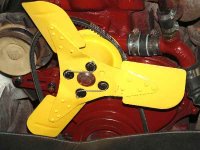
I can't find th' photo of my MGB fan just now but it's been wired with those. :wink:
 
I've had a pair for years and use them more than one might think.
 
I used them on Helicopters (USAF 70-74), you can twist alot of wire with them. I thought of them when I replaced the clutch fork on a TR. Can't say it would be justifiable to buy a pair for that job alone but tools are tools.

Marv
 
Found it. Bit of overkill, but hey, I've seen 'em get away and make a radiator into yard art before. :wink:
 

Attachments

  • 18786.jpg
    18786.jpg
    36.1 KB · Views: 370
Did you use aviation bolts Doc? Funny, I used the safety wire tool many times in the Navy and loved it, but never bought one for home use. Don't know why.
confused0031.gif
 
That was a dreaded tool in the Navy for me. Seem everytime they would drop a seta a chip would come out. Then we have to shut down the shop and look for the FOD (foreign object debris).
I actually went through and did a comaprison as to which was the most durable set. Blue Point came back as the winner with a comapany out of germany as the second.
 
DrEntropy said:
Found it. Bit of overkill, but hey, I've seen 'em get away and make a radiator into yard art before. :wink:
fanwire.jpg

A nice example of the proper use of lock wire. For those who have not done this, you will notice the application of the wire, with tension on each bolt, in the direction that would tighten the bolt. The real trick is to get just enough of the wire twist to reach the second bolt, then when the wire that passes through the second bolt is twisted, it creates tension on the twisted wire between the two bolts holding them fast. That puppy is going no where.
 
Thanks for the explanations of its use and the picture!
 
'smits wants to make jewelery with it...

*sigh*
 
The saftey wiring of fasteners is common on race cars and motorcycles. Most race organizations have detailed rules about what fasteners are to be safety wired, on which ones Loctite may be used etc. I can tell you from experience, drilling holes into bolt heads or nuts takes a lot of patience and extra drills. Well, the things you do to get your vehicle ready for the track...
 
Back
Top