Hey Guest!
OP

CJD
Yoda
Offline
A slip fit means there is several thousandths clearance on the sides of the splines. Since there is a lot of torque applied in both directions under varying conditions (acceleration one way, hard braking the other), I'm guessing that even with the nut and wedge clamping it, the hub can move slightly on the splines. The motion (the 'fretting' mentioned in Sports/1/F) will eventually wear and damage the splines, allowing them to first leak, and ultimately fail..
I agree completely with the engineering. I'm just looking at the history. It appears even the tight splines did not fix the leaks and breaks problem. Anyway, at this point I would bet any axle left is of the later tight spline design, since they switched to that in the first year of production.
The grease cup is indeed, just a steel insert that was added during manufacture in 1954 to help prevent the grease from washing out of the outer bearings. The service bulletin is meant to retrofit cars that were already on the road.
Looking inside the flange, it looks like a cup going all the way around the inside of the axle tube. It has a steel lip that almost reaches the axle shaft...and that is what confused me looking at it. It looks like a seal made of steel, rather than one with a rubber lip. I assume without this cup, the axle tube would be the same diameter all the way through to the differential.
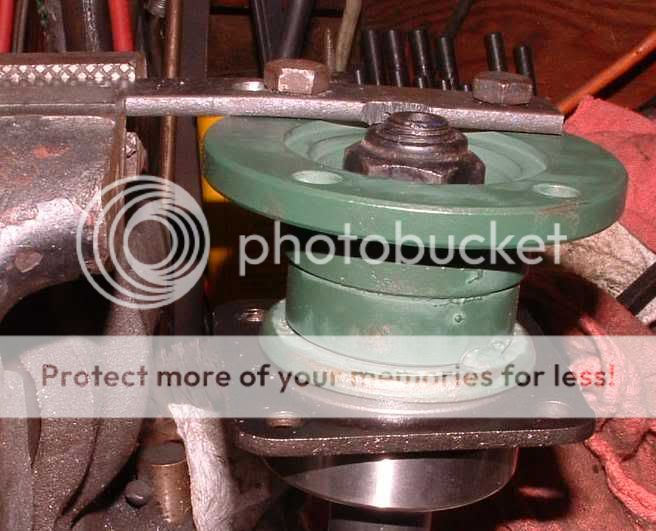
This is a photo of the axle flange as it looks when the axle is just removed. The insert is seen full of grease.