• Hey Guest!
    British Car Forum has been supporting enthusiasts for over 25 years by providing a great place to share our love for British cars. You can support our efforts by upgrading your membership for less than the dues of most car clubs. There are some perks with a member upgrade!

    **Upgrade Now**
    (PS: Upgraded members don't see this banner, nor will you see the Google ads that appear on the site.)
Tips
Tips

TR2/3/3A Lockheed Axle

CJD

Yoda
Country flag
Offline
OK, got the Jag running, got Xmas out of the way...so I am finally getting back to the TR2 basket case. First question about the lockheed axle...

The Girling axle had grease seals inside the outer bearings. Looking in this axle, I cannot tell what I am looking at, but they are definitely not traditional seals. It is about 1" of bare metal and an outer cup around the inside edge to hold grease. Is this all these axles use for grease seals? It appears if you over grease the bearings it'll just squeeze into the axle tube, but I guess that would work?!? Looking at them, I do not think they can be tapped out easily, and I'm not sure they would need to be tapped out.

Anyway...any insight would be appreciated. Once I get rolling, I'll post the pics, as usual.
 
That does seem to be the arrangement shown in the workshop manual; there is no mention of an inner seal that I can find.

I don't think getting grease into the oil would be a problem as such; since grease is just oil with a thickening agent added. Having the oil wash grease out of the wheel bearing might be more of an issue, but I'm guessing it stays lubricated well enough until the next grease injection.
 
Thanks, Randall. As with all this old stuff, I just wanted to make sure it wasn't missing something.
 
OK, next question...

The top of the differential has a TS +4 digit number. Does anyone know if that relates to the commission number, or is it completely different like the engine number?
 
As far as I know, doesn't match anything.
 
Thanks, again Randall. I honestly don't remember the TR3 axle having anything stamped. It's a shame the early axles were weak, as I much prefer the way it is assembled compared to the later. The hubs come right off with no fuss, and there is no shimming the outer bearings for float.
 
I do not know about the tr2, but the tr3s I have had the number on the trans and diff are kinda close to the vin TS number
 
Thanks, again Randall. I honestly don't remember the TR3 axle having anything stamped. It's a shame the early axles were weak, as I much prefer the way it is assembled compared to the later. The hubs come right off with no fuss, and there is no shimming the outer bearings for float.

A friend of mine is restoring a TR2. Says he wants to keep it completely stock. I'n my opinion I would consider doing the upgrades,within reason,that Triumph did to the TR3 ie.what's this about the Lockheed axle being weak?.....also if you install a Girling rear axle is it still a TR2
 
Thanks, Steve. Karl, my goal on this restoration is as it rolled out of the factory, so it'll be the Lockheed axle.

I have studied the manual, and there is one assembly question that stands out...the outer axle bearings are held by the bearing retainers. These pinch the bearings, which are loaded with grease. There is a seal to keep the grease out of the brakes, but no seal or mention of sealant between the axle tubes and the bearing retainers. I assume sealant should be used, even though the manual doesn't say to??
 
Hi John,

I think the diff oil would have a hard time getting around the bearing once bolted into the axle housing, I have had more issues with grease and oil getting into the brake drum, burning onto the braking surface and causing the affected wheel to lock up prematurely. I installed new bearings in my Lockheed rear axle but don't recall using sealant, I wish I had better memory, it was a few years ago. Does the bearing stand proud of its retainer? Like half of the bearing is in the retainer and the other half in the axle flange?

I did take my entire axle shaft, bearing retainer, and backing plate assembly to a machine shop to press the axle out, install the new bearing/seal, and press the axle back in. I think the pressure needed exceeds most home presses or pullers.

I think the Lockheed axles may be considered "weak" if used in racing or very hard road driving. Remember when these cars were new, people probably beat on them like kids today with Honda Civics. But for normal and spirited but smooth driving by semi-mature adults, I haven't had any issues for the last 4 years my car has been driven. If you dump the clutch, sure they will break.

I wouldn't go out of my way to replace the Lockheed axle, just inspect and service it as much as possible and use it until something fails if ever.
 
My experience with differentials is very limited, so I am trying learn more about them. I have always replaced them as a whole, but one day fate will happen, and I will need some knowledge. Anyways, what did other cars in 1954 have for a seal to keep the grease and the oil separate, or I guess to make sure some grease stays on the bearing. It would seem to me that the 90W would better than grease. I suppose at some point the grease would wash off and the 90W would drain back into the case at the lowest point, but again perhaps when the gears turn they would create pressure and through the grease back at the brakes; that is what seems to happen when the outer seal fails, the brakes get wet. Anyway just trying to wrap my mind around how the differential works.
 
Tim, you are correct...the bearing is half in the tube and half in the retainer. It wouldn't leak fast, but it seems it would leak a little with no sealant.

Steve, the later axle has a double seal. One is on each side of the outer bearing. The Lockheed has just an outer grease seal. The inside of the tube comes in close proximity to the axle shaft, so grease and oil must surely mix to some extent. Illpost pics once I'm done cleaning and start assembling.
 
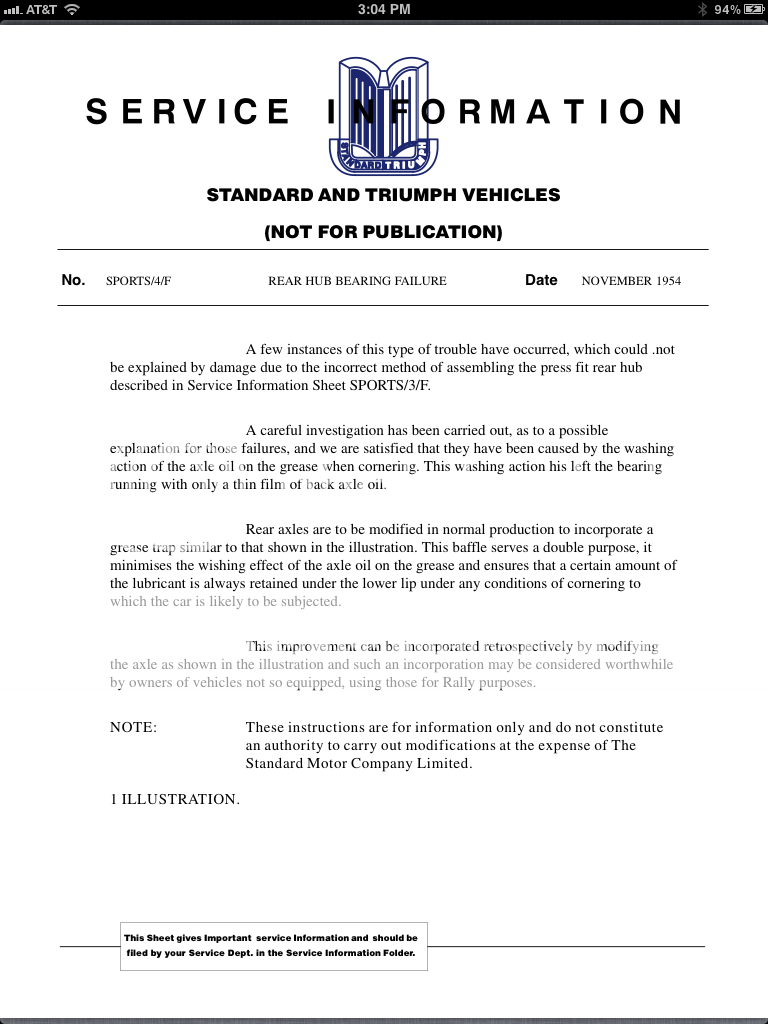
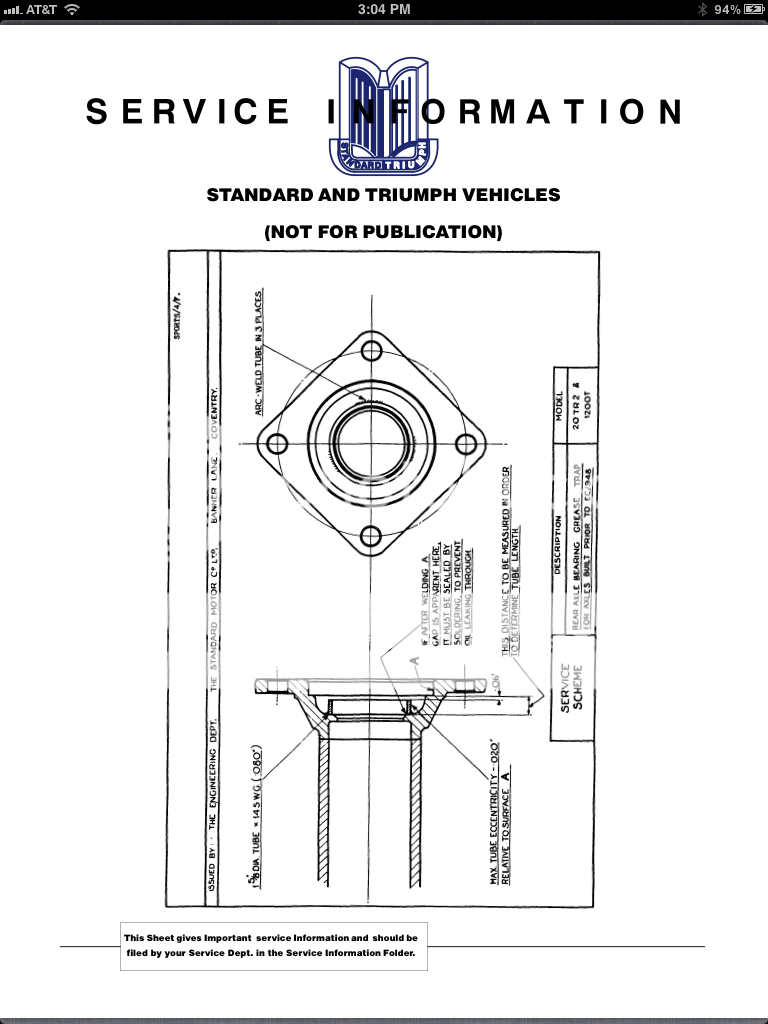
I have been reviewing the original service bulletins, and I found several that touch on my axle questions. It turns out the very early axles had problems with outer bearing failures caused by oil washing out the grease. The fix was to weld little cups to retain grease at the bearings. Luckily my axle has those cups...and they are odd looking, which explains why I couldn't tell what I was looking at.

Also, the axles were redesigned with oversized outer splines to prevent oil leakage through the hub splines. The down side...you damage the outer bearings if you press the hubs off of the " interference" style axles. You have to remove the axles first and then press the hubs on or off.

Also of interest, the factory service time manual lists replacing an early axle as 1 hour and 30 minutes start to finish. Anyway...back to studying Lockheeds...
 
Can you provide a picture of the "cups" and a reference to the service bulletin describing that fix? And excuse my ignorance, but I want to avoid the problem you describe with removing the Lockheed hubs (wire wheel is what I have), but I don't understand the part about the oversized splines and having to remove the axle first.

Thanks

Dan
 
Good thought, John. It didn't even occur to me to look through those old bulletins.

Dan, I believe you can download them from https://www.tr3a.info/Service_sheets.htm If TeriAnn's site doesn't work, try Google for one of the many others that have copies of them. Looks like bulletins Sports/1/F, 1/Q, 3/F and 4/F have most of the information that John mentioned, including a diagram of the shield (second page of Sports/4/F).

Basically, the point is that the improved shaft is a press fit inside the hub, and it is important to be certain that the wheel bearing does not take the force required to move the hub on or off of the splines. That much force applied to the bearing will damage it, causing premature failure. So for both removing and installing the hub, it is important to use a puller/press that forces against the shaft rather than the housing (through the bearing). The instructions, and photos of the tools, are in the workshop manual (although there appears to be a mistake in the photo of installing the non-wire wheel hubs).

The comment about removing the axle applies only if you don't have the special tools (or similar). The alternative is to set the half shaft up in a press while installing (or removing) the hub, so the force is on the end of the shaft. (The service notes use the phrase "axle shaft", but I'm confident that's what John meant when he said you have to remove the axle. Just the half shafts, not the entire assembly.)
 
null_zpsbbfade01.png


null_zps9dd21cdf.png


The early hubs were a slip fit, so you could merely pull them off by hand, and the outer bearings were not stressed during removal. There was an issue with oil leakage thought the hub splines. First Standard increased the hub nut torque, but the oil still leaked. Next, they increased the size of the axle splines to make the axle a press fit into the hub. At that point the hubs were no longer a slip fit. If you pull the hubs with the axle in place, you are now stressing the outer axle bearings...and that is the problem. The solution is you have to remove the brake back plate to remove the hub, bearing, back plate, and axle as a unit. Then you can press the axle from the hub without stressing the bearings.

Ultimately, continued oil leakage and occasional axle breakage at the splines led them to the cone hubs used in the girling axle.
 
Ok, thanks for the pdf of the bulletin! I am really bad at reading those engineering diagrams, but it seems like it shows the tube getting welded onto a bolt-on type hub rather than a wire wheel hub. Would it be the same for the wire wheel hub, and is the tube arc welded to the hub or to the axle itself? John, do you happen to have a picture of the set up with the tube welded in place? I think mine (from May 1954) is the slip on type rather than the press on type, so I don't need a puller. But I have had some leakage from the rear hub onto the braking surfaces.

Dan
 
That diagram above only shows the outer flange on the axle tube. There is no hub shown. I don't think there is any benefit to a tight axle vs a slip fit one, from what I can tell. They all leaked at the hub splines. The final attempt to stop leakage was to add sealant around the outside edge of the splined hub washers. Personally, I don't think that is the best location to add sealant...I will try to seal where the hub contacts the inner bearing race.

There are about a dozen bulletins related to the Lockheed axle. Some service changes were listed by the TS number stamped on the top of the differential bell. If you give me your axle number, I may be able to compare it to the axle change points. Or, you can download all the bulletins from TerryAnn's website...

https://www.tr3a.info/Service_sheets.htm
 
So the added tube described in the bulletin is welded to the inner flange of the axle tube? My apologies but I want to figure this out.

Dan
 
I don't think there is any benefit to a tight axle vs a slip fit one, from what I can tell.
A slip fit means there is several thousandths clearance on the sides of the splines. Since there is a lot of torque applied in both directions under varying conditions (acceleration one way, hard braking the other), I'm guessing that even with the nut and wedge clamping it, the hub can move slightly on the splines. The motion (the 'fretting' mentioned in Sports/1/F) will eventually wear and damage the splines, allowing them to first leak, and ultimately fail.

A perfect press fit would have no clearance at any point (preventing the leak), but machining is never perfect. This is the "variation in manufacturing fits" mentioned in Sports/6/F.

Likely none of this matters for a show car, but the engineering makes sense to me.

I believe the 'sealant' mentioned in 6/F is a rope caulk type, supplied as a somewhat soft solid rope rather than liquid or paste. Not the same as the 'Prestik' sold today. I'm not sure what would be a good modern substitute, though, as those hubs get pretty hot under hard braking. Something like Permatex #3 (which is rated to 400F) might work OK.
 
Back
Top