• Hey Guest!
    British Car Forum has been supporting enthusiasts for over 25 years by providing a great place to share our love for British cars. You can support our efforts by upgrading your membership for less than the dues of most car clubs. There are some perks with a member upgrade!

    **Upgrade Now**
    (PS: Upgraded members don't see this banner, nor will you see the Google ads that appear on the site.)
Tips
Tips

TR2/3/3A Liner spigot fit?

LionelJrudd

Jedi Trainee
Country flag
Offline
I have a new set of liners to install. I find they are quite tight when seated in the block and would have to be pressed in.
My understanding from the workshop manuals I have read is that they must be retained in the block with keepers until such time as the head is installed as turning the crankshaft can be enough to lift the liners out, especially with new pistons and rings that might be a little tight.
Without having tried to press the liners in, I doubt once they are in that they will easily slip out.
Unfortunately I do not have a micrometer large enough to check the diameter of the spigot and the bore in the block at this stage to give a quantitative view of the issue.
Any comments on how tight this should be?
regards, Lionel
 
Hello Lionel,

I had a hard time getting my old ones out of the block, destroyed 3 of them in the process but after spending a lot of time cleaning up the fo8 seating area the new ones just fell into place and definitely needed to be retained to stop them being pushed up on rotation.

Graham
 
Thanks Graham. That fits with what I have read. I think I ran some weld in the old liners to shrink the spigot a bit when I pulled the old block apart.
Not sure what I will do going forward. Looking for suggestions.
 
I have always been impressed how tight they fit into the block. Plus it is a difficult place to use something like WD40 because they used something to seal down there. My understanding is they used a product called well-seal and a copper figure 8 gasket to set the seal.

People use spacers on the head bolts to hold them down when repairing things, like a valve job. My guess is at the factory they put the head on right away and did not need to do that. I had a set of figure 8 leak once, but the leak could have come from a non-compression spot from about the figure 8. I have also seen the figure 8 with a coating on them. The last ones I installed I painted the figure 8 with 3 coats of silver spray paint from a suggestion of a mechanic friend because I did not put the head on right away.

I cannot wrap my mind around the comment of welding something that you mentioned
 
A very clever way to remove bearing races or any press fit parts if you are not trying to save the part. When the weld cools it shrinks the part that has been welded allowing the part to be removed. Good thinking Lionel
 
The liners should be no more than a light press fit; too much force may distort the liner and cause clearance problems. My preference would be to clean up the block and work the liner spigot down a bit with emery cloth or fine sandpaper until you can push them into place by hand or a few taps with a soft faced hammer.

The gaskets came in at least two different styles; either solid copper alloy, or steel coated with plastic. I suspect the copper ones are more prone to leak after long neglect (engine stored with stale coolant), but I've never had a problem with them.

I use Permatex Aviation Form-A-Gasket on the Fo8 gaskets. But I'm not sure if it's sold in Australia or not. It remains pliable for a long time, so no worries if you don't install the head right away.
 
Yes, Randall Permatex Aviation Gasket cement is sold in Australia and has been around for decades my father used to swear by it and I have always used it.

Graham
 
Got to work on the liners today. I cleaned the block thoroughly again, this time with a flapper wheel in my drill to ensure there was no old sealer or surface rust in the block.
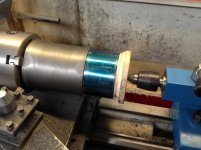
I then made a mandrel/plug to go in the end of the liners so they could be mounted on my lathe to skim the spigot. I checked the alignment with a test dial indicator to ensure the liner was centred on the lathe.
IMG_2110.jpg
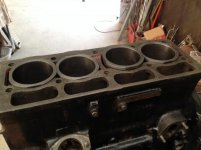
Unfortunately it required several clean cuts with lathe to bring the diameter down to close to the required diameter. Since I don't have a large enough outside micrometer, I used an internal micrometer to measure the diameter of the hole in the block. I then used a vernier to get an outside measure and locked the vernier. I then used the vernier as a go/no go reference to check the outside diameter of the spigot as I turned it down. When close to the correct diameter, I then used carborundum paper to finish it to the correct size, taking the liner off the lathe and checking it in the block. The following shows the liners loose fitted.
IMG_2111.jpg
It took most of the afternoon but finally got what I would call a nice interference fit in the block for each of the liners.
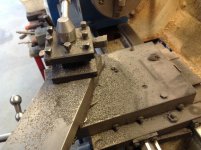
Not sure how many thou I had to reduce the diameter of the spigot on each of the liners, but the following photo shows the amount of metal removed.
IMG_2112.jpg
 
Wow, that's a lot!

Something I haven't bothered to run to ground yet; the Standard motor used in a Ferguson TEA20 tractor came with either 85mm or 87mm liners. But the bore size in the block is apparently different between the two versions, the 87 liners won't fit in an 85 block. I'm wondering if maybe you got tractor liners by mistake. Someday, I'll have to dig those "wrong" liners out and measure more carefully. At the time I discovered the issue, I was in a rush trying to get it back together for a show, and just had the correct liners shipped overnight. (The tractor made the show, but I wound up in the hospital, so didn't get to enjoy it. Parade was rained out all 3 days anyway.)

Anyway, glad you got the problem resolved.
 
That makes sense Randall. The liners I got were purchased from a guy for half price, surplus to his requirements. They have sat on my shelf for quite some time.
Even so, I doubt my brother in law will be letting me strip down his TEA20 to check out the theory.
For now, I will consider the job done and move on with pressing in cam bearings.
 
You should be able to check the Brother in law's liners by just removing the sump. I think they stick through the block by a small amount. Sure he would be OK with that.

David
 
The bottom edge of at least most of them is tapered, so you won't get the true diameter by measuring what sticks out (if they stick out at all).

And dropping the pan on a TEA20 is a lot more involved than doing it on a TR. The TEA20 pan is effectively part of the tractor frame, to remove it you start by removing the hood, radiator, front suspension and so on. This was absolute minimum for getting the pan and head off:
Lw0Jrqo.jpg
 
Maybe I should have put one of those emoji things at the end of the comment. It was intended mainly as tongue in cheek.

David
 
Back
Top