• Hey Guest!
    British Car Forum has been supporting enthusiasts for over 25 years by providing a great place to share our love for British cars. You can support our efforts by upgrading your membership for less than the dues of most car clubs. There are some perks with a member upgrade!

    **Upgrade Now**
    (PS: Upgraded members don't see this banner, nor will you see the Google ads that appear on the site.)
Tips
Tips

Leaky oil pan... again

M

Member 10617

Guest
Guest
Offline
Yes, I know that these TR3s notoriously leak oil, but I haven't given up on the idea that with proper sealing, many of the leaks can be reduced or even eliminated. Vain hope?

My current problem has to do with the oil pan. About two months ago I installed a new gasket (I also made sure the pan around the bolt holes was flat), and all seemed well. But now I have leaks around a number of the bolts.

When I reinstalled the pan, I put some gasket sealant around the bolts, but that didn't seem to work in every case.

My next option is to use teflon tape around the bolts. I know that some advise against this, and that others approve of it. But has anyone out there tried this and had success? It seems to be my last fall-back position.

Or, perhaps, there are other options I am unaware of.
Surely there must be a solution...(???)

BTW -- I have been adding up the miles here in beautiful western Virginia while we still have relatively warm days and the fall leaves have not all fallen off the trees.
 
This is one of the very few places where I use silicone RTV (aka gasket maker). The bolt threads are straight, not tapered, so there is always a tiny path along the threads that is not sealed by the gasket. And the split lockwasher also has a gap. So just smear a little dab of RTV on the bolt threads before you install it.

Also, it is very common for leaks higher up to look like they are coming from the pan bolts. The oil forms a thin film on the side of the block that can be very hard to see, but the drip on the bolt head is visible.

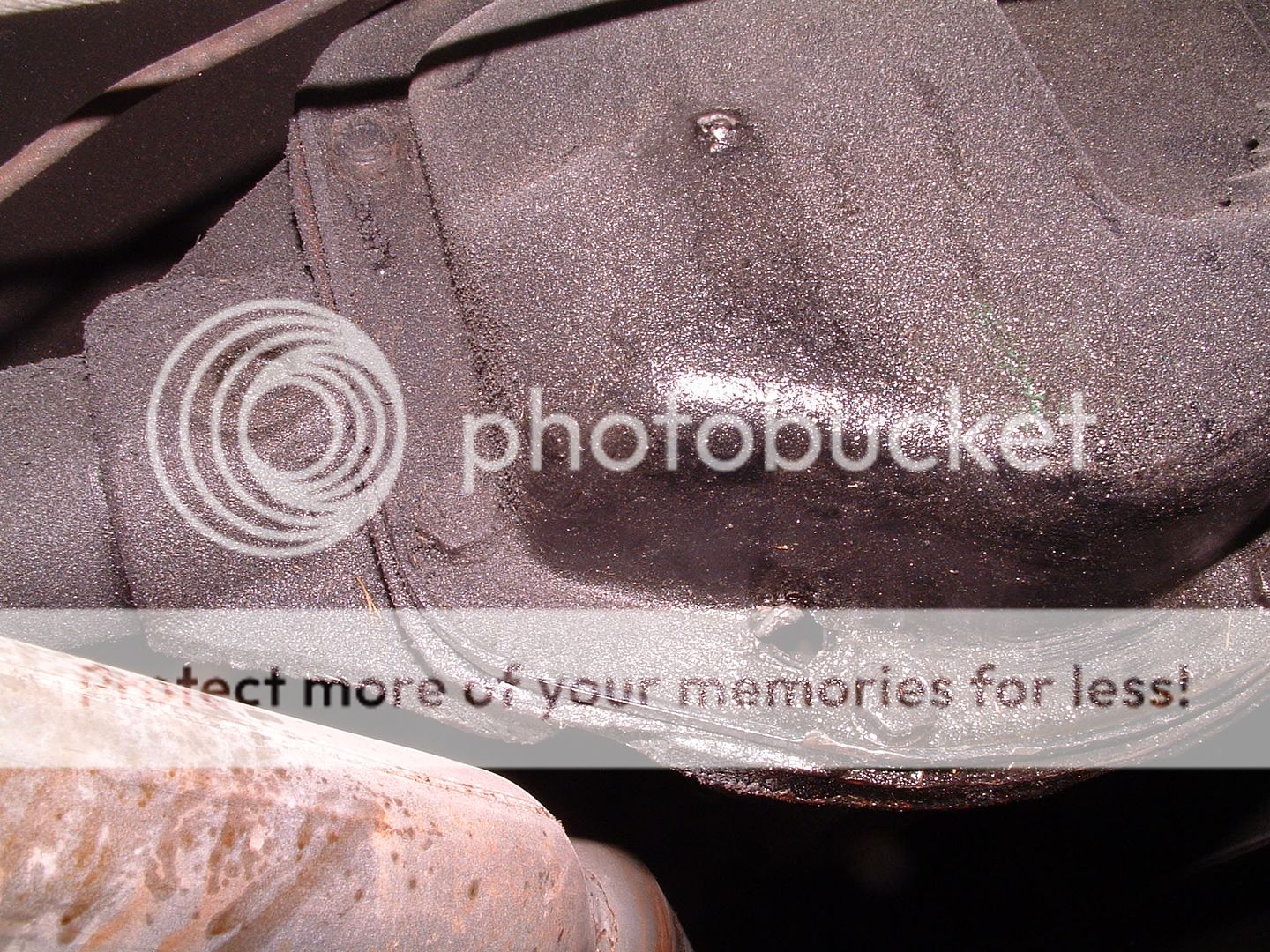
At first glance, I thought this one was coming from the spare tire well! That's where I could see an oil drop hanging off ...

DSCF0038.jpg
 
Hi Ed,

Which bolts appear to be leaking? Except for some at the front and rear, most are not threaded into the inside of the crankcase. If you do think that sealant on the threads will help, I'd stick to Hylomar.

But I'd first make really sure the oil isn't leaking down from somewhere else. The pan (and bolts) tend to collect anything coming down from above.

-Darrell
 
Are you sure it's the oil pan that's leaking? I've seen many an oil leak wick to another area and give a false appearance to it's location. Florescent light and dye,maybe? Surprises might await.
 
What makes me think the bolts are leaking is that the heads of the offending bolts have drops of oil on them. The areas around the rest of the oil pan are dry.

There are also other leaks, or seeps, but they are not in the area of the oil pan.
 
If you really want to seal a "wet" bolt, you have to go through a painful process. First, chase the hole with a tap to clear out the old sealant and crud. Then use carb cleaner or the like to completely clean the threads and surrounding area. When the hole and area are completely clean and dry, then you can finally apply a thread sealant and install the bolt.

I learned this on 2 stroke aircraft motors, where a case seal is critical...and after years of futily just adding more sealant to dirty holes.

John
 
TR3driver said:
At first glance, I thought this one was coming from the spare tire well! That's where I could see an oil drop hanging off ...

DSCF0038.jpg

Yowza! I have to wonder what caused that -- small arms fire during rush hour on the 5?

Ed -- I, too, am in the camp that suspects that the drip is merely presenting itself on the bolt heads and the 'dry' condition you see in surrounding areas is just the nature of metal that oil has thoroughly crept off of.
 
Geo Hahn said:
Yowza! I have to wonder what caused that -- small arms fire during rush hour on the 5?
Well, there was most of a tooth missing from the pinion gear, but only about half of it stuck to the drain plug. I'm guessing the other half got ejected through the cover.
 
Hoping the problem is mainly with leaky bolts, I will take John's advice to removed each bolt, clean out the old sealant, clean the bolt, apply new sealant, and put the bolt back.

the last time I reinstalled the oil pan, I torqued the bolts about 10 ft. lbs. This seemed a little light to me, but it is what is called for. What do you think?

I'm also toying with the idea of inserting a reinforced rubber gasket between the lockwasher and the face of the oil pan (not an o-ring) to better hold the sealant and to make an even tighter fit. What do you think?

There are several other oil leaks, but if I can stop these leaky bolts, then I will have solved a big part of the problem (assuming, of course, that the bolts are indeed leaking).

The frustrating thing about all this -- and I have been warned -- is that from time to time I get the leaks down to a slow seep, and then after 500 miles or so everything starts leading again. Bolts probably have to be retorque, or something like that.

Well, as they say, if it stops leaking, it is empty. Ha, ha!
 
Something you might want to look at is if most the drips are on the driver side then the oil could be coming out of the breather as vapor and condensing on the bolt heads.
 
I don't like the rubber washer idea in conjunction with the lockwasher.

You might save yourself some time by doing the thread goo treatment on just one bolt (one that typically exhibits a drop of oil) and see if anyhting changes.

If that bolt still has oil accumulating on it you'll know that either the thread sealant didn't work or the oil is coming from somewhere else.
 
George,

Great minds think alike! I did exactly today exactly what you suggested, choosing one of the bolts with oil on it. I'll leave it overnight to "cure" a bit and run it tomorrow to see if anything changes.

I have also retorqued the bolts from 8 ft. lbs. to 12 ft. lbs. They just seemed too loose at 8 ft. lbs. We'll see.

If all else fails, I will remove the oil pan and start over. I installed a new gasket (from The Roadster Factory) and all new bolts earlier in the summer. One thing I did not do was to follow a suggestion from The Roadster Factory that I might want to use two of the treated fiber gaskets, instead of one. The technician said two would serve better if there was any uneveness even after I flattened out the face of the pan. If I do it again, I will try two gaskets.

I take it -- from lack of responses -- that no one uses teflon tape on the threads of the bolts (???)
 
NEXT DAY INSPECTION OF OIL PAN BOLTS


Well... so far so good. No leaks or seeps around the bolts this morning. I don't know if it was the gasket treatment on the worst leaking bolt or increasing the torque from 8 ft. lbs. to 12 ft. lbs., but so far it is working.

Next... to the road test.

But I am always aware of the admonition: "Your Triumph will leak."

Oh.. well... if I get lost on these back roads of western Virginia, I can always follow the oil drips home.
 
Hate to be so negative -- but if it is other leaks with the oil creeping down to the bolt heads -- those will probably not show up until a couple of hours after a good drive. Good luck.
 
Hi, George,

You are not being negative... just realistic.

My thinking that the bolt heads are the main culprits comes from some "evidence" on the oil pan itself. Above the oil pan (directly over the bolts), there were no oil leaks showing. But the bolts have had oil on them and the oil pan below the bolts have shown traces of the oil coming from the bolts. I am still hoping that the problem may have been that the bolts were not torqued enough. But I've had enough experience with this car to know that it is going to leak somewhere.

I also have numerous small leaks in the vicinity of the transmission and overdrive, but not enough to be too concerned about. Just an aggravation.
 
LexTR3 said:
the last time I reinstalled the oil pan, I torqued the bolts about 10 ft. lbs. This seemed a little light to me, but it is what is called for. What do you think?
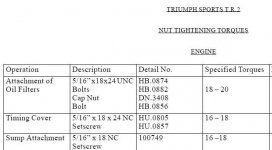
Which book is that? The factory workshop manual says 16-18 ftlb. I wouldn't go any higher than that, as it just distorts the pan and splits the gasket, making things worse instead of better.

<div class="ubbcode-block"><div class="ubbcode-header">Quote:]I'm also toying with the idea of inserting a reinforced rubber gasket between the lockwasher and the face of the oil pan (not an o-ring) to better hold the sealant and to make an even tighter fit. What do you think?[/QUOTE]
If you want to go that way, I would suggest a sealing washer with rubber inside and a metal surround; then leave out the lockwasher. Otherwise the lockwasher will tear up any soft gasket. Eg, https://www.mcmaster.com/#sealing-washers/=esxc8k

(this scan is from a TSB, but it echoes the information in the workshop manual)
 

Attachments

  • 26884.jpg
    26884.jpg
    34 KB · Views: 207
I would think that 16-17 lbs would be OK for tightening, but I can't imagine that a little extra should hurt unless the bolt holes start to dish up so easily. Maybe the old steel is just too weak.

As for that front middle bolt that goes into the front aluminum sealing block, I'd be afraid to strip that above 14 lbs or so.

And BTW, why doesn't Moss sell that sealing block? I thought they used to offer it??
 
Back
Top