• Hey Guest!
    British Car Forum has been supporting enthusiasts for over 25 years by providing a great place to share our love for British cars. You can support our efforts by upgrading your membership for less than the dues of most car clubs. There are some perks with a member upgrade!

    **Upgrade Now**
    (PS: Upgraded members don't see this banner, nor will you see the Google ads that appear on the site.)
Tips
Tips

Leaky Carbs

Crisis

Jedi Hopeful
Offline
I know its been asked before, but I can't seem to find it through searching, what are the possibles for leaking carbs; o-ring on bowl plug, gasket for bowl, float with hole(sinks), fuel pump with broken valve. Anything else? I've got a good leak that is actually dripping-even when the car isn't running. I checked; the float height, gasket for bowl looks good, not leaking at plug, new gasket on choke body, gas stops when hose is disconnected. Any suggestions?
Thanks.
 
There is some residual pressure in the fuel line between the fuel pump and the carbs even after the fuel pump has stopped.
The needle valve should shut off the continued flow of gas into the float chamber once the floats rise high enough to close the needle valve.
Needle valves do get stuck in the open or closed or in between position.
Floats can develop leaks and take in gas and sit too low to shut off the needle valve.
And the float level can be out of adjustment allowing too much fuel into the chamber, possibly over flowing up the jet and into the manifold, crankcase, diluting the motor oil, etc, etc.

The problem is probably somewhere in the float chamber.
 
Thanks Poolboy. I think you're right. Somethings up in the float bowl. I do get fuel in manifold, dripping out the opening to the air filters, and I suspect into the crankcase as well (oil smells funny). Need to do more investigating. Thanks.
 
FWIW: from a non-mechanic TR6 owner.

1. It's easy to drop both float bowls (6 screws each)
w/out removing the carbs from the manifold.

2. Take off both fuel lines into the carbs.

3. the floats will rotate downward and the fuel metering
valves will drop open by gravity. Gently lift the floats
to make sure they are filled with AIR not fuel.

4. Spray carb cleaner into both carb fuel inlet pipes.
If crud is there or the metering valve is stuck, the carb
cleaner should fix the problem. Do this procedure a few times.

5. Lift each carb piston and spray carb cleaner downward into
the needle holes. If crud or "a small bit of meat" is present,
the cleaner should blow it clean. Do this a few times.

6. Rub some engine oil on the float bowl gaskets (replace them
if you have two) and reinstall the float bowls.

If this corrects the leak- OK! If not - you've ruled out several
possible leak causes and cleaned your carbs a bit.

>>>>>>>>>>>>>>>>>>>>>>>>>>>>>>>>>>>>>>>>>>>>>>>>>>>>>>>>>>>>>>>

Bearing in mind, Tinster isn't really a knowledgeable TR6
mechanic but he DID stay at a Holliday Inn in Manaus, Brazil

best of luck and keep us posted.

tinster

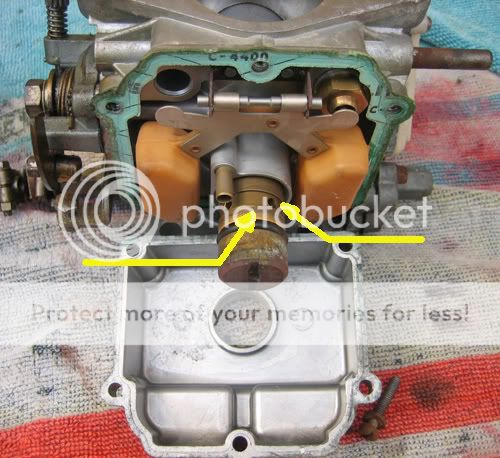
1969 Carbs as seen from below w/ bowls removed:

carbBowl.jpg


gasManaus.jpg
 
I've always assumed that the carb bowls are not supposed to totally fill up, and the float bowl gasket prevents escape of fluid that gets sloshed around inside the bowl. Is this true? What about the choke gasket? Is it a barrier to the gas only when the choke is open? My leak may be coming from there, I still can't find it. Gaskets look good-no tears.
A gasket in these areas can be re-used if they are still in one piece, correct? I don't want to drive this car with a leak in that area as it could be dangerous. My wife doesn't want it in the garage smelling like this. Can't wait to try out the new suspension-the suspense is killing me.
Carbs were rebuilt a few years ago. Mechanically they seem perfect.
Couldn't be a timing issue could it? Un-burnt fuel spilling out the throttle body?
Any more suggestions would be appreciated. Thanks.
 
I don't think the valve is sticking open. With the carb off the car simply turning the carb upside down and back will move the needle. No force required-gravity does the trick. Is there something that could change that when it's installed on the car? I can't see what.
 
Just to be sure, turn the carb upside down as you described. Hold it there and blow thru the fuel inlet nipple. If air passes, the valve is not completly closing.
What is your float height set at ?
 
Let's see that's .661 inch , right ?
Mine are about .627, so I don't think you are overfilling the float chamber.
About those gaskets. The float chamber gasket is pretty thick. I've had my float chamber off the carb at least 3 times, I bet, and it is still sealing.
The choke gasket is quite a bit thinner.
I think the best way to check for a leak there would be to start with a dry carb, have someone spin the starter with the coil disabled while you stand by the carbs and with the air cleaner removed watch as the bowls are filling up by the fuel pump and see where the gas appears first.

Take the wire from the coil to dizzy cap out of the coil Or disconnect the wire from the coil + terminal.
Gotta get to the bottom of this.
 
poolboy said:
Just to be sure, turn the carb upside down as you described. Hold it there and blow thru the fuel inlet nipple. If air passes, the valve is not completly closing.

I will disagree.............. but only a little.
Push enough psi into the carb inlet pipe and the valve WILL
open. My defective 16 psi fuel pump opened the valve easily
and flooded my engine compartment with gasoline. Mouth blow
pressure can also open the valve, if ya puff strong enough.

d
 
Tonight I tried to determine exactly where the gas was coming from. As far as I could tell, it appears to be coming from the choke assembly. The choke cam was wet, and it was definitely wet around the choke body. Hard to tell if the float chamber was leaking because of the fact that the choke is located directly above the chamber. And, if the choke cam was wet it couldn't have come from the float chamber below.
I removed the choke bodies to see if they are oriented properly, which they appear to be, and a lot of gas dripped out of there. Is that normal?
Those gaskets under the choke body are very thin, and thin walled. I'm quite surprised that they are expected to hold back the gas under that choke disc. Problem is, I think those gaskets are only sold in kits!
I'm going to research on the Buckeye site to see if the chokes are oriented properly, but I think they are. My feeling is that the float chamber is not leaking but I will try lightly blowing through the gas input line to see that the needle valves are in fact closing (I think they are though).
 
After I read Tinster's post, I tried the test again on a spare carb that I use for reference. By mouth, I couldn't muster enough pressure to open the needle valve with just the weight of the floats holding them closed.
I know that the mechanical fuel pump is supposed to supply a max of 2.5 #s of pressure. I may have supplied that much.
I suppose that the boyancy of the floats in gas may apply more pressure than the weight of the floats to keep the valve closed.
Whether or not it can withstand the 16 #s of pressure that an electric fuel pump delivers.... well Dale says it will open it.
 
poolboy said:
I suppose that the boyancy of the floats in gas may apply more pressure than the weight of the floats to keep the valve closed.
Or, it could just as easily be less. If you just drop the floats into a bowl of fuel, they don't stick out by much. In normal operation, the weight of the float tends to allow the valve to open rather than hold it closed.
<div class="ubbcode-block"><div class="ubbcode-header">Quote:] Whether or not it can withstand the 16 #s of pressure that an electric fuel pump delivers.... well Dale says it will open it. [/QUOTE]Absolutely ! Half that much is enough to cause problems !
 
Or, it could just as easily be less. If you just drop the floats into a bowl of fuel, they don't stick out by much. In normal operation, the weight of the float tends to allow the valve to open rather than hold it closed.
I was thinking that when you are talking about bouyancy, the weight of volumn of the displaced gasoline was, in effect, pushing up against the valve, The weight of the floats are under the influence of gravity, but bouyancy above the "water line". Below the water line is the weight, above is due to bouyant force, right?
I was just trying to theorize why the carbs are flooding.
 
With my motorcycle experence most of the valves popoff thier seat at 10psi.

Don
 
poolboy said:
I was thinking that when you are talking about bouyancy, the weight of volumn of the displaced gasoline was, in effect, pushing up against the valve, The weight of the floats are under the influence of gravity, but bouyancy above the "water line". Below the water line is the weight, above is due to bouyant force, right?
Yeah, kinda.

In order to float at all, the floats must first displace a volume of gasoline equal to their own weight. Then as the gasoline rises farther, they push up against the valve with a force equal to the additional volume of gasoline displaced. Until the gasoline gets to the top of the float, then the force no longer increases (because there is no additional gasoline displaced).

The force available is surprisingly small, less than an ounce, but gets amplified through the length of the lever arm, and the small area of the opening in the float valve until it's enough (hopefully) to hold back the fuel pressure. But even using Grose jets (which apparently have a larger effective opening) can sometimes cause problems with "sunken" floats.

Some other types of carbs are designed for more pressure (eg, most American carbs are designed for 7 psi) but the Brits and Italians used less.
 
Back
Top