• Hey Guest!
    British Car Forum has been supporting enthusiasts for over 25 years by providing a great place to share our love for British cars. You can support our efforts by upgrading your membership for less than the dues of most car clubs. There are some perks with a member upgrade!

    **Upgrade Now**
    (PS: Upgraded members don't see this banner, nor will you see the Google ads that appear on the site.)
Tips
Tips

Knock Offs - Whats the deal?

UmmYeahOk

Jedi Warrior
Offline
Ok, whats the deal with these wire wheels?
GRID008062.jpg


Ive got theses on my car. The owner and his father made such a big deal about them, and how 2 additional rusty old ones would come with the car. I understand theyre expensive, but not as much a most rims Im used to.

But the deal is everyone who I show the car to immediately asks me "are those real knock offs?" My first answer is always, "if theyre knock offs, then how could they be real?" Eventually I learned why they are called that. But because everyone seems to ask me this, why is it such a big deal? I mean, yes, I understand that they are a factory option, but the people asking me this dont know that. Was this some crazy hot rod fad back in the day? Why are these so special?
 
Probably because functional knock-offs have been practically unknown for many years. Most wire wheels in the last 30 years or so have used lugs for attachment, the knock-off (if any) is fake.
 
Many years back there were no alloy wheels and wire wheels were an effective way to reduce unspring weight.

Their appeal now is that they are the quintessential Brit car accessory.

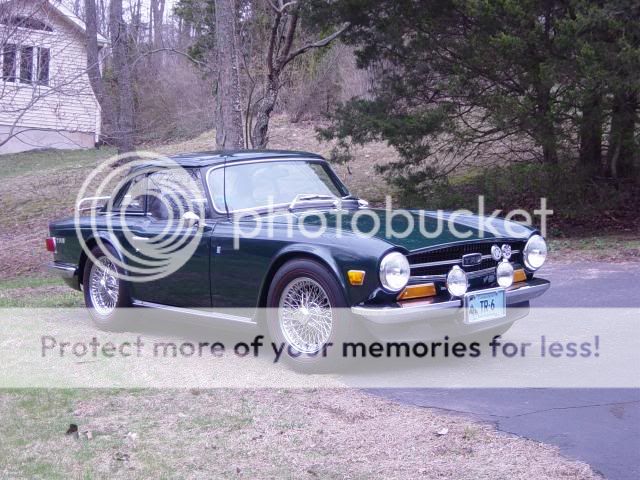
The ones in that pic are chrome and have a LOT of spokes. More typical on TRs are the painted variety with 60 spokes.

They can be troublesome, out-of-round, hard to clean, etc -- neverthe less I like them and prefer them on my cars -- though I keep sets of disc and wires and swap them on and off.

As you note, they are not particularly expensive (esp if you get them on sale or thru a discounted distributor) but if you have nice ones please don't use that hammer in the picture. That hammer is for displaying in the tool roll -- there are much kinder ways to mount & remove those wheel nuts.
 
Geo hit it for me. Wire wheels are one of the things that makes a British sports car for me.

Scott
 
Hey, Monica -

Knock-off wire wheels are about as British as it gets. Built for speed, but not velocity; rather for quick-changing necessary in racing.

Here's an article about them.

Mickey
 
Geo Hahn said:
I like them and prefer them on my cars -- though I keep sets of disc and wires and swap them on and off.

George: I assume that you use the alum. spacers when running wires. Is that correct?

fja
 
When I bought my 1958 TR3A brand new in May, 1958, I wanted the lowest price I could get from the 4 S-T dealers here in Montreal. It cost me $2616.00 with the overdrive option, undercoating (big mistake) and the windscreen washer kit + 2% tax ($51.00) and $15.00 for the licence plate.

The wire wheels were an extra and at age 20, I had to keep the cost down.

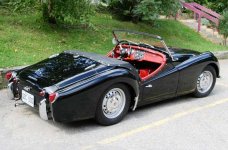
But at that time, so many people were complaining about how wire wheels went "square" so quickly that it was common thinking that the new steel wheels were "high-tech" because they would stay straight and round. My TR now has over 180,000 miles on it and look at the photo. I have never had to spend a penny to get any wires replaced or straightened and I've never spent more than 2 minutes to clean all four of the wheels. To me, it looks super and they are original parts. No TRA or VTR judge can take points away from me or give extra points to someone because his TR has wire wheels.

Did you know that chromed wire wheels were never original equipment because chrome embrittlement of the wires which was reported to be a dangerous cause of broken wires. I wonder if that is still a problem if it ever was a problem or if TR owners who have chromed wire wheels today trailer their TR so the wires won't suffer from the embrittlement problem.
 

Attachments

  • 18355.jpg
    18355.jpg
    56.3 KB · Views: 443
Don Elliott said:
Did you know that chromed wire wheels were never original equipment because chrome embrittlement of the wires which was reported to be a dangerous cause of broken wires.
According to Bill Piggott, they were available but were "discouraged" by the factory.
<div class="ubbcode-block"><div class="ubbcode-header">Quote:] I wonder if that is still a problem [/QUOTE]I believe the problem was real. Apparently Dayton does too, as their chrome wire wheels now come with high tensile stainless steel spokes.
 
kodanja said:
I dont use any spacers
The spacers are only needed when you want to switch back and forth between wires & steel wheels. Otherwise, the studs have to be shorter for the wire wheels and longer for the steel wheels.
 
TR3driver said:
kodanja said:
I dont use any spacers
The spacers are only needed when you want to switch back and forth between wires & steel wheels. Otherwise, the studs have to be shorter for the wire wheels and longer for the steel wheels.
Right! Several Service Bulletins over the years were issued to remind service staff that the wheel studs needed to be shortened approximately 5/16" when converting TO wire wheels. Without that shortening, the wire wheel will foul on the studs and not seat properly on the wire wheel hub adaptor. Note that this applies to the TR series but not to the Herald-based cars, including Spitfire and GT6.
 
The reason that they ask: starting back in the late 1950s or early 1960s, you could buy "wire wheel HUBCAPS" for American cars, that looked just like wire wheels. I will admit that I have never seen them on a British sports car, but I have seen ads for them in sports car catalogs.

As you would expect, the high-end hubcaps looked pretty good on American cars, but the cheap ones really looked tacky.

I can remember asking folks if theirs were real wire wheels or hubcaps. I don't think that any insult was intended toward you - they just wanted to know.

I have to agree with George and a few others: they really DO give a personality to a sports car. I have had a TR3A, a Datsun 1600, and a TR3B, and only the last one has had WW, and I am IN LOVE WITH THEM! They don't compare with the disc wheel for strength, ease of cleaning, ease of balancing, ability to hold a tire, etc, BUT THEY LOOK SEXY AS heck. Which reminds me, Brigitte Bardot is <span style="font-weight: bold">SEVENTY-FIVE !!!</span>
 
Andrew Mace said:
Note that this applies to the TR series but not to the Herald-based cars, including Spitfire and GT6.
Does also apply to the Stag, though.
 
Andy,

Applies to my 73 Spit. I have the old wires in storage with stud marks in the back of the wheels to prove it, YMMV.
 
Don,

It definitely didn't apply to the Mk 3 Spitfires (and presumably the Mk 1 and 2 as well). Were wire wheels still a factory option with the later Mk IV/1500 Spitfires? Sounds like the studs were longer on the later cars (I'm assuming your car still had the original factory studs).

Scott
 
As I understand it, the real knock off wires were not an option for the 1500.

Knock offs were added by a PO. The studs in the front were smashed into the back of the rims so bad that the studs had a chamfer to them that matched the rim profile. I trimmed the studs down and ran the wires till a spline failed, then switched to minilite replicas. The cost of new wires was more than I wanted to spend.
 
When I had my 72 MGBGT the wire wheel splines were so worn out .
One time I hit the brakes and the grind sound was deafining', then the car just kept going'
 
Back
Top