
• Hey Guest!
    British Car Forum has been supporting enthusiasts for over 25 years by providing a great place to share our love for British cars. You can support our efforts by upgrading your membership for less than the dues of most car clubs. There are some perks with a member upgrade!

    **Upgrade Now**
    (PS: Upgraded members don't see this banner, nor will you see the Google ads that appear on the site.)
Tips
Tips

TR2/3/3A Knock knock... what's this?

The bottom end work you have done has no affect on the valve clearances.
No need to buy new pushrods unless the ones in the engine are bent, corroded or otherwise damaged.

It now sounds (pun intended) like the knocking sound is being caused by excessive valve clearance(s) caused by a stuck tappet(s) in No.4 cylinder.
That would be consistent with your observation that the knock went away as the engine warmed up.

When setting valve clearances I make it a practice to push down on the tappet side of the rocker arm while checking the clearance with a feeler gage at the valve end.

Also, since you don't know the history of this engine, you should check the valve end of the rocker arms for cupping wear.

M.
 
Last edited:
Excessive (what you call) pushrod play would make noise and essentially be too large a gap in the valve setting. Could be a valve isn't even opening which would make some noise.

A new pushrod is probably not the answer - but I would start by checking and adjusting the rocker for the correct gap (good time to check and adjust all 8).

Edit: The suggestion of a stuck tappet is a good one - would also account for the symptoms.


If you find you cannot get it to spec (.010 cold) then you can look into why that is. FWIW - I set them .010 on intake and .012 on exhaust just to have a bit of leeway on the exhaust valves. A little too loose doesn't matter much, a little too tight is trouble.

BTW - in case you do not know - you can run the engine with the valve cover off. May be a little messy but nothing terrible will happen. That might let you further pinpoint the sound if an adjustment doesn't quiet things.
 
Just my opinion, but I think everyone is getting away from the real problem. As the OP's first video shows, when he pulls the plug wire off of #4 cylinder, the knock goes away. Usually that means a rod knock...too much clearance. However, since he also says it goes away when things warm up, there is a possibility that it might be an exhaust manifold leak at #4 that as things heat up and expand, it closes the leak down. Just speculation on the exhaust leak, but easy enough to check out. I don't see how pulling the plug wire would make a valve noise go away, but again that is also an easy check. A valve knock that loud would have to have a lot of clearance.

If it were my engine, I would check for the exhaust leak. If that checks OK, then I would check the rod clearance on #4 with the plastigage using the old bearing shell, and then again with the new bearing shell and see what's going on. Actually, check the rod clearances even if you find an exhaust leak, because the initial journal dimensions taken showed that that it wasn't up to spec. Might as well check the other three while you've gone this far.
 
The video sure sounds like rod knock to me, it appears the journal is worn about 3 or 4 thou undersize. New STD shells should help a bit for a while, but that's a fair bit of bearing clearance.
The long term solution is a regrind on the crank and undersize bearing shells fitted. Removing the crankshaft can be done with the engine in situ but uncomfortable lying on your back.
 
The video sure sounds like rod knock to me, it appears the journal is worn about 3 or 4 thou undersize. New STD shells should help a bit for a while, but that's a fair bit of bearing clearance.
The long term solution is a regrind on the crank and undersize bearing shells fitted. Removing the crankshaft can be done with the engine in situ but uncomfortable lying on your back.
After listening to the second video I have to agree with Graham.
You can very clearly hear the valves and rockers "doing their thing", but there is a second noise that appears to come from deeper within the engine.
Rod knock is a very high possibility since the crank journal for No.4 cylinder is 0.0036" undersize according to your measurement.
You should plastigage all four con rod journals using the old bearing shells to see what the actual bearing clearances are.
The max bearing clearance (wear limit)per the workshop manual is .005"

M.
 
I measured again and got 2.0830. I am using a digital micrometer, so not the best, but I'm somewhere in that range. However, regardless of the actual clearance with the plastigauge, I am going to replace it with STD bearings. If the knock goes away, then I'll run it until i need it repaired again. If the knock does not go away, I will probably have to have the engine serviced by a professional. I'm going to use plastigauge anyway so I know where I'm at...

AltaKnight mentions removing the crank from the bottom, every manual I have read says this needs to be done with engine out... is this possible? If so, I'd consider taking the crank out and sending it away to be turned.
 
Also, I have had engine knock from warn bearings, but off by .05 not .0025-.003 (granted I'm used to working on slightly larger engines...) would 3/1000's make that much noise?! That would blow me away a bit.
 
Well, you'd have to take the transmission out among other things. I think it would be easier to just yank the engine with the transmission...as it's easier to get back in that way. Sometimes the perceived long way is in reality the easier short way.

Edit: Re: the clearances on the journal. You don't know how much the bearing shells are worn, that's why I originally suggested to use the plastigage with both the old bearing shells, and the new ones so you can really see what the story is. Also, remember that your journal seems to measure 0.003" small, then you have to add bearing clearances. So until you get the plastigage and measure, you shooting in the dark.
 
Apologies HighAltitudeTR3, I was thinking of a TR6 insitu crankshaft removal not a TR3. It would need engine out which isn't as daunting a task as you might imagine, although you do need a place (garage) to do it in.
As Martx-5 indicates, the real clearance is the sum of journal wear plus the old bearing shell wear which might total as much as 8 thou range, plenty room to cause a knock. New shells will close it up and improve things for a while.
I'm really surprised you didn't lose significant oil pressure with that kind of clearance, will be interesting to hear what your other bearings are like when you change them, maybe all the wear is on that one bearing, in which case I wonder why?
 
I would imagine pulling the engine is quite simple on the TR3. I guess I'm not opposed to it, just a little in denial. :/
 
In the long run pulling the motor and gear box will be a lot less work than trying to do it in situ. Can't imagine laying on my back doing the big end bearings. You will always have oil dripping on you and you are working in a cramped position.

With a motor stand you can rotate the engine for easy access.

David
 
I have a friend coming over who is an engine builder. He's going to look everything over and hopefully shine some light on this. I will post his findings soon... in the down time I've replaced the gas tank (new one had a hole ��) rebuilt both carbs, and cleaned the garage. ��
 
Hopefully he will have mics to check the clearance inside the original bearing shells. We really need to figure out where the extra clearance is that is causing it to knock.

Just a thought, try blowing compressed air into the oil supply hole in the crank. It should blow out of the main bearing...and if not, there could be a clog that is preventing the #4 rod from getting oil. No oil will also cause a rod bearing knock.
 
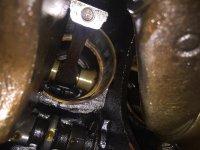
Well... maybe enough oil has dropped away or perhaps I've got the lighting just right, but I just inspected the valve guide again. I included a photo. :/

You might have to zoom in... I think i found the source of the knock.
IMG_9613.jpg
 
Well... maybe enough oil has dropped away or perhaps I've got the lighting just right, but I just inspected the valve guide again. I included a photo. :/

You might have to zoom in... I think i found the source of the knock.
View attachment 49115

Edit: I just checked to see if I could feel the scores, and I cannot. Smooth at it's supposed to be. I checked for any play in the piston and didn't feel any. I will gauge it tomorrow when I can get the right tools.
 
Valve guides are in the cylinder head, did you mean to write cam lobes or cylinder scoring?

M.
 
I assume you are referring to the apparent score marks on the cylinder wall?
Usually most of the wear on a cylinder is in the plane of the thrust which would be at 90 degrees to the wrist pin, or to put it another way, the wear is normally on the side where the longer piston skirt is located which I could not see in your photo. Measuring the cylinder diameter with a quality inside micrometer would help; however in the case of piston slap it is usually the soft aluminum piston skirt that takes the brunt of the wear rather than the cylinder wall; only sure way to know is removing the head and popping the piston out
 
Back
Top