Hey Guest!

 Hey - did you know if you click on the title of a thread it will take you to the first unread post since you last visited that thread?
 but were afraid to ask:
  STOP!! Never post your email address in open forums. Bots can "harvest" your email! If you must share your email use a Private Message or use the
  smilie in place of the real @
 Pretty Please - add it to our Events forum(s) and add to the calendar! >>
M
Member 10617
Guest
Guest
Offline
If you are like me, when someone suggests something for your car and it not only works but makes a dramatic improvement in its performance, you are curious to know why or how the suggestion worked.
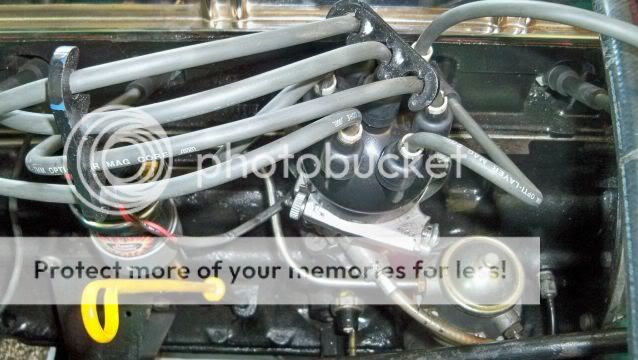
That is the case with my rebuilt Lucas 40480 distributor.
The rebuild came with instructions to set the timing at 15 degrees BTDC at idle, without vacuum. I know the main reason for this has to do with a change in the advance curve that was made to the distributor in order to better deal with today's fuels.
In addition, it was recommended that the vacuum advance be set almost to the extreme advance position on the vernier scale before setting the timing (that position, in other words, would be the starting position for the timing procedure). The explanation that came with this recommendation was that with any other position on the scale, the distributor would run into phasing problems (the rotor would not be in the right position when it tries to fire to the cap terminal).
I followed these instructions, and the car runs very well, indeed.
But I don't know how or why the phasing would be affected by screwing the vacuum advance to the advance position on the vernier scale. I'm not questioning this recommendation (because it works extremely well), but I am curious and would really like to understand what's going on and why.
I'm not sure why any point on the vernier scale couldn't be used as the "initial" setting (except that in my case it has something to do with phasing). Most manuals recommend that you set the vacuum advance on the midpoint of the scale and then set the timing. That would allow for adustments up and down the scale on road tests.
Again, I am not questioning this recommendation because it works so very well for my car -- and I'm not proposing to change the adjustment -- but I'm really interested in learning why it is correct and why it works so well.
Can one of you tech-savy guys shed some light on this for me? I would really appreciate the information, and perhaps it will help others as well.
That is the case with my rebuilt Lucas 40480 distributor.
The rebuild came with instructions to set the timing at 15 degrees BTDC at idle, without vacuum. I know the main reason for this has to do with a change in the advance curve that was made to the distributor in order to better deal with today's fuels.
In addition, it was recommended that the vacuum advance be set almost to the extreme advance position on the vernier scale before setting the timing (that position, in other words, would be the starting position for the timing procedure). The explanation that came with this recommendation was that with any other position on the scale, the distributor would run into phasing problems (the rotor would not be in the right position when it tries to fire to the cap terminal).
I followed these instructions, and the car runs very well, indeed.
But I don't know how or why the phasing would be affected by screwing the vacuum advance to the advance position on the vernier scale. I'm not questioning this recommendation (because it works extremely well), but I am curious and would really like to understand what's going on and why.
I'm not sure why any point on the vernier scale couldn't be used as the "initial" setting (except that in my case it has something to do with phasing). Most manuals recommend that you set the vacuum advance on the midpoint of the scale and then set the timing. That would allow for adustments up and down the scale on road tests.
Again, I am not questioning this recommendation because it works so very well for my car -- and I'm not proposing to change the adjustment -- but I'm really interested in learning why it is correct and why it works so well.
Can one of you tech-savy guys shed some light on this for me? I would really appreciate the information, and perhaps it will help others as well.