• Hey Guest!
    British Car Forum has been supporting enthusiasts for over 25 years by providing a great place to share our love for British cars. You can support our efforts by upgrading your membership for less than the dues of most car clubs. There are some perks with a member upgrade!

    **Upgrade Now**
    (PS: Upgraded members don't see this banner, nor will you see the Google ads that appear on the site.)
Tips
Tips

jack's newbie question of the day-increasing comp

jackag91

Jedi Warrior
Offline
I was reading a bunch of sites that people have about their Tr6's. Most of them mentioned that they had increased the compression on their engines to at least 9.5:1.

What is required to do that? Is it just making the head sit a little closer to the block? Does it require different con rods? or pistons?

ganted I am at least a year away from doing anything like this, but I am just trying to learn as much as I can.
 
Lots of ways to do that, but the "easiest" is shaving the head surface (assuming that doesn't compromise valve/piston clearance). Even different head gaskets might make a change in compression.

Flat or domed pistons, instead of dished.

Etc., etc.
 
Just out of curiosity ...

What HP do you have with the "stock" compression, and what's the HP with the 9.5:1 ratio?

I don't have a clue, but seems that shaving the head (etc.) would cost mucho buckos, and needs to give good "value for money".

Thanks.
Tom
 
You would need to take off quite a few thou to increase the compression ratio, problem with doing this on some of the Triumph heads is that it can weaken the lower corners too much. Could be better to go for flat pistons first.

I am upping the ratio on my GT6 by removing 1/32 from the block and some off the head also, with the right head there is no issues with weakening the corners, but then I am going PI and reworked head /bcforum/images/%%GRAEMLIN_URL%%/smile.gif
 
The pistons in the TR6 are already flat top. With the later low compression head you can remove .100-.125" without any problems, you will however need shorter push rods.
 
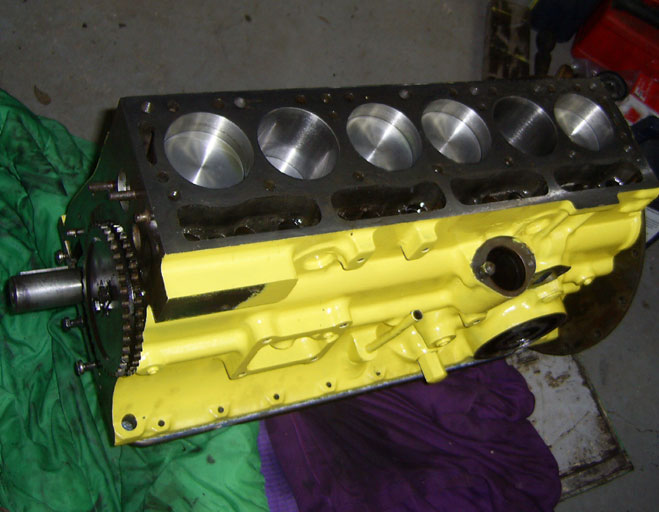
If the engine is being completely rebuilt, then one of the best methods is to do what is called zero decking the block. So that when the pistons are at top dead center they are even with the surface of the block. That way you keep as much of your combustion chamber as possible for the best burn. Just shaving the head can compromise the ignition quality. Shaving the head is easier than and less expensive than decking the block though.
 
Re: jack's newbie question of the day-increasing c

swift6 said:
If the engine is being completely rebuilt, then one of the best methods is to do what is called zero decking the block.

This is the way to go unless you have the late model engine, which has, the counter bore recesses for the composite head gasket. In that case decking the block becomes involved and not to many machinists are going to want to do the job. My machinist told me that duplicating the counter bore accurately is a real PITA so milling the head is less expensive.
Another thing with the late model heads is that the factory increased the thickness to reduce the CR. This was done for lowering the exhaust emissions. Milling the haed in this case brings the combustion chambers back closer to the shape and profile that they were originally designed to.
 
Re: jack's newbie question of the day-increasing c

With my GT6 the counter bore recess on the block has been removed, hence the 1/32 off the block, but I have not put the recess back on as it allows you to use the earlier head gasket.
The good thing about doing this is that it gives more land between the top of the bores. At the same time you do away with the crush ring in the head gasket.

One thing worth mentioning if you decide to skim the block, you will also need to check the piston heights. I had to have between 4 and 16 thou removed from the piston tops, it varies with each piston due to tolerances in pistons, rods, crank grind etc..
Doing this will also mean you have the same compression ratio in each cylinder.
block.jpg
 
Re: jack's newbie question of the day-increasing c

If you shave the TR6 head to achieve 9.5:1 cr, you won't run into any problems. Will have to have shorter push rods. I sat with Ted Schumacher (on the phone) to figure how much shorter and then he had a set of chromoly push rods made up for me. There ain't no way around this. Some have suggested shimming the valve train. This is lunacy.
 
Re: jack's newbie question of the day-increasing c

TR6BILL said:
Some have suggested shimming the valve train. This is lunacy.

Why is it lunacy? Shimming the valve train will actually keep your rocker geometry correct to as it was designed. Shorter valve stems still slightly change that geometry.
 
Re: jack's newbie question of the day-increasing c

Guess because I am using roller rockers, that becomes less of an issue. I was told by Richard Good, when I first had my head shaved and realized the the stock-sized push rods absolutely would not work, that all I had to do was shim the train to lift them. We went round and round with that, never quite sure why Richard, in all his wisdom, kept insisting that that was all I needed to do. And he knew the amount of shaving we had done to the head, took the info right off his site and got all the new springs, seals, etc. from him for the machine shop to assemble. Finally, Ted Schumacher and I figured out how much shorter I needed on my chromoly push rods (I honestly don't remember the amount but it was quite a bit shorter than stock) and he had me a set made up. I actually made up an adjustable push rod out of a couple of my old stock rods, and after multiple turns of the crank and many, many measurements, came up with a number that almost perfectly matched Ted's number. Again, forgot the number, Ted would know. The ones that I had, brand new, could have been shortened but no machine shop around here wanted to take on the project of doing a cut-off and reinserting the shaft in the stem. I even doubled the number of shims to the point that the rocker train became unstable and was blocking the oil ports. Sooooo, I figured getting new push rods was enough. I think there was a disconnect between Richard and me and his insisting that I only needed to shim. One of us was having a bad day or a brain-frt. Anyway, have checked valve lash multiple times since and everything seems quite stable. Perhaps lunacy was a strong word.

 
Re: jack's newbie question of the day-increasing c

Hello all,

Triumph already make shorter push rods, if you can find a set, as used on all P.I. engines.

Shimming the rocker arms does not compensate for skimming the head, and will upset the rocker geometry. (This is with standard components) Reground cams and altered valves could be another situation. If all you are doing is skimming the head/block do not shim the rockers.

Alec
 
Re: jack's newbie question of the day-increasing c

ALEC! Welcome back - we've missed you!

Mickey
 
Re: jack's newbie question of the day-increasing c

Thanks for all of the information.

The PO gave me an extra head. It looks like it is wide spaced port model. I put an old gasket on it and it fit.

I noticed two things that are different from the one that is on the car (73 tr6)

1. There is no erg valve
2. the casting number is different.

what else do I need to look for, to see which head this is?
 
Re: jack's newbie question of the day-increasing c

man,

neither of my heads are listed.

219019 and 218227. This one does have the circle b on it though.
 
Re: jack's newbie question of the day-increasing c

219019, are you sure it is not 219015? that would mean it was used on TR6 PI from CR2936 and late GT6 Mk3,
Uses a 30.3mm exhaust valve and 8 1/8 pushrod length.
The raised coasting number would be 313248.
Used on a TR6 it would have a compression ratio of 9.5:1

218227, for TR6 Carb
Uses a 32mm exhaust valve
The raised coasting number would be 313247.
And it has a squared EGR hump
Has a compression ratio of 7.5:1, not very good eh?
 
Re: jack's newbie question of the day-increasing c

There was another page on the internet somewhere in which someone had tested all the six cylinder Triumph heads on a flow bench to find out which was best. The best was a late 2500 head or something. I regret not bookmarking the page.
 
Back
Top