• Hey Guest!
    British Car Forum has been supporting enthusiasts for over 25 years by providing a great place to share our love for British cars. You can support our efforts by upgrading your membership for less than the dues of most car clubs. There are some perks with a member upgrade!

    **Upgrade Now**
    (PS: Upgraded members don't see this banner, nor will you see the Google ads that appear on the site.)
Tips
Tips

It's your turn...

Gliderman8

Great Pumpkin
Gold
Country flag
Online
... to install a new anode in your water heater. I just did mine!
The last one I installed was 4 years ago so I thought it was time. Since my water heater is in the basement with not to much room overhead, I went with a segmented anode which made it lots easier to installed. I just pulled the old one up until it hit the ceiling, put a vise grip on it and cut it with a hacksaw and took it out in two pieces. The hardest part was loosening the 3/4" pipe thread on the old one; even with a breaker bar it was not easy.
Who's next?
 
Sadly, anode-less here. Such a deprived life I lead!

(Like many New Englanders, I have a "tankless" water heater built into the oil burner furnace. Heats on demand, runs on 125 volts.)

Inkedtankless_LI.jpg
 
You're LATE, Elliot! Did ours back in June. Different drill though. Anode is from the top, yes, little head room so your method was employed... but what prompted the whole thing is both elements had konked out. Limped it along for a while on only one but it soon quit as well. Had to drain that sucka to the bottom. Real PITA. Changed thermostats too. Thing will likely spring a leak before too long and I will have done the deed for naught! :smirk:
 
You're LATE, Elliot! Did ours back in June. Different drill though. Anode is from the top, yes, little head room so your method was employed... but what prompted the whole thing is both elements had konked out. Limped it along for a while on only one but it soon quit as well. Had to drain that sucka to the bottom. Real PITA. Changed thermostats too. Thing will likely spring a leak before too long and I will have done the deed for naught! :smirk:
Late?... this is the SECOND anode I've put in THIS TANK. I'm trying to keep this tank from doing the same thing we do when we drink too much beer :jester:

Tom: Nice setup but I'm happy to not have the OPEC tanker show up to unload :rolleye:
 
Elliot, have tried for years to put one in ours
I just can't figure where to hook the gas line to it.
 
Elliot, have tried for years to put one in ours
I just can't figure where to hook the gas line to it.

Don - you can hook the gas line just about anywhere.

Once.
 
Elliot, have tried for years to put one in ours
I just can't figure where to hook the gas line to it.
I think you put it here:
BCC1F8F0-1494-444F-80B4-E6497DFD6AC5.jpg
 
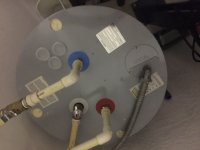
After reading this thread, I decided to have a look at my HW tank. This tank was installed about 6 years ago, and the installer placed the T&P Relief Valve in the top of the tank where you would normally find the anode rod. The instruction manual with the tank shows this as an option, but then, anybody know where the anode rod would be located?
 
Many times it's under a plastic cap... once the cap is removed, there may be some insulation covering the anode hex-head plug. It's got to be there.
If you can't find it, call the manufacturer and ask them.
 
How often should they be replaced? I had to replace my whole tank last year because it started leaking (well, it apparently leaked a bit around the element and rusted itself shut, then when the element failed I couldn't replace it so I put a new element in the blank upper port (don't have enough wiring for dual element) and moved the thermostat up to that location (casting was the same as a dual element unit)...worked for 2 or 3 years but with much limited capacity that didn't matter much since I live by myself)..then it started leaking again where the blow off valve threads into the casting so I just replaced the whole thing with some painfully creative pipe routing to get it all to work since I couldn't find a new one in same form factor as the old. Dealing with old British machines is SO much easier than trying to do these so-called normal jobs. So its only a year old, but what is the normal life span of the anode and where does one GET a new anode?
 
There are lots of variables like hardness of water and usage. I try to change mine approximately every four years but honestly I don’t know what is recommended. I bought mine on Amazon; I have seen them at the big box stores in aluminum but I wanted magnesium.
 
Elliot -

I have attached a picture. I popped off the three plastic caps that are equidistant around the edge of the top. I stuck a stiff wire down the center of each hole to about 6-7 inches and hit nothing. I think these holes are just for installing the insulation.

I called State Water Heater Customer Service. After an 18 minute hold, the girl said, "it's under the plastic cap." I told her that the T&P Relief Valve is in the top of the tank where you would expect to find the anode rod. All she did was repeat herself.
HW Tank.jpg
 
John,
The caps around the perimeter are not the place to look. The anode should be under one of the three that you didn't investigate.
Here's a pic of my water heater... the anode was under the cap circled in RED.
The top of the anode is about 3/8" under the insulation.
IMPORTANT NOTE: You will need a breaker bar to loosen it and someone to help you hold the tank so it doesn't rotate and damage your plumbing. Generally the socket size is 1 1/16".

IMG_3541.jpg
 
Elliot -

Thanks for the quick reply. I called the manufacturer's help line again. This time I got right through and spoke with someone who understood my situation. She said that when an installer elects to place the T&P Valve on top of the tank, then the anode rod is a special secondary rod/nipple arrangement on the hot outlet. If you compare your tank to the picture of my tank, you will notice that we both have the red, white and blue ports. You have a fourth port for the anode rod. My tank does not offer this fourth port.

I am a bit apprehensive about trying to open up that hot outlet. I don't see what I would consider unions to separate the pipe from the tank nipple. It looks like a PVC adapter from NPT to PVC and that is it. I will take on anything electrical and most mechanical tasks, but plumbing is something I never really messed with.
 
At this point I might elect to leave it alone. “If its not broken.....”
 
Well said....
 
Back
Top