• Hey Guest!
    British Car Forum has been supporting enthusiasts for over 25 years by providing a great place to share our love for British cars. You can support our efforts by upgrading your membership for less than the dues of most car clubs. There are some perks with a member upgrade!

    **Upgrade Now**
    (PS: Upgraded members don't see this banner, nor will you see the Google ads that appear on the site.)
Tips
Tips

Interesting Story.....

Steve

Moderator
Platinum
Country flag
Offline
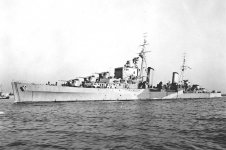
Argonaut.jpg

I’m a huge history buff, especially when it comes to military history so when I recently discovered this story about my father’s cousin it sparked my interest.

Leslie Lewis was from the town of Wolverhampton in the British Midlands, and served in the Royal Navy during WW2. Posted to the aircraft carrier HMS Ark Royal, he was one of the survivors when it was torpedoed on November 13th, 1941 and sank the following day.

He subsequently joined the crew of HMS Argonaut, a light cruiser which was commissioned on August 8th, 1942. On December 14th of that year, Argonaut was hit by two torpedoes fired from an Italian submarine, suffering extensive structural damage to both bows and stern, which were blown off, and losing its steering. After making its way to Gibraltar, temporary repairs were effected, and the ship set out across the Atlantic, escorted by a Destroyer, headed for Philadelphia where it had been arranged that she would be repaired.

The destroyer developed engine trouble and had to leave the stricken cruiser, which was taking on water.

Argonaut made it to the Azores, 850 miles west of Portugal, and under Portuguese ownership. Although friendly towards Britain, Portugal was nonetheless neutral in WW2, therefore as a warship Argonaut would not have been allowed to remain there for long, but her crew would be able to work in safety to make her watertight once again.

Les takes up the story: “To cut a long story short, we called in to Punto Delgorda in the Azores to shore up our bulkheads as we were likely to founder. When we came in to dock the men who took our wires and berthed us were members of a U-Boat crew! We were moored next to a German U-Boat! They were not Nazis, but good German seamen, we all went out and got drunk as monkeys together. When we finally left, she was not allowed to sail for at least twenty-four hours but she never came after us. She could have caught us and put us under easy, the only way we could steer was slow ahead on one engine and up and down on t’other.”

Argonaut made it to Philadelphia, was repaired and served with distinction for the remainder of the war, assisting the American Pacific Fleet.

Makes you reconsider your opinion of German U-Boat crews, doesn't it?
 
Steve - that is quite a story. And it reminds us that *many* German military weren't members of the Nazi party, especially officers. I've heard way too many young folks say that all the Germans and Austrians were Nazis. Not true.

Our school district got an exchange teacher from Germany a few years ago. Many high school students asked her if she was a Nazi.

oy.

I just finished Hastings' "Armageddon" - story of the last year of WW2 in Europe. Many examples of what your father's cousin experienced.

Tom
 
Tom, that is interesting.... I have a friend in Germany, met him through a school exchange that we did when I was a kid. He married a woman whose family owned a large farm close to Munich, breeding horses. One of the buildings is a huge stone barn. There is a full-length basement to this barn, which no-one knew about except immediate family and they used this to shelter local Jewish families when the Nazis started rounding them up. Being a working farm they were able to feed their refugees without too much difficulty.

Yet another example of decent people doing what they could.
 
Here's another interesting story relating to WWII that I read this morning in the Washington Post..... The state of Maryland is trying to pass a bill to exclude a French rail company from bidding on a multi-billion dollar contract to build a new rail line. The state’s General Assembly would block a subsidiary of the French railway from winning a contract for the proposed 16-mile Purple Line until the railway compensates U.S. holocaust victims. It seems that during WWII the rail line transported many Jews to the concentration camps; some of the survivors now live in the DC area. If the bill is approved, it would be the first state law to ban companies with Holocaust ties from receiving U.S. government contracts until reparations are paid.
Another interesting story....
https://www.washingtonpost.com/loca...e89634-9a4d-11e3-b931-0204122c514b_story.html
 
Not just SNCF. There are some USA companies who don't want to admit their dealings with Nazi Germany.
 
Nial - thanks for reminding us of that. Here's the first face to face meeting of Brown and Stigler *after* 1943.


Brown enlisted at age 17, and was only 21 when the incident occurred.
 
The Brown and Stigler story is very interesting, never heard of it before. I do know from what my dad told me that many Germans were only fighting for their country and were not Nazis! He said that most were very nice people but were scared to death to say anything, a lot of them helped the Allies escape when the need arose. This story brings to mind the bravery of our bomber crews and how they got some of those aircraft back home, unbelievable! This is just one example. That tail gunner must have had one heck of a ride! :hororr: PJ

 
Not just SNCF. There are some USA companies who don't want to admit their dealings with Nazi Germany.

There were a number of British and American companies and individuals who were very pro-Hitler in the mid to late 30s. Henry Ford was probably the most well-known in the US, and a number of the British nobility were sympathisers. He was anti-communist and got Germany back to work - seemed ideal, superficially.
 
That was one of the things that Henry Ford pushed into retirement by the company I've read. Used to be that dealers were required to carry the Ford newletter and pass it out to customers. Henry apparently wrote columns for it and during the 30s tended to write about how Hitler had the right ideas and what he felt was our need to be closer to Germany to "fix" the same problems he saw here. Didn't take too long for the company to start being concerned for the potential impact on the business.
 
It wasn't just Hitler's Germany:

https://www.ihr.org/jhr/v15/v15n3p6_weber.html

During the early 1930s, there was much admiration for leaders who could "manhandle" the countries out of the Depression. Unfortunately, people often look for a strong leader, rather than use brains and knowledge of history.

yikes
 
Back
Top