• Hey Guest!
    British Car Forum has been supporting enthusiasts for over 25 years by providing a great place to share our love for British cars. You can support our efforts by upgrading your membership for less than the dues of most car clubs. There are some perks with a member upgrade!

    **Upgrade Now**
    (PS: Upgraded members don't see this banner, nor will you see the Google ads that appear on the site.)
Tips
Tips

Increasing Compression Ratio

G

Guest

Guest
Guest
Offline
OK, I have arrived at the point that I might seriously consider increasing the compression ratio on my TR6. I have done everthing that I can think of externally to increase performance: triple ZS carbs, roller rockers, headers (on the way), hot coil. I think that I want now to have the head shaved to increase the compression ratio and want imput from you guys out there. What to do, where to send it, how much to shave. The head is a new TRF rebuild. I want to keep a stock cam, mainly because I don't want to pull down so much of the car anymore to change it or linebore it and I want to keep it streetable. The short block has a mild bore (out of necessity) and is otherwise stock, certainly not balanced or blueprinted or anything exotic. Am I barking up the wrong tree? I just want more punch and a badder bite. I'll be 60 in a little over a year and the Cialis gives me a headache.

Bill
 
Bill,

So far you have done a great job of giving your car more grunt. Increasing the CR is a good next step but you won't see it all come together until you do something about the cam. That camshaft is the very heart and soul of the engine and unless you get the valves opening quicker and staying open longer the rest of what you have done will, in some part be wasted.

While you have the head off for milling it would be a ideal time to have the ports done to get smoother flow. A little expensive perhaps but worth it. Just my 2 cents worth.
 
Hello Bill,
what exhaust manifold are you getting, there is a school of thought that the only effective manifold for the Triumph six is a 6-3-1 configuration. I don't know if they are available in your part of the world. Have a look on E-Bay for Kas Kastners modification manual for the TR5\TR6, it has a lot of useful information and gives head skimming figures.

Alec
 
If your 6 has the same general dimensions as the Spitfire engine (I think it does), then you can take up to 0.125" off the head without fear of valve interference. For a street car, I'd probably plane off about half that (0.062"). Should make a useful difference.
If you combine this with higher comp pistons, you should have a better "punch". For a street car, I use pistons around 9:1 (or maybe 9.5:1 at the most). You should still be able to run pump gas (93 or 94 RON). I've seen folks run higher comp ratios, but then they have to retard the igniton timing back to 26 degrees or so (total at redline) to supress detonation. That, of course, kind of defeats the whole point of increased compression.
Darwin has a point re: the cam. If you check with Rimmer Brothers or APT, you should be able to find a nice "fast road" cam that will help low to mid-range RPM. It's not that much more work. A new timing chain would be a must if you swap cams and most folks would recommend new lifters as well (although I've gotten away with good used lifters...it may be possible to clean up the old ones on a surface grinder).
In the long run, you're much better off spending your money on Triumphs and not on little yellow (or blue) pills. /ubbthreads/images/graemlins/devilgrin.gif
 
Bill,

I'm going through the exact same thing that you're doing, although I've decided to change the cam as well. Everyone is right, you're not going to see any significant improvement until you change the cam. I personally am using Goodparts GP2 cam, which really isn't that mean, but rather a good autocross/torque cam. My car should sound close to stock. According to my Bently manual, you can change the cam while the engine is in the car.. and doesn't look to be an overly complicated job

Back to compression. Richard Good has a compression ratio chart on his website at:
https://www.goodparts.com/tech_docs/TR6_Compression_Ratio.html

With this chart, you can measure your head thickness and see how much you need shaved to achieve your desired CR. I'm moving mine to 9.5.

With the addition of a cam and more compression, your setup should really come together, just make sure you get the heads re-done (harden valve seats and the like) while you've got the head off.

Let me know what you decide, I'm very curious.

-Shannon
 
Thanks fellas,
And Shannon, Richard is a good man and has quality parts. TRF features some of his parts in their catalog. My head is new with hardened seats, new springs, etc. I think that I would have to go to better push rods if the head is reworked. Guess the cam route is necessary if I want to get the complete package. Bolt-ons just go so far. And Piman, the header is the Falcon brand, 6-3-2 I believe. Tried getting Revington headers but they don't respond to my queries. Will keep ya'll posted. You all well know that pulling the bonnet off a TR6 and putting it back straight is like standing on your head and stacking BB's. Gotta do it though if I want the cam out, along witht the shroud, radiator, grill, etc. Whew!

Bill
 
You're on to something great Bill with the CR mod; it will be an awesome complement to the mods you already have. This was my project last winter and I absolutely love the results! Be careful with your cam selection as you already have an altered ratio with the rockers--you need to factor that into the total valve lift (and may need to install cam bearings if excessive with the rocker ratio). I took my head down from 4.550 to 4.430 (0.120 milled) to get in the neighborhood of 9.5:1 with 0.030 oversize pistons. The machine shop told me there was plenty of head material left to take it further if I wanted to. Got an Isky Z-19 cam [Int. 24-64, Exh. 61-25, Lift 0.400, Duration 268] so that I can add roller gear later without worrying about excessive lift. Also spent good money on APT's nitrided lifters, Ted Schumachers shortened tubular pushrods, and an all new timing gear set. To get the cam out, you'll likely have to remove the driver's side engine mount bolts and jack that side up; it's a close fit through the valence.

Good luck!
 
About the hardened valve seats, which is a very expensive proposition. Not truly necessary unless you continuously spend a bunch of time at high rpm for 10's of thousands of miles. Without them, seat recession is miniscule (and easily detectable during valve adjustment) and you actually have better heat transfer between the exhaust valves and their seats which is crucial to long valve life.
 
One thing you can do is the have the engine balanced and blueprinted. Making all the rods, pistons, and other spinning bits weigh exactly the same can make a great difference in throttle response and power. If cost isn't much concern, triple Webers will give more power and reliabilty than your current ZS setup. Once you want to go inside the engine, the crankshaft can be knife edged to create less turbulence through the oil. And all the obvious things can be done, like lightening rods, pistons, flywheel, etc. And if I'm not mistaken, the intake valve can be enlarged a small amount. Speaking of valves, a port and polish is good, and the valve stems can be reshaped to be more streamlined. Of course all this stuff with come with a serious decrease in streetablility, especially with a really hot cam, and you've probably thought of most of this stuff anyway.
 
[ QUOTE ]
Speaking of valves, a port and polish is good, and the valve stems can be reshaped to be more streamlined.

[/ QUOTE ]
Hi Webb,
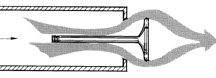
I agree with most of your suggestions. The one that I don't agree with is reshaping the valve stems. The air doesn't just follow the stem until it reaches the valve head & then turn sharply. If you think about it, the valve stem & a good portion of the back of the valve head don't see much air flow. Because the valve to stem juncture is a dead air flow area, no place for the air to go, it builds a high pressure & diverts the flow to the outer edges of the valve where it has a place to go. See the attached sketch. Of course in the real world the port will be curved quite a bit but the same physics apply. Tapering the valve guide will help a bit & some can be gained by unshrouding the combustion chamber area around the valve seat.

You have heard of multi angle valve jobs? This will help quite a bit to increase flow through the valve & it's seat. It will give a smooth venturi shape to the passage way around the valves.
For the intake valve something like;
A narrow 25 degree top cut on the valve head
A .050" margin on the valve edge
A 45 degree face about .060" wide
A 35 degree under cut on the stem side of the valve

For the intake seat;
A narrow 15 degree top cut at the chamber
A 45 degree seat about .060 wide
A 60 degree bottom cut toward the stem side

For the exhaust valve;
A narrow 25 degree top cut
A .065 margin on the valve edge
A 45 degree face about .075 wide
No corresponding bottom cut, adjust the margin to fit.

For the exhaust seat;
A 15 degree top cut at the chamber
A 45 degree seat about .075 wide
A radius from seat to port

Intake ports;
Due to the real world curved shape of the port, & the tendency for the flow to follow a straight line, the bottom of the port is practically a dead air area. I have had success filling the intake port bottom with JB Weld to create a semi D shaped port, in conjunction with raising the port roof to help straighten the flow. Most of the time higher port velocity obtained by smaller reshaped ports helps more than just making everything larger. Properly applied JB Weld will stay put in the intake ports forever.

Enlarging the exhaust port other than removing large obstructions is not likely to help much.

Much of this information has come from Smokey Yunick who you may not have heard of. I have found it to work extremely well.
D
 

Attachments

  • 93167-PortFlow.jpg
    93167-PortFlow.jpg
    6.9 KB · Views: 149
So, you guys think I could pull the cam out without removing the bonnet? I'm serious. Putting the bonnet back on without scratching the paint is virtually impossible. In my mind's eye, start the pull with the hood up (sorry, bonnet takes too long to type), lower it and finish through the grill. Part of my obsessive/compulsive disorder makes me do it in my mind three times before I attempt it in real time. Too, I would follow Richard Good's guideline in getting the head ground and use his fast-road cam, especially since I have his roller rockers. Line boring the block is not an option for cam bearings. Ain't pulling the engine again unless I got to.

Bill
 
[ QUOTE ]
So, you guys think I could pull the cam out without removing the bonnet?

[/ QUOTE ]
Absoutely. Support the engine with a jack, remove the 2 driver's side engine mount bolts, lift the engine just enough for the cam to clear the valence (be sure the speedo cable does't get pinched between the gearbox and the scuttle), close the bonnet, pull the cam.
 
[ QUOTE ]
triple Webers will give more power and reliabilty than your current ZS setup

[/ QUOTE ]

I say stick with your GoodParts triple Stromberg set! I'd give my eye-teeth for one of those for my GT6. The Webbers may be fancy looking but they are finicky to set up/keep in tune and they really don't work any better than a good set of well tuned ZS carbs for anything short of a full race motor.
 
Can you or any one tell me where to measure the head to see how much has (if any)has been preveiously milled off of a 1974 TR6 head.
Thanks in advance for a reply.
Any hents on getting the head off would be helpful. It appears to be slightly loose on the drivers side but I can't make any progress on the intake side. A few studs came out on the drivers side but none came out on the intake side. I pryed with a hammer handle via intake ports enough to flex the motor mounts but still no progress. I liquid wrenced the studs last night in hopes that the studs are binding via (gag) rust or what ever but I will resume the removal task today and I have to have it in the shop by 3 to day to get a turn around before Christmas. HELP!
 
Sounds like a great idea, especially since we're putting new pistons in anyway. My question is: where do I feed the rope into the cylinder? Spark plug hole or what?
 
[ QUOTE ]
My question is: where do I feed the rope into the cylinder? Spark plug hole or what?

[/ QUOTE ]
Sparkplug hole. Make sure that the piston is down first.
D
 
Why can't I use the starter for this? Does that just endanger the rods more?
 
Though I've not tried it myself...the problem of fuel quality looms large with increases in comp ratio, I understand that the GT6 head is a bolt on.
With it's shorter deck it will raise the ratio considerably.

The added benefit is preserving your original head in case you opt to revert to stock CR.
 
Back
Top