• Hey Guest!
    British Car Forum has been supporting enthusiasts for over 25 years by providing a great place to share our love for British cars. You can support our efforts by upgrading your membership for less than the dues of most car clubs. There are some perks with a member upgrade!

    **Upgrade Now**
    (PS: Upgraded members don't see this banner, nor will you see the Google ads that appear on the site.)
Tips
Tips

Ignition leads/wires

richie

Senior Member
Offline
Hey all,

I recently ordered a new rotor and wire set for my TR4A. I am a little unfamiliar with this setup and am curious what the best method is to install these.

It would appear that you just slip the wire end into the cap and screw down the plastic set screw, however it seems that without any thought put into the length of the exposed electrode, I would imagine the current will have no direct path and will therefore be arcing from the actual copper terminal in the rotor to the exposed bit of wire on the leads.

Surely there must be a way to ensure proper contact between the individual terminals in the distributor cap and the wire ends and I was wondering if someone could direct me to a resource explaining this?

Thanks!!

IMG_1606-1_zps20148a77.jpg


IMG_6141-2_zps2fe8ec94.jpg
 
Hi Richie -

Here's what I did: unscrew the "set screw" so the wire end goes completely down into the hole. Then screw the set back until firmly seated.

I'm pretty sure the screw isn't plastic; I think it's a carbon screw which actually pierces the wire to ensure contact.

Also, if the wires are pre-measured, be sure you put the correct wire into the correct hole. (hopefully you marked the original "hole-wire-plug" location)

Worked for me.

Tom
 
I see! Well I phoned TRF and got a similar answer so this all makes sense.

It just seems a little unconventional to not make direct contact with the terminal in the distributor and the core of the lead however I guess that's just how it was done 50 years ago!

Thanks Tom!
 
Guys, I'm not sure what the issue is here, but the original screws were definitely NOT plastic, and the points MUST pierce the insulation on the wire to make direct connection to the inner conductor.

Cut the end of the wire square (so the conductor is flush), and make sure the screw is backed out far enough that the wire can bottom in the hole (not just up against the screw tip). Hold the wire bottomed while tightening the screw. Afterwards, check the resistance with an ohmmeter to be sure you got a good solid connection. An iffy connection now will turn into a cylinder miss later on.

It's been a year or two since I ordered a new cap from TRF, but it did not have plastic screws. If you got one that did, I would like to know more about it (via PM or email if you are nervous discussing it "in public"). I don't believe Charles would willingly sell such a thing.
 
Carbon screws ? Still doesn't sound right. How much resistance do they have?
 
TR3driver said:
Carbon screws ? Still doesn't sound right. How much resistance do they have?

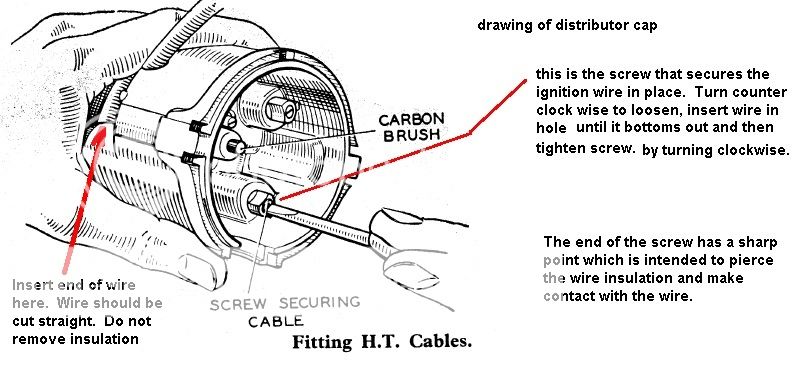
Carbon screws. No, I don't think so. There is a carbon button bellow the center electrode for the coil connection. This contacts the top of the rotor. The screws which pierce and connect each high voltage wire are most likely silver plated brass or phosphor-bronze. See diagram below. The original unedited diagram us from Bentley.

cap-1.jpg
 
richie said:
Well I'm repeating what TRF said and they are black screws.

Ha Ha, if <span style="font-weight: bold">Charles R</span> knew who at TRF told you the dizzy cap has carbon screws, I think they'd be asked to clear out their desk! This has to be a misunderstanding. Next time you have a carbon brush in your hands don't try to apply any twisting (torsional) force (like in tightening a screw) or it will surely shatter. :yesnod:
 
Back
Top