• Hi Guest!
    If you appreciate British Car Forum and our 25 years of supporting British car enthusiasts with technical and anicdotal information, collected from our thousands of great members, please support us with a low-cost subscription. You can become a supporting member for less than the dues of most car clubs.

    There are some perks with a member upgrade!
    **Upgrade Now**
    (PS: Subscribers don't see this gawd-aweful banner
Tips
Tips

Ignition coils

70herald

Luke Skywalker
Country flag
Offline
Since there is lots of discussion about ignition coils I just thought I would point out that there are MANY high quality universal coils available such as:

www.summitracing.com/parts/SUM-G5220/?rtype=10


or what I have on my car (seems to be well made)

https://www.jegs.com/i/JEGS-Performance-Products/555/40100/10002/-1?parentProductId=750781

Note that you probably should also add a ballast resistor (the summit unit comes with one)

https://www.jegs.com/i/JEGS-Performance-Products/555/40102/10002/-1?parentProductId=1087689

Yisrael
 
Thanks for the links.

Which TRs (and which coils) require a ballast?

Thanks.
Tom
 
NutmegCT said:
Thanks for the links.

Which TRs (and which coils) require a ballast?

Thanks.
Tom

Coils that measure about 1.5 ohms across the two small terminals of coil require a ballast. If the coil measures about 3 ohms, it doesn't need a ballast resistor.

I believe that Triumph started using ballasted coils in the '73 TR6. They used a resistor wire for the ballast.
 
TR6 from 73 onwards has a ballast resistance incorporated in the wiring harness. I'm pretty sure all Stags, TR7 & TR8 had ballasts. Looks like Spitfire from 1970 onwards (Mk IV & 1500) as well. All of these Triumphs (and a few more that I didn't bother to look up) take a 1.5 ohm coil without additional resistance.

All the earlier cars need either a 3 ohm coil, or a 1.5 plus a ballast resistor when used with the stock ignition (points). If you have an electronic ignition conversion, it may or may not require the 3 ohm setup. (For example, the Pertronix Ignitor and Crane XR700 do require 3 ohms, either 3 ohm coil or 1.5 plus ballast. But the Crane XR3000 and MSD 6 specifically require a 1.5 ohm coil without a ballast.

The large majority of aftermarket coils will be 1.5 ohm. Usually they will say something like "External ballast required". Common exceptions include the Bosch "blue" and Lucas Sports coils (but be careful, both of these are sometimes sold in 1.5 ohm as well as 3 ohm). Pertronix also sells both varieties, although when I asked at my FLAPS, they only stock the 1.5 ohm flavor. Amazon had the best deal I found on the 3 ohm Pertronix coil (when I bought mine last year).

Are we confused yet?


:crazyeyes:
 
martx-5 said:
I believe that Triumph started using ballasted coils in the '73 TR6. They used a resistor wire for the ballast.

Of course if some previous owner rewired things you may or may not need a ballast resistor. If you have a DVM capable of accurately measuring low resistance, you can of course just measure between the output on the dizzy and the coil.
Coil + wire should be a total of 3 ohms, how it gets there is irrelevant. (3 ohm coil or 1.5 ohm coil +1.5 ohm resistor (or ballast wire)
 
As a footnote to the ballast discussion, there are MANY British cars where Lucas put the ballast resistor inside the harness as a white/pink wire that typically looks all pink with age.

Those ballast resistor wires have a bad reputation. It is not uncommon for them to overheat within the harness damaging both their insulation and those of adjacent wires. For some reason it is especially common in Minis.

My Spitfire has the external ballast resistor, not the pink wire. You can always convert a car with the pink resistor wire to use an external resistor. All that is required is to buy and mount the ballast resistor such that the resistor is wired in series between the coil (+) terminal and a switched 12V supply. Do not use the pink wire anymore, disconnect it at the coil and tape over its disconnected end. Generic ballast resistors around 1.5 Ohms will be available from your local parts store and from online sources like Summit and Jegs.
 
dklawson said:
...Generic ballast resistors around 1.5 Ohms will be available from your local parts store and from online sources like Summit and Jegs.

Typical ballast resistor with coil bracket mounting:

BallastResistor.jpg


Any idea what wattage you'd want on a resistor for that application?
 
Geo Hahn said:
Any idea what wattage you'd want on a resistor for that application?

Ohms Law says at 14 volts, a 1.5 ohm resistor will have to dissipate about 131 watts...P=(V*V)/R...Of course, temperature and other factors affect things, so it's best to give yourself a wide margin. The only ballast resistor I saw that that had a wattage rating was a Mallory, and that was 200 watts.

Here's a nifty Ohms Law calculator for us lazy folks.
grin.gif
 
Geo Hahn said:
Any idea what wattage you'd want on a resistor for that application?
Quick "worst case" : 12v across 3 ohms (resistor plus coil) is 4 amps. 4 amps through 1.5 ohms is 24 watts. A 25 watt resistor should do, although you might want to go larger because of the hot environment.

But I wouldn't be surprised to learn that they did something odd with the temperature coefficient as well; for a bit more current when cold and less when hot.
 
martx-5 said:
Ohms Law says at 14 volts, a 1.5 ohm resistor will have to dissipate about 131 watts.
Yes, but there isn't 14 volts dropped across the ballast resistor. And there is only 14 volts present with the engine running, which means the current through the ballast is not continuous.

Still, maybe I've overlooked something. Here is one that claims to be rated 200 watts (and also have that positive temperature coefficient that I mentioned):
https://www.speedwaymotors.com/Mallory-Ballast-Resistor-75-150-Ohm,27571.html
 
I had never given any thought to the Wattage of a ballast resistor. I don't know that I will give it any thought in the future either. If you buy a proper (nominal) 1.5 Ohm ballast resistor (as shown in Geo's picture) the manufacturer will already have designed a unit suitable for a the 12V electrical system and the current. If in doubt, and if the manufacturer lists it, buy the one with the largest Wattage rating.
 
Lets say we have a TR3 with original distributor & a Pertronix ignition.
Lets say it runs fine with a 1.5 ohm restor.
What affect will this have & what harm will it do long term?

Thanks
Bob
 
The answer depends on what coil you are using. If you have a coil that requires an external resistor then I believe that set-up is correct.
 
Geo Hahn said:
The answer depends on what coil you are using. If you have a coil that requires an external resistor then I believe that set-up is correct.
:iagree:

And if you have a coil that doesn't require an external resistor, then it won't damage anything. You might find that it is harder to start, or pickier about the plugs being fresh, than with a 'proper' setup; but it won't burn anything up or whatever.
 
Thanks George & Randall for reponding.

My car has a Delco 1.5 ohm coil that was in the car when I bought it.
There is no ballast resistor or resister wire in the harness.

I contacted Pertronix today & they commented that eventually I would burn out the Pertronix module in the distributer unless I install a 3 ohm coil. So I will buy a 3 ohm coil just in case.

I am not sure that adding a resister in the circuit would help as it would reduce the voltage drop accross the coil.

For what it is worth, a lot of guys have installed Pertronix ignitor ignitions without changing coils.

Bob
 
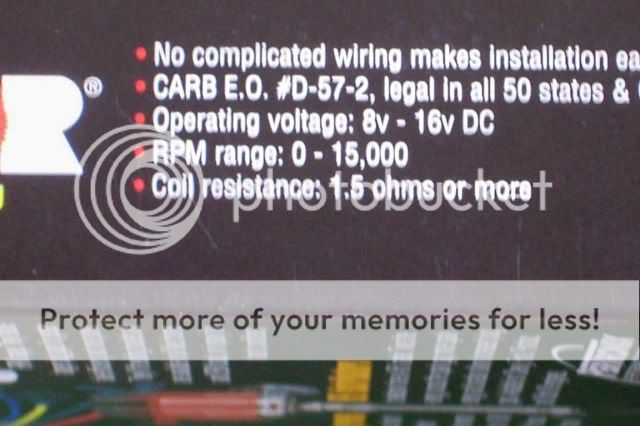
Assuming that Pertronix knows their product and it's requirements in addition to a 12 volt 3 ohm coil, you can use the Pertronix with a 1.5 ohm coil as long as the coil is being fed at least 8 volts, according to what they have printed on the product container.

PERTRONIXvolts.jpg
 
SPACER said:
I am not sure that adding a resister in the circuit would help as it would reduce the voltage drop accross the coil.
I'm missing your point here. Of course it would help reduce the current to what the Pertronix and coil are designed to handle. I've run a lot of miles with a 1.5 ohm coil plus a ballast resistor, it works just fine.

<div class="ubbcode-block"><div class="ubbcode-header">Quote:]For what it is worth, a lot of guys have installed Pertronix ignitor ignitions without changing coils. [/QUOTE]
Yes, of course. The whole concept is that the Pertronix module works with the same coil and resistor (or lack thereof) as the points that it replaces.

But your original coil was a 3 ohm coil; someone has installed the wrong coil on your car. If that combination was used with points, the point life would have been severely shortened as well. I have even seen the rubbing block melt (disabling the car), due to the extra current.
 
poolboy said:
you can use the Pertronix with a 1.5 ohm coil as long as the coil is being fed at least 8 volts, according to what they have printed on the product container.
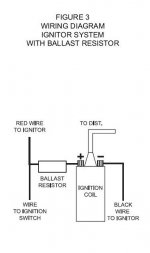
That rating is for the Pertronix module, not the coil. Pertronix instructions are quite clear that the module should not receive power through the resistor.
 

Attachments

  • 29589.jpg
    29589.jpg
    22.6 KB · Views: 202
SPACER said:
I am not sure that adding a resister in the circuit would help as it would reduce the voltage drop accross the coil.
A "3 ohm coil" is just a 1.5 ohm coil with a built in 1.5 ohm resistor. it makes no difference what so ever if the resistor is inside the case or outside.
 
Ballast vs standard, internal vs external is not the point here so much as...

<ul style="list-style-type: disc">[*] limiting the current through the low-tension circuit to what the electronic module can handle, and
[/list] <ul style="list-style-type: disc">[*] insuring that the electronic module is supplied sufficient voltage to operate properly.
[/list]
I have seen what is printed on the Pertronix packaging and I have seen the instructions Randall posted. They do not have to be considered as contradictory but the packaging notes can be misleading. If you wire as shown in the schematic you will have no problem supplying the ignition module the full system voltage it needs.
 
Back
Top