• Hey Guest!
    British Car Forum has been supporting enthusiasts for over 25 years by providing a great place to share our love for British cars. You can support our efforts by upgrading your membership for less than the dues of most car clubs. There are some perks with a member upgrade!

    **Upgrade Now**
    (PS: Upgraded members don't see this banner, nor will you see the Google ads that appear on the site.)
Tips
Tips

TR2/3/3A idle wandering TR3a

Jim Lee

Jedi Trainee
Offline
As far back as I can remember I have had a wandering idle. It can wander as much as 200 rpm which is why I try to keep
the median idle at 1200 instead of something more normal like 900. I have been able to run like that but I have always wondered what is at the root of this wandering. My first notion is that this is an air leak somewhere in the system. I would think that the
most obvious suspect would be the huge gaskets that separate the carbs from the manifold. Besides the air filters which I have
removed from the equation for testing purposes. If I spray starting fluid on these gaskets the idle will raise maybe 100 rpm but
nothing extraordinary. Should I be spraying PBlaster on them as a better test of its porosity? Those gaskets are so substantial it is
hard to imagine that any leak could occur.

Is there any other place I should check that would be a usual suspect for this idle wander? I cannot think of any other place
that air could be leaking on the intake side. I have the tube that goes from the distributor to underneath the right carb fully
inserted.

Thanks very much,
Jim Lee
 
I rounded up the usual suspects by spraying oil on the various weak spots.
Like the throttle shaft and the connection between the carbs and the manifold and various other
places. One thing that I did find was that my right, and possibly left, carb seemed to be leaking
fuel from the bottom at the nut just above the mixture nut. I spoke to Dave at TRF to find out what
seal was there and he told me there is a cork seal that can get old and die. I have ordered the
less expensive carb rebuild kit ($39.99) which is the only way to get that cork seal. He recommended
that I remove the carbs (once again) and take them completely apart and replace all the seals
that I have in the kit. I am thinking I might try to just replace that bottom seal on both
carbs with the carbs in situ.

I am hoping that this small fuel leakage might be at least part of my wandering idle mystery.

I will keep you all posted and if anyone has replaced that bottom most cork seal I would
really appreciate any 'best practices'.

Thanks very much,
Jim Lee
 
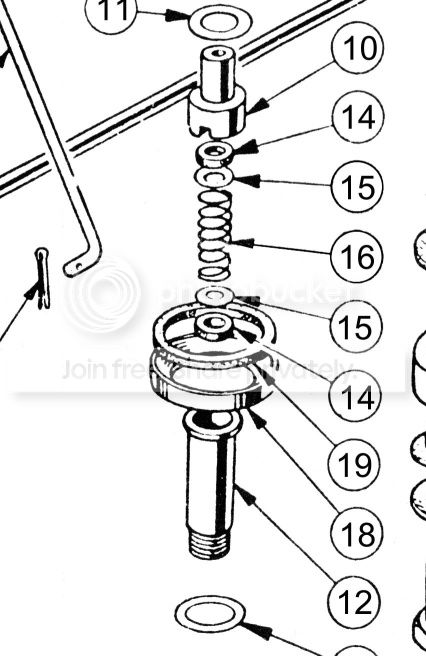
Are you talking about the larger cork ring, item 19 in this diagram?
PLATEGSH6CARBSCOOKED.jpg


If so, I don't think it will affect idle at all. Also, TRF does have it listed separately. The Stanpart number was 108312, which their parts database has cross referenced to SUAUC2118 for $.95/each.

It can be replaced without removing the carbs, but don't forget you will have to center the jet afterwards. (That big nut is what clamps the jet in place.) As long as you have the jet out, I would certainly replace the two smaller cork seals (item 14) as they are usually the ones that wear and leak.

When you say the idle wanders, do you mean it goes up and down on it's own, with the car just sitting still? Or that it varies with conditions, like trying to die at stop lights? If it moves around on its own, then I would be look at ignition first. Whatever vacuum and/or fuel leaks you have, they aren't likely to come and go on their own; but it is quite possible, for example, that the distributor shaft is loose in its bushings and waving around (changing the point gap and timing).

Also, have you check the accuracy of the tach? Not unusual for them to read high by 500 rpm or more.

Is the engine stock? No 'hot' cam, etc? I used to run a "3/4 race" cam that would pull like a train over about 3300 rpm, but had a definite lope at 1200. Always sounded like it needed a tune-up.
 
1200 is a very high idle. You may be opening the vacuum port so the vacuum advance is kicking in and out and varying the idle.

Also, the thick plastic thing is a heat insulator. It should not be a gasket, but rather have a separate gasket on either side of it...one against the manifold and the other against the carb. If you get ANY rise in rpm while spraying ether around these insulators, you have an air leak there.

The fuel leak from the needles is annoying, but is not affecting the idle speed.
 
Guys,

"When you say the idle wanders, do you mean it goes up and down on it's own, with the car just sitting still?"
Yes. It will be sitting in the garage with me under the hood and it really is almost like
listening to the waves wash up on the beach. It is not a sudden jerky move to idle but slow
,and although I don't think you could set your watch to it, rhythmic.

"If it moves around on its own, then I would be look at ignition first."
I get that. Maybe it's time to retry a Petronix substitution? Would that compensate
for distributor shaft movement? Would I be able to feel the shaft move in any practical
way by hand? If shaft movement is the problem is this something that a machinist could
measure for me and/or fix by putting in a new bushing?

I think though that I have also had vacuum leaks that would lope. Come and go like the waves
at Malibu. For various reasons it would open, then close, then open...etc.

My ignition has an interesting history in that I replaced the points with a petronix ignition
which has worked wonderfully on another old points car I have but caused me no end
of frustration on this car. I would be driving for maybe 20 minutes, long after getting
up to temperature, and then it would start missing like it was running with two cylinders,
then it would die. This left me on the side of the road too many times. I finally
took someones advice on this forum to reinstall the points. Problem gone. That really confused me
because the reason I was thinking that it could not be the electronic ignition is
because I thought that would either work, or not. No in between as in when it went down
to 2 cylinders firing before it quit. My best guess now is that there was a certain heat threshold
that my particular Petronix would get flaky at and then just give up the ghost. I would tow it
home and after it cooled down it would start right up again.

I don't even need the tach to tell me that I have a changing idle. You can hear and feel it very
clearly. I just use the tach to see how much the change is.

"Is the engine stock?"
Absolutely.
---------------------------------------------------------------------------------
"1200 is a very high idle. You may be opening the vacuum port so the vacuum advance is kicking in and out and varying the idle."
If I do not set it at 1200 I run the risk of it going so low that it stalls out. 1200 hundred is about 300 rpm higher
than I would set it at if I could keep it steady. I would be happy with a variation of 100rpm. Right now it is about 300+.

"1200 is a very high idle. You may be opening the vacuum port so the vacuum advance is kicking in and out and varying the idle."
Now I remember. I thought that was a little thick for a gasket. Which would be a better test, spraying oil or
starting fluid. Is starting fluid more sensitive to finding leaks?

Thanks very much all. I will keep you posted.
Jim Lee
 
In my experience with SU and Stromberg carbs - especially with an MG TD - idle speed tends to vary with air temperature - lower when cold, higher when hot.Every Spring and Fall I would have to re-adjust the idle speed. The TR6 is not as bad.
 
Let me see if I can describe as specifically as I can how my TR is behaving...and include a video showing the same.

* First thing in the morning it will not start on its own. I have to give it a couple of shots of starting fluid. After that
first start it will start up almost immediately.

* Because the choke is all the way pulled out it will be revving way high. I then have to very carefully push the
choke in and if I do this too quickly it will stall out.

* If I can now get the idle to a reasonable place like 900rpm, with the adjustment screw all the way out so it is not
touching the cam, then it will act as in Video #1. Some oscillatingi and then a dive down to die that appears
pretty random to me.

Video #1 Many apologies for the lack of focus on this. I have not learned how to do that yet with my camera.
This is a pretty classic example of my TR fading out on me after waving the idle up and down for a while. This usually
happens when the engine is not up to temp (185+). The numbers that it is bouncing between before it dies are
800 to about 900rpm.
I have other videos but they take so long to upload I am going to start you all out with this unfocused gem.

Thanks very much,
Jim Lee
 
It sounds like an air leak. My engine will tick along at 500 rpm and I have no worry about stalling. The fact it won't start cold also says air leak. The carbs are not getting enough suction to draw fuel.
 
This was decades ago ('60's). My TR3 acted similarly after (what was guessed as) a backfire through the carburetors created a small tear in the manifold gasket. It had the dealership mechanics scratching their heads for a bit. A new gasket was installed and a steady idle returned.
 
"If it moves around on its own, then I would be look at ignition first."
I get that. Maybe it's time to retry a Petronix substitution?
An easier test is to just hook up a timing light and watch what the timing mark does under the light. If the problem is shaft wobble, the mark will jump around.

Would I be able to feel the shaft move in any practical
way by hand?
Yes. Grab the end and try to wiggle it from side to side. If that is the problem, it will move a lot, easily more than enough to feel.

I think though that I have also had vacuum leaks that would lope. Come and go like the waves
at Malibu.
After reading more information (can't see the videos until later tonight), that is my thought too. Especially the part about needing more than full choke to start.

That really confused me
because the reason I was thinking that it could not be the electronic ignition is
because I thought that would either work, or not. No in between as in when it went down
to 2 cylinders firing before it quit.
I've had lots of electronic ignitions that got flaky in various ways, for various reasons. My favorite I think was the MSD that would cause the engine to just die, always only after driving 2-4 miles on a cold morning and always only at idle. It would then refuse to work at all for anywhere from 5 to 30 seconds (usually just long enough to get the hood open) and then work fine all day, including when I started the car at noon and again at 6-8 PM to go home.

But I also had a Crane that would just miss a beat (or two or three or four) when it felt like it and then go back to running OK (or not). Sometimes it would run on 2 or 3 cylinders (but not always the same 2 or 3). Never quite quit entirely, but sometimes the engine ran too rough to drive. Then in a few minutes it would smooth out (but usually not back to perfect).

Somewhere I've got a photo taken in a friend's driveway, on the way to VTR 2000 in Oregon, where I yanked the Crane out and put back points (which ran perfectly the entire trip).

"Is the engine stock?"
Absolutely.
Just a thought.
 
I just replaced the exhaust manifold gasket.

I would consider a distributor rebuild but I would rather
avoid the time and money involved until I have
a feeling of confidence with a diagnosis. I am trying to
avoid my past habit of throwing parts at a problem.

If I put a Petronix electronic ignition back
in would that remedy shaft slop? If so I will get that.

I also am suspecting an air leak. I tested
the usual suspects by spraying starter fluid on thr throttle shaft
and nothing doing there. Same with carb to manifold.
I need some leads on other suspects to round up.

I need to know where else I can check for an air leak.
I have the vacuum advance hooked up correctly.
Where else could unintended air being sucked from?

I am also going to dynamically set my timing to various
degrees starting with the 4 degrees I see in my manual
and see where that gets me.

My test drive was really nasty. Huge hesitation on acceleration.
I would put my foot down and there would be a pregnant pause
before the revs came up. Once it warmed up it idled in the
garage pretty steady. When I was driving it was like it chose
a different rpm to go to everytime I stopped. I think
I have some slop in my accerlation mechanics. I know that
feel movement in the ball joints. I tightened all the screws
that looked like they might tighten up the joint but
it seemed to make no difference. Any advice on
inspecting that mechanical setup would be most appreciated.

I think my main task now is to find an air leak.
Unfortunately I do not know where to look other
than the 'usual suspects'.

Anotheor reason I think it is an air leak is the
pregnant pause on hard accerleration. I am guessing
that it is taking longer than usual for air to get
sucked in the correct place. Or to put it another way
there is some secret hiding place that is sucking in air
where it should not be.

Thanks very much,
Jim Lee
 
Time to regroup.

Remember me saying I did not want to rebuild my disrtrib?
I am considering it a miracle that I got the car running at all.
I took the cap off to see if everything was kosher and the
distrib shaft turns freely.. I know that ain't right. And I discovered
that I do have a Petronix ignition on this car.

If anyone has any ideas on how or why this may have happened
I am all ears. I am nothing more than a shade tree mechanic (actually looking for shade most often) but I have never seen this before. I cannot believe how much I am learning about my tr3 <ironic emotican>

Thanks Jim (distributor-less) Lee
 
How would one who knows what they are doing analyze this distributor. Is there a way to do
it in situ? I am assuming I will have to take it out. I need to find out if I can resurrect this distrib
and avoid the high cost of distributors today. If it is sheared...why? I am hoping old age it being one year younger than me which is pretty old.

Thanks,
Jim Lee
 
The distributor need work..It's what I would consider specialized if you want it done right and back to specs..
I gave you a link to Jeff Schlemmers operation (Advanced Distributors)..give him a phone call. He's pretty good about answering questions over the phone.
 
Thanks Poolboy.
They have a 3-4 week wait on rebuilds which bums me out.

I was looking at some rebuild instructions and it looks like deep water for me BUT stranger thinigs
have happened then me working on something I know nothing about.

Could there be some other root problem that caused the key to bust (I am assuming right now) or does it just take Father Time
54 years to give it up?

Thanks,
Jim Lee
 
Jim, I think this has to be another false alarm. If the shaft really "turns freely" then there is no way that the engine could run. However, the rotor end is supposed to be able to turn a small amount, around 20 degrees or so, against the springs in the centrifugal advance mechanism (which may be too weak to feel for part of the rotation) and the backlash in the gear drive.

Unlike some other engines, on the TR2-4 the distributor drive dog sits directly into the same gear that engages the camshaft. There is a Mills pin that locates the drive dog on the distributor shaft, but it is very unlikely that it would shear (and the engine would quit running instantly if it did). I have seen TR distributors that were badly torn up inside (to the point of breaking the outer housing) without ever shearing that pin.

In fact, the only time I have ever seen that pin sheared was on a Ford motor where the gear was mounted directly to the shaft and the oil pump drive came off of the same gear. It's oil pump had sucked up some debris, locked up and sheared the pin (a roll pin in the Ford's case), which stopped the motor instantly. (I got the car for less than the tires were worth, because it "wasn't worth fixing". Cleaned the pump, replaced the pin and drove it home.) When something similar happened to a previous TR3A, the pump shaft sheared and the engine kept right on running. (Fortunately I heard the change in sound and got it shut off before any serious damage from lack of oil pressure.)

For a first-level, on-car test, hook up a timing light, start the motor and watch the timing mark under the light as you slowly rev the engine up. If the mark moves smoothly to the right without skipping all over the place; and back to the left as you let the rpm back down; then the mechanical part of the distributor is almost certainly fine. If the mark seems to skip around, or flops over and back, or doesn't move at all, then you've got a problem.
 
Good point, Randall. Jim, I bet you have lost the springs on the advance and are just feeling the play in the advance mechanism. If it only turns freely a small distance, like 20 degrees, then that is what happened. The good news is that this is not a big deal to fix. If there are no springs, the advance could bounce back and forth as the engine runs...which can also account for the drift in the idle.
 
Back
Top