• Hey Guest!
    British Car Forum has been supporting enthusiasts for over 25 years by providing a great place to share our love for British cars. You can support our efforts by upgrading your membership for less than the dues of most car clubs. There are some perks with a member upgrade!

    **Upgrade Now**
    (PS: Upgraded members don't see this banner, nor will you see the Google ads that appear on the site.)
Tips
Tips

TR2/3/3A Hydraulic supply lines from reservoir..replace with flexible

GeezerJarhead

Freshman Member
Offline
I was going to bleed the slave cylinder and found the lines and reservoir cruddy. Broke one line when removing. Not looking forward to bending the "pretzel" shape of the new ones from Moss. Any suggestions on replacing them with flexible lines Thanks for any help!
 
The ones from TRF come pre-bent. A bit confusing, they fit the opposite of what the SPC lists ("brake" line fits clutch side and vice versa), but that is apparently because the reservoir moves to the other side for LHD. They even have original style nuts on them.

TSI will probably make up flexible lines for you; but they weren't included in the set. You'll have to call and ask if they can do a special for you.
https://www.tsimportedautomotive.com/tr3_tr4a.html

Here is another source, but you will probably have to give them the exact specifications (diameter, length, thread, fitting type, etc)
https://ormebrothers.com/
 
Last edited:
TRF sells the reservoir. 10+ years ago, only MOSS had the pre-bent lines, and I bought both clutch and brake lines. Had to put a copper crush washer in one of them to cure a leak with the rebuilt original master cylinders.

I’ve rebuilt both master cylinders since then, and no problems with either lines.

In your position, I’d try the pre-bent TRF lines. In most instances, I prefer the TRF offerings.
 
Then perhaps I should explain about TRF : They don't really publish a full catalog of all the TR3 parts they carry. Only a couple of "mini" catalogs are available either in print or on their web site. They carry much more than is listed in those catalogs.

So to find out if they have something in particular, you first look up the factory part number in the factory Spare Parts Catalogue (SPC). There is a downloadable PDF at https://drive.google.com/open?id=0B2H2NJt34OffMWQ4N2EzZGQtNjc0Ny00YmE2LWFiN2UtZWYzMjNjNGFiYzY4
or TRF will be happy to sell you a paper reprint (under the factory P/N 501653 of course :smile: )

Then armed with the factory part number, you can go to TRF's on-line database at https://secure.zeni.net/trf/ and search for it by part number. So, for example, the line from the reservoir to the brake MC is P/N 505063 (remember, I said the numbers are swapped between brake and clutch for LHD cars). You should get something like this
t76Ynsk.jpg

If the "Status" field shows "CUR", then the part is available to order. Almost always, it means they have one on the shelf (or think they do), but occasionally it means they are expecting one soon.

There's more, but that should be enough to get you started.
 
Thanks again, I did order them and found their web site easily navigable, even for an ancient. Do you happen to know if the master cylinders they sell come with the "innards" or must one buy the kit and rebuild them? I was unable to determine that from the description...I am betting on the latter.
 
I don't know for a fact (never bought one), but I'm reasonably certain the tanks come as an assembly. The SPC doesn't even list the "innards" as available separately. And TRF is usually very good about that; if what they are selling is not the same as original, it's listed under a different number with a cross-reference from the original number.
 
Thanks, "Pumpkin"...your are great to have patience...I'm going to order a new MC from TRF and will let you know if your theory is incorrect.
 
I'm sorry, misread your question. I thought you were asking about the reservoir rather than the cylinder itself. Yes, the cylinders come assembled; the rebuild kits are only for those of us who want to replace the seals without replacing the entire cylinder.

BTW, the "Great Pumpkin" thing is supplied by the forum, based on number of posts I believe. I have no other control over it.
 
Last edited:
Sorry bout the "Pumpkin" reference...not trying to be smart..I do appreciate your help. The reservoir and MC are both "Gunked" up with a black residue. Am expecting to have to hone out the MC if I were to replace the seals and then question whether they would hold pressure. What do you recommend using to hone them out? I have a hone i used on engine block cylinders but the stones may be too course?
 
No worries about "Pumpkin", just wanted to explain. I use a small 2-jaw hone like this
https://www.amazon.com/OEMTOOLS-250...eywords=brake+hone&qid=1553961988&s=hi&sr=1-3
fitted with fine grit stones like this
https://www.amazon.com/OEMTOOLS-253...s=brake+hone+fine&qid=1553961892&s=hi&sr=1-31

Go easy on the pressure, plenty of lube, and let it develop kind of a slurry at the end

These cylinders are really soft (at least compared to steel or iron) and corrode easily when combined with a steel piston and conventional brake fluid. If you can see that the bore is significantly pitted in the area where the seal rides, it's probably better to replace the cylinder.

PS, forgot to mention : the bore is not straight all the way down. It deliberately gets smaller near the bottom. But the seal doesn't go down that far, so no need to worry about it.
This diagram is for the later Girling MC with integral reservoir, but the bore profile and internal parts are the same
qT8vMzO.jpg
 
Last edited:
Whoa...you were right! I "bored" them out way beyond the specs for the cups...will now proceed to order new MC s..both the brake and clutch. That is soft metal, like pot metal.
The 200 grit was more aggressive than I thought...my hone has three stones...but did fit. I should have read your post before proceeding. Is Gurling refit an option? I like the idea of separate reservoir? Thanks for the good help and diagram! Sorry I didnt heed your good advice before boring out the MCs to .0015 over.
 
Last edited:
Hmm, seems my previous reply got lost somehow.

I don't know if there is room for both TR4 master cylinders on the TR3 bracket or not. Seems to me that maybe the cylinders are spaced just a bit farther apart on the TR4, and they still come close to interfering with each other.

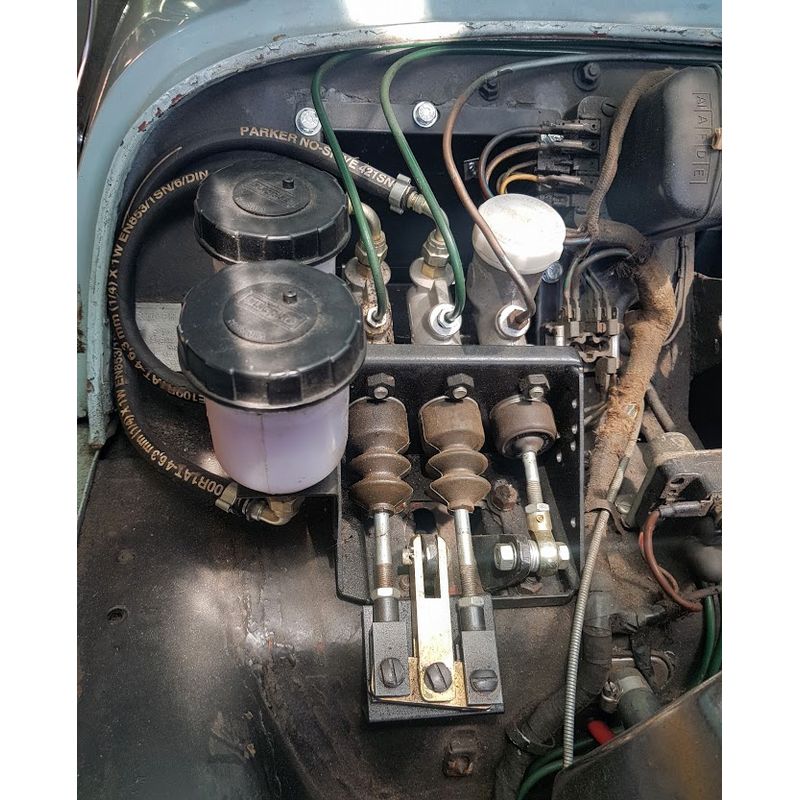
But you could certainly add separate reservoirs if you want. Similar to what's been done here:


Note that the original single reservoir does have a divider inside, so a leak in the clutch can't rob the brakes of fluid (and vice versa).
 
That is a clean looking layout! Your previous post did not get lost, I jumped the gun and honed the cylinder before reading it..dummy. I noticed the photo had flexible lines. Are they made by TSI?
 
That photo is from Revington in the UK https://www.revingtontr.com/tr3/fue...utch/dual-circuit-master-cylinder-kits-tr2-4a

I'm not sure where those reservoirs came from, but the cylinders look to be Wilwood items (Wilwood carries a lot of the old Girling pattern stuff)
https://www.wilwood.com/search/partnosearch?q=compact+remote+reservoir+master+cylinder

I poked around on Ted's site but didn't see anything similar listed. Couldn't hurt to ask, though. I'm pretty sure he has access to the components, but maybe hasn't developed an off-the-shelf kit like Neal Revington has.
 
Good information! I did spend some time on both of those web sites, Interesting and great products but a little more expensive than I was anticipating. I found the MC and lines on TRF and am now trying to blow all the crud out of the lines. I used some penetrating oil to soak the metal lines and blew them out with air but still have residual black contamination. Will do it again and flush with Dot 4 before attaching the new components...make sense?
 
Yeah, Revington does run a bit on the high side. But from what I've heard, his products are well engineered and top quality.

Penetrating oil is something I wouldn't want to have even traces of near my brake seals; so I would suggest an intermediate flush with something less capable of attacking the seals. Long ago, I bought a bottle of methanol just for this purpose, because it is supposedly fully safe for the seals (plus of course it evaporates easily and cleanly). But you could also use "brake cleaner" from FLAPS, Wal-mart, etc.

Actually, if the lines are that badly contaminated (or even maybe if they aren't), I would seriously think about replacing them. Even the steel hard lines don't last forever in this application, and it's really, really unpleasant to lose your brakes. I lost the TR3A I brought with me when I moved to CA, after a rather, er, exciting ride down a steep hill into an underground parking garage with no brakes (and no exit from the garage except back the way I came). Caused, I believe, by one of the hard lines rotting through while the car was parked on top of the hill. You can also get unpleasant (and dangerous) failures from old soft lines.

And replacing the whole mess doesn't cost much at all. Moss sells a nice hard line kit in "Cunifer", an alloy developed by Volvo for better corrosion resistance in brake lines than steel; for $130
https://mossmotors.com/brake-pipe-set-late-tr3-3a-3b?assoc=70534

Ted's "braided SS" soft lines are also a nice upgrade, IMO
https://www.tsimportedautomotive.com/tr3_tr4a.html
 
Thanks again..glad you made it past the brake failure. Since this car is going to my Granddaughter, I will make sure she has brakes. I was going to flush the lines with alcohol before adding brake fluid. The brake cleaner I have is in a pressurized can. Great for spraying but not to pour into lines. So $130 is a bargain for insurance against failure. I suspect I'm going to need to replace one or more wheel cylinders as well.

What is the proper brake fluid? I see that some folks recommend Dot 5 synthetic while others seem to be OK with Dot 4?
 
We've debated brake fluid endlessly, with much passion on both sides. Personally, I'm a big fan of DOT 5 silicone fluid; but I wouldn't say that Castrol brand "LMA" DOT 4 is "wrong".

If you do run DOT 4 though, it needs to be periodically changed, as it will absorb moisture from the air which makes it boil easier and become corrosive to brake components. DOT 5 should be good for 10 years or more (as long as it doesn't get contaminated by rain or other FOD falling into the reservoir).

There is an old article at https://www.buckeyetriumphs.org/s/Selecting-Brake-Fluid.pdf that I think fairly goes over pros and cons of both types. (In spite of the date in the corner, the article was written in 2002. Yes, you'll see my name mentioned.)

Don't be fooled by the "synthetic" label. All brake fluid is synthetic, it's not made from crude oil. The label is just a marketing ploy. Also beware of "DOT 5.1", which is NOT silicone. Although the specs are better, it still suffers from the same ills as DOT 4, namely sucking water from the air and eating paint when it gets loose. By DOT rules, if it's DOT 5 silicone, it has to say "silicone" on the front.

PS, many years ago, there was a problem with using non-Castrol fluids with British brake systems. The problem was real (although also somewhat contested, we didn't have the Internet to get into a proper flame war over it :smile: ). No one has mentioned it for a long time, so my theory is that the currently available seals ("currently" meaning the past 30 years or so) will work and play well with other DOT 3/4 fluids. Still, Castrol is a good brand and is readily available, so why take a chance?

 
Back
Top