Hey Guest!


 Hey - did you know if you click on the title of a thread it will take you to the first unread post since you last visited that thread?
 but were afraid to ask:
  STOP!! Never post your email address in open forums. Bots can "harvest" your email! If you must share your email use a Private Message or use the
  smilie in place of the real @
 Pretty Please - add it to our Events forum(s) and add to the calendar! >>
TexasKnucklehead
Jedi Knight

Offline
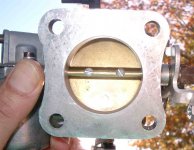
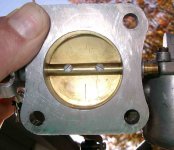
If you've looked at my unisyn post, you know I'm adjusting HS6s on a TR3. I noticed as I reworked the linkage to center pull, that the butterflies on both carbs did not exactly align the same way to the adjustment/stop mechanism (throttle return lever). When balancing, I found the front carb idle adjustment screw ended up so high that it doesn't contact the lever (butterfly completely closed). The rear carb idle screw was used to synchronize to the front carb, then the linkage synced. (And checked at a throttle activated position.) So, basically, the idle cannot be dropped below 900RPMs. Is this a problem? And if so, how could I possibly drop the idle speed?
After fiddling with the jet adjusting nut, I used "color tune" and think I have it running pretty well. Both jets are set 17 flats from the top. It starts quickly and idles smooth with a nice blue color on the tuning plug. As soon as I get the tub finished and put back on, I'll take it for a ride to see how well it performs, but for now, I'm happy.
After fiddling with the jet adjusting nut, I used "color tune" and think I have it running pretty well. Both jets are set 17 flats from the top. It starts quickly and idles smooth with a nice blue color on the tuning plug. As soon as I get the tub finished and put back on, I'll take it for a ride to see how well it performs, but for now, I'm happy.