
• Hey Guest!
    British Car Forum has been supporting enthusiasts for over 25 years by providing a great place to share our love for British cars. You can support our efforts by upgrading your membership for less than the dues of most car clubs. There are some perks with a member upgrade!

    **Upgrade Now**
    (PS: Upgraded members don't see this banner, nor will you see the Google ads that appear on the site.)
  • When posting a classified ad, you MUST select a prefix from the drop-down next to the subject line. If you don't you will get an error and your ad will not be posted!
Tips
Tips

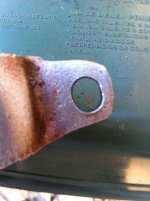
how would you fix this?

doughairfield

Jedi Trainee
Offline
I've been noticing some play in my clutch pedal when I push it in so I took the whole pedal assembly out and cleaned it up this weekend, hoping to tighten everything up a bit. I've not been able to figure out a good fix for this reamed out end of my clutch pedal where the clevis pin passes through and connects the pedel to the fork on the master cylinder. Any suggestions?
 

Attachments

  • 23215.jpg
    23215.jpg
    46.2 KB · Views: 524
Doug ,I tink yo will have to weld the hole solid,grind flat on both sides and drill a new hole.
Have fun
Tom
 
If it is unseen I've had luck on some other things welding a washer on both sides that has the correct size hole and in the right location.
 
I have used both of the above methods. You don't have to weld the whole hole shut... weld is hard to drill through. You can drill that clevis hole out to the next standard size for which you can buy round stock at the home center. Then cut a disk of steel from that round stock and tack it in place in the drilled out clevis hole. File the tack weld flat with the sides and finally drill out the plug to fit the clevis pin.

The washer method works well also but you generally have a bit less surface area and you may or may not be able to use this method depending on the pushrod for your master cylinder. If you can use the washer method, it is much faster than plugging and re-drilling the original pedal.
 
Great ideas on how to fix the hole. I would also look at the slave cylinder pushrod and clutch shaft. Those holes may look the same. The pins will be worn also.
 
All good suggestions. I've also had good luck just reaming the hole back to round and making a sleeve/bushing to fit inside it. Most hobby stores sell thin wall brass tubing that works well.

On the Stag's clutch pedal (which is hidden under the dash unlike the TRs), I found a metric bolt with a slightly larger smooth shank, and reamed the holes in both pedal and clevis to match the larger "pin". Someday I may have to pull the pedal assembly out and "do it right", but it worked very well for a quick fix.
 
Very clever of ST to make the pedal of softer metal so it would not cause any wear on that $1.10 clevis pin.

I'll admit to fudging a bit on my TR3A to get around the slack caused by the ovalling of that hole by using bolts to limit the travel of the pedals (similar to adjustment bolts used on early TR3s).

TR3%20Stop%20Bolts.JPG


Wouldn't be suitable for Doug's TR4 but bought me some time until I get around to having it apart for one of the fine fixes noted above.
 
the other option would be to use brass as a bushing in a drilled out clevis hole. You can buy bushings at any reasonably well equipped hardware store. This option works well if your shop isn't equipped with the welder drill press etc.
 
Thanks for all the suggestions. I fiddled with it a while, and was able to shape a thin strip of sheet metal to pass through the space between the clevis and the hole that has now become worn out. It's essentially a sacrificial piece I guess I'll have to change out at some point as it wears down.

Or until I get a welder and can fill that hole in.
 
Doug - I completed this exact repair a few months ago. With everything apart it is about a 15 minute job to weld the hole up, grind it smooth, and re-drill it. Just do it. Do it once and do it right. Don't fuss with any other jury-rigged fixes.

85464-s-0.jpg
 
Back
Top