

-
 Hey Guest!
British Car Forum has been supporting enthusiasts for over 25 years by providing a great place to share our love for British cars. You can support our efforts by upgrading your membership for less than the dues of most car clubs. There are some perks with a member upgrade!**Upgrade Now**
(PS: Upgraded members don't see this banner, nor will you see the Google ads that appear on the site.)
You are using an out of date browser. It may not display this or other websites correctly.
You should upgrade or use an alternative browser.
You should upgrade or use an alternative browser.
TR2/3/3A How would you de-gap these gaps?
- Thread starter bnw
- Start date

bertl
Member
Offline
I assume that your outer sill is already welded into place along with the A&B posts, and you have used a straight edge along the bottom of the door from rear quarter panel to the front fender and this shows no gaps ? and you've aligned the front fender to it's best fit to door. No adjustment on the frame spacers ( outriggers and spacers on frame in engine compartment) is going to change your alignment on the door because everything is attached to the inner sill. The only option I see is - get your vertical body line on the r-quarter panel straight first, work your way forward and use a small dia rod (you can bend it to conform to the door edge) to match the door panel thickness and tack weld it along the edge of the door and grind back to get your gaps. This requires a lot of door on-off checking but if everything else is welded into place then you only have the door edges to work with.
I'm in the middle of the same problem but my situation is that I have just tack welded the A&B posts to frame while fitting the outer sill. I remove and install the door to check my alignment. I also have the lower fender patch panel to contend with in my process.
Hope this helps
Bert

CJD
Yoda
Offline
You are sooo close!
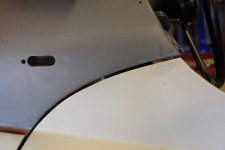
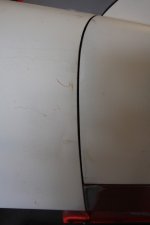
The spacers will only help with the rear door gap at this point. It appears just a tad larger at the top than the bottom, so an extra shim at the rear of the body could even that. It is so close though, that it would not take much.
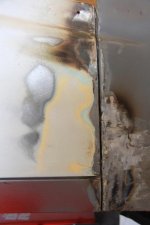
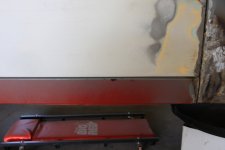
The lower door gap appears good across the bottom till maybe the rear 6 inches? For that, anything you do to move the door will not help. I would lean towards just a skim coat of body glaze on the rear top of the sill.
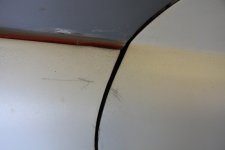
The door to scuttle looks similar to the lower door gap. It looks like good spacing, but just irregular. A skim coat of glaze on the bottom of the scuttle looks like all it would take to even it out.
Are you happy with the front door to wing gap? In the pics it's hard to tell...it really looks pretty good. If you don't like it...the hing would need to be compressed to tighten it up...which will increase the rear door gap...which means more edge welding on the door. In the pic, I don't think it looks bad the way it is.
You've come a long way...great work!
The spacers will only help with the rear door gap at this point. It appears just a tad larger at the top than the bottom, so an extra shim at the rear of the body could even that. It is so close though, that it would not take much.
The lower door gap appears good across the bottom till maybe the rear 6 inches? For that, anything you do to move the door will not help. I would lean towards just a skim coat of body glaze on the rear top of the sill.
The door to scuttle looks similar to the lower door gap. It looks like good spacing, but just irregular. A skim coat of glaze on the bottom of the scuttle looks like all it would take to even it out.
Are you happy with the front door to wing gap? In the pics it's hard to tell...it really looks pretty good. If you don't like it...the hing would need to be compressed to tighten it up...which will increase the rear door gap...which means more edge welding on the door. In the pic, I don't think it looks bad the way it is.
You've come a long way...great work!

Marvin Gruber
Yoda
Offline
They were never uniform to start with. If you don't do any more alignment they look pretty good. I seen a lot worse. Good job.
Marv
Marv

looks like you have not painted yet. Depending on the color, IE: dark colors, the gap would not show as much, light colors it will, plan for paint thickness. I did not plan for enough, and had to come back and file down some areas. The opening of the door needs almost an 1/8 inch.
Jerry
Jerry

M_Pied_Lourd
Darth Vader
Offline
I think that they look pretty darn good as is.
Cheers
M. Pied Lourd
Cheers
M. Pied Lourd
WOW! Thanks for all the great words of encouragement! I like Johns idea of using the body glaze. Are you referring to the tube of polyester "icing" I have but have but have yet to use? If so, would I be building up the leading edge by "glazing" the door edge and the surrounding areas as well? And as to Bert's questions, I "farmed" out the inner, outer sills land floors to a body shop several years ago. It was probably a mistake. Even though the body was braced and the sheet metal was installed, the shop really didn't know Triumphs and I've been fighting their work for years.


Offline
Personally, I'd be really nervous about using glaze or even filler to establish an unsupported edge like on a door. I'd be afraid of it chipping or cracking.
Personally, I'd be really nervous about using glaze or even filler to establish an unsupported edge like on a door. I'd be afraid of it chipping or cracking.
+1
TexasKnucklehead
Jedi Knight
Offline
...I'm no expert, but I can tell you what I did and how it came out.
It came out looking great, but that's just my opinion, and it did take a lot of time.
The door gap where you have the pencil arrows, at the top curve of the fender, needs to have the most space. When the door opens, it has to move past the fender edge without scraping off paint. Your gaps look fine, although the door/fender edge does seem to be uneven/inconsistent. The door (skin) edge is rolled onto the door frame. If you take some masking tape (or a fine line marker), you can lay out a more consistent line/gap that you would like it to be. Then you can remove the door, and use a hammer/dolly to roll the edge where you want it (assuming you can only move it towards the back -a larger gap). You can do the same with the edge of the fender (moving it forward). If you hammer it too much, or move it too far, the sheet metal will crack or separate. Then you have to carefully weld it back together, grind and reshape it. I used some plastic tile spacers to check all the gaps (all the way around) because you can't trust your eyes -or at least I can't trust mine.
The door bottom to outer sill can be moved with a block of wood and a BFH. It helps if you use a jack, or two to support places you don't want to move. I have a pre-60K, so my sills and door bottoms are curved (top to bottom and front to back) while the post-60K are more flat (front to back). I did not try to curve the new sill, instead, I matched the door to the sill (some bending and some filler). Once again, a block of wood can be hammered into the corner at the top of the sill and significant movement is possible. When it's all done, a skim coat of filler can hide the hammer marks (assuming they are not too big).
I see something on your car that looks like mine. Take a straight edge, and lay it down the B-post, where the sill is closest to the dog-leg (where the rear edge of the door closes). You need to be sure that outside line is straight all the way to the bottom of the sill. My dog-leg repair wasn't done exactly straight, and I didn't notice it until after it was painted. (Much too late.)
I used 3M seam sealer to close the gap between the sill and the dog-leg. It's supposed to remain flexible, but can be painted. It took several coats of primer to get it to look smooth, but I like the way it turned out. Many prefer to let that gap open.
Another thing to remember about door gaps is the amount of movement they might have after everything is together. By movement, I mean the door is closed and latched, but the flexing of the tub (whilst spirited driving) will create relative door movement. You should be able to pull the door up and down as much as the hinge will allow, without the edges of the door hitting the fender, cowl or b-post. -The latch can be set to disallow most downward movement, but it should be easy to open/close even if its on an incline.
It came out looking great, but that's just my opinion, and it did take a lot of time.
The door gap where you have the pencil arrows, at the top curve of the fender, needs to have the most space. When the door opens, it has to move past the fender edge without scraping off paint. Your gaps look fine, although the door/fender edge does seem to be uneven/inconsistent. The door (skin) edge is rolled onto the door frame. If you take some masking tape (or a fine line marker), you can lay out a more consistent line/gap that you would like it to be. Then you can remove the door, and use a hammer/dolly to roll the edge where you want it (assuming you can only move it towards the back -a larger gap). You can do the same with the edge of the fender (moving it forward). If you hammer it too much, or move it too far, the sheet metal will crack or separate. Then you have to carefully weld it back together, grind and reshape it. I used some plastic tile spacers to check all the gaps (all the way around) because you can't trust your eyes -or at least I can't trust mine.
The door bottom to outer sill can be moved with a block of wood and a BFH. It helps if you use a jack, or two to support places you don't want to move. I have a pre-60K, so my sills and door bottoms are curved (top to bottom and front to back) while the post-60K are more flat (front to back). I did not try to curve the new sill, instead, I matched the door to the sill (some bending and some filler). Once again, a block of wood can be hammered into the corner at the top of the sill and significant movement is possible. When it's all done, a skim coat of filler can hide the hammer marks (assuming they are not too big).
I see something on your car that looks like mine. Take a straight edge, and lay it down the B-post, where the sill is closest to the dog-leg (where the rear edge of the door closes). You need to be sure that outside line is straight all the way to the bottom of the sill. My dog-leg repair wasn't done exactly straight, and I didn't notice it until after it was painted. (Much too late.)
I used 3M seam sealer to close the gap between the sill and the dog-leg. It's supposed to remain flexible, but can be painted. It took several coats of primer to get it to look smooth, but I like the way it turned out. Many prefer to let that gap open.
Another thing to remember about door gaps is the amount of movement they might have after everything is together. By movement, I mean the door is closed and latched, but the flexing of the tub (whilst spirited driving) will create relative door movement. You should be able to pull the door up and down as much as the hinge will allow, without the edges of the door hitting the fender, cowl or b-post. -The latch can be set to disallow most downward movement, but it should be easy to open/close even if its on an incline.

trrdster2000
Luke Skywalker
Offline
I agree, unless you plan to jump into your car each time and never open the door. The only way to get a filler to stick on the edge of the door is to drill 1/16 inch holes all the down the edge and pack it in, it would work better on the pillars instead of the door itself.
Wayne
Wayne
CJD
Yoda
Offline
Definitely no glaze on the sharp edges of the door. It has to have a large base to adhere properly. The top of the sill and bottom of the scuttle are the only places it will work. No more than 1/16" thick, but I think all your gaps are within about 1/32" from the pics. Like I said, you are very close!
Offline
Definitely no glaze on the sharp edges of the door. It has to have a large base to adhere properly. The top of the sill and bottom of the scuttle are the only places it will work. No more than 1/16" thick, but I think all your gaps are within about 1/32" from the pics. Like I said, you are very close!
Are you talking about building up this area on top of the sill with glaze?

I just don't see that as likely to be a long-lasting repair.
M_Pied_Lourd
Darth Vader
Offline
On the 3A that I am working on, the gaps were pretty bad being that it was a vintage race car for quite a few years and it recieved some bumps and bangs over the course of it's career. I ended up welding in some metal rod on the rear edge of the fender and along the top saddle piece where it meets the door.
My gaps are still not perfect but are much better than they were...
Cheers
M. Pied Lourd.
My gaps are still not perfect but are much better than they were...
Cheers
M. Pied Lourd.
CJD
Yoda
Offline
Are you talking about building up this area on top of the sill with glaze?
I just don't see that as likely to be a long-lasting repair.
It will last as long as there is paint. It's not intended to repair...just about .03" thick to true that line.
There is an alternative. Beat the front of the sill down to straighten the line, but then the good gap will increase...so the door has to shift down, increasing the scuttle to door gap....so then youre edge welding the top of the door. Or, edge weld the door and grind it back to match the sill...and then rework the warpage you get from the heat.
This is one of those situations that you can spend 10 hours working the metal...for .03". Or add 6" of glaze that will take 10 minutes. I know what I would do!

Offline
I would love to learn lead! Be sure to post pictures. It's obvious from the bodies I've worked on that the factory used lead as a matter of course in several spots.
True enough, and the panel beaters of that period did too. It does take a bit of knowledge, skill and practice to get i right, it requires enough heat to warp things a bit, and, in my opinion, won't do anything that bondo won't do.
Having said that, I think that preserving the old skills is as important as preserving the old cars.
Tom