• Hey Guest!
    British Car Forum has been supporting enthusiasts for over 25 years by providing a great place to share our love for British cars. You can support our efforts by upgrading your membership for less than the dues of most car clubs. There are some perks with a member upgrade!

    **Upgrade Now**
    (PS: Upgraded members don't see this banner, nor will you see the Google ads that appear on the site.)
Tips
Tips

Holy Leakin' carbs, Batman

angelfj1

Yoda
Country flag
Offline
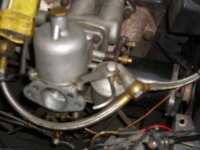
With less than 1000 miles on the clock, both carbs on the Grey Lady are leaking badly! The leak is at the point where the banjo bolt joins the float bowl to the carb body. See below.
carbLeak.jpg


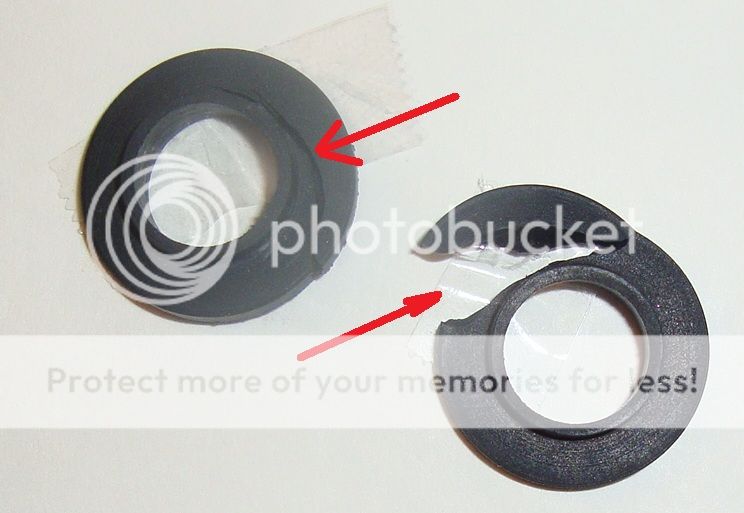
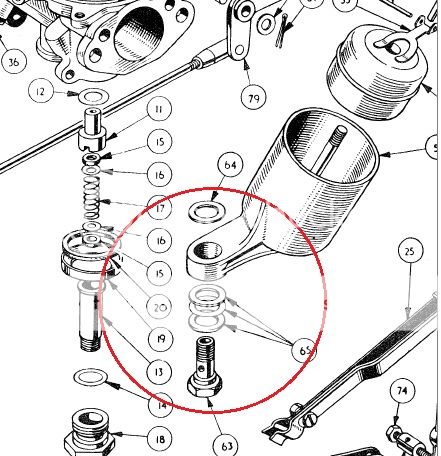
The washers identified as No. 64 & 65 on my carbs look different than what is shown here. Mine look more like a top hat, one on top and the other on the bottom of the banjo bolt joint. Upon close examination my washers look swollen and bulging out. The rear set are actually torn and hanging below the banjo bolt head.

Our first thought was the ethanol has attacked the rubber. However, the carb rebuild kits were sourced within the past 2 - 3 years. I would have thought that new carb seals and washers would be resistant to ethanol.

So, has anyone else had this problem? Could there be another cause for these seals failing?

Thanks, Frank
 
So how long did they last, Frank? I've had very much the same problem for quite a few years now, those rubber "top hats" never seem to last very long. I'm hoping that the heat shield I added a few months ago will help prolong their life.

ISTR Mark Macy was offering some uprated seals in poly, you might check with him.
 
TR3driver said:
So how long did they last, Frank? I've had very much the same problem for quite a few years now, those rubber "top hats" never seem to last very long. I'm hoping that the heat shield I added a few months ago will help prolong their life.

ISTR Mark Macy was offering some uprated seals in poly, you might check with him.


Well, have driven the car less than 1000 miles since June, but the engine was first run almost two years ago. So, that's how long the seals would have been exposed to ethanol.

Frank
 
That's about all I remember ever getting out of them. Of course we've been running "oxygenated" fuel around here for so long that maybe I just don't remember before that.

I note that Burlen/SU brag about their new ethanol-resistant floats; but don't say a word about those seals being improved ...
https://www.sucarb.co.uk/ProductDetail.aspx?Id=24382
 
Simmo said:
I changed to HS6 Carburettors and they work just great.

Simmo: do you have "only" ethanol blend petrol in Oz?

Why would changing to a different carb solve the problem?

Thanks,

Frank
 
go to your local NAPA and get copper washers, I feel that would solve the issue, I actually found copper washers at the ACE hardware, they usually have tons of fine thread bolts and special things too, they might also have fiber washers that would work too

good luck

Hondo
 
Hi, Frank,

I see that you have a TR3A. The picture that you are showing is for a carburetor for a TR2. The washer arrangement for the TR3-4 is different (there are two options here depending on if you use the stud or the bolt).

Take a look at p. 24 in the Moss catalog: parts 118, 116, 115.

You may know all this, but I just point it out.
 
angelfj said:
Why would changing to a different carb solve the problem?
The HS6 carbs are a later "improved" design that doesn't use those rubber 'top hats'. Instead the bowl is hard mounted to the carb body with a 'dry' connection, and there is a soft line that carries fuel to the jet (which also eliminates those troublesome cork seals around the jet).

They do use plastic floats, though, which have apparently been a problem for some people. Hence the 'unsinkable' floats on the Burlen web site. And although they will bolt up to the manifold, there are some changes required to the throttle and choke linkage. The vacuum advance port is on top instead of on the bottom, etc.
 
Anybody try HD6 carbs on a TR3A. I have a set and was wondering what the differences are. I know they don't have the cork washers or the top hats.

Jerry
 
Let me preface the following by stating I have no experience with the earlier H series carbs, only HS.

My thoughts were the same as Hondo's. Is there a reason you could not use copper or hard-fiber washers on the float bowl? Are they rubber to dampen vibrations or something? With good flat surfaces the fiber washers should more than be up to the requirements both in ethanol and heat resistance.
 
Frank's drawing is of a TR2 1.5" H4 carby with solid fiber washer mounted fuel bowl. These solid washers tended to loosen when the fuel line banjo bolts were being tightened. Of course Frank has a 3A with 1.75" H6 carbs which were fitted with soft rubber fuel bowl washers, and these were the problem. Early repro rubber washers were notoriously short lived, but recent improvements such as nitrile have helped.

The change to soft mounts was an attempt to lower bowl vibration and also to act as an insulator against fuel heat in the bowls, thought to contribute to fuel vaporization. A marginal improvement at best.

Early H6 carbs used a banjo bolt to attach the bowl to the body, but later versions from mid 1958 used a machined stud screwed into the carby body. The stud was an improvement on the banjo bolt, which turned inside the rubber washers when tightened. The limitation with the stud was a built in stop shelf to avoid over tightening. Both types of attachment can be shimmed to better compress the top hat washers.

Viv.

PS re Frank's query on Simmo's post - thankfully we have very litle e blend fuel in Oz.
 
Frank
Now that you mention it, I had EXACTLY the same experience after a complete carb rebuild. Got a new set of gaskets from Moss and has been fine since.
Gordon
 
Gordon_Dedrick said:
Frank
Now that you mention it, I had EXACTLY the same experience after a complete carb rebuild. Got a new set of gaskets from Moss and has been fine since.
Gordon

Hello Dedrick and thanks for your input.

What exactly did you get from Moss? Was this a special order or were the parts listed in their on line catalog? Finally, how long has it been since you replaced the parts. I apologize for all the questions, but you see our rebuild kits came from the same source, Burlen - SU.

Thanks, Frank
 
vivdownunder said:
Frank's drawing is of a TR2 1.5" H4 carby with solid fiber washer mounted fuel bowl. These solid washers tended to loosen when the fuel line banjo bolts were being tightened. Of course Frank has a 3A with 1.75" H6 carbs which were fitted with soft rubber fuel bowl washers, and these were the problem. Early repro rubber washers were notoriously short lived, but recent improvements such as nitrile have helped.

The change to soft mounts was an attempt to lower bowl vibration and also to act as an insulator against fuel heat in the bowls, thought to contribute to fuel vaporization. A marginal improvement at best.

Early H6 carbs used a banjo bolt to attach the bowl to the body, but later versions from mid 1958 used a machined stud screwed into the carby body. The stud was an improvement on the banjo bolt, which turned inside the rubber washers when tightened. The limitation with the stud was a built in stop shelf to avoid over tightening. Both types of attachment can be shimmed to better compress the top hat washers.

Viv.

PS re Frank's query on Simmo's post - thankfully we have very litle e blend fuel in Oz.


FWIW, I now have anecdotal evidence that Joe Curto and other carb specialists are using Viton and Nitrile washers. Will give Joe a call this week.
 
vivdownunder said:
These solid washers tended to loosen when the fuel line banjo bolts were being tightened. Of course Frank has a 3A with 1.75" H6 carbs which were fitted with soft rubber fuel bowl washers, and these were the problem. Early repro rubber washers were notoriously short lived, but recent improvements such as nitrile have helped.

Thanks. That is very interesting information and it is always helpful to have the history behind product changes.
 
Frank

My carbs were rebuilt by the "other SU rebuilder" out west. I decided on using him because he polished the domes @ no additional charge.....call me cheap, but I spent a couple of months admiring them before they ever got re- installed. I guess I drove the car for 3-4 months before I noticed the gas leak.... actually it was my wife "do I smell gas in the garage..again!!" I tried tightening the banjo bolt to stop the leak which is EXACTLY what you should NOT do. The gaskets need to be snug only to seal correctly. After a couple of weeks I broke down and bought the new gaskets from Moss, stock parts 370-021. Believe I must have gotten the first viton sets as I have not had a problem since. This is one of the more simple fixes!
Cheers
Gordon
 
Hey Frank if you look in the Moss catalog at the H4 for TR2 carbs you will see a float chamber support arm part # 133 that supports the float bowl. They are NA, but I made up a couple of those and put them on my Banjo bolt carbs. The support stopped the strong vibration of the float bowl caused by the heavier banjo bolt and bradded fuel line. I did not know there was such a thing available before I made them. It was one of those mother is necessity of invention deals. I showed an old TR guy what I came up with to stop the seal from wearing out, and his comment was did you get those off a TR2. I said no, but they fixed the problem. I am not sure if they ever used them on the tr3 with the banjo bolts, but I think they discontinued the banjo bolts early anyway.
Steve
 
<span style="font-weight: bold">UPDATE</span>

We got new Viton® washers from Joe Curto and installed them on both SU carbs. No leaks, but you can be sure that this is something that will be checked often. The original washers shown below were installed about 2 years ago, that is they were exposed to E10 gasoline for that long. However, since the car was finished in June there are only about 1000 miles on the clock. If you have ANY doubts check your car before you put it in storage over the winter. Most experts recommend a full tank of fuel to avoid condensation in the tank. However you don't want a failed rubber washer to cause a serious fuel leak and possible failure. I installed an in line shut off valve (locking type) which I will close and then run the engine until the lines and fuel bowls are empty.

Cheers, Frank

Washers_SU_fuel_bowl_DSC07017.jpg
 
Frank, if you have the banjo fuel lines, I would like to suggest using the little bracket like they used on the tr2. The bracket stops the vibration from the heaver braded line. Mine would leak about every year until I put the brace on, and now they have not leaked for ten years.
 

Attachments

  • 29968.jpg
    29968.jpg
    88.5 KB · Views: 238
Back
Top