

-
 Hey Guest!
British Car Forum has been supporting enthusiasts for over 25 years by providing a great place to share our love for British cars. You can support our efforts by upgrading your membership for less than the dues of most car clubs. There are some perks with a member upgrade!**Upgrade Now**
(PS: Upgraded members don't see this banner, nor will you see the Google ads that appear on the site.)
You are using an out of date browser. It may not display this or other websites correctly.
You should upgrade or use an alternative browser.
You should upgrade or use an alternative browser.
Hindenburg: The New Evidence
- Thread starter Basil
- Start date


Offline
That is such a tragic story, and the latest info from the new camera angles and static discharge testing is fascinating. Eckener was so proud of the Zeppelin company's safety record in over a million miles of passenger service in 27 years - with not one single accident. And then the Lakehurst disaster. It could have been prevented if hydrogen hadn't been the lifting gas, instead of the helium the Hindenburg had been originally meant to use.
Schiff hoch!
Schiff hoch!
Last edited:

OP

Offline
Also they knew the ship was tail heavy, which should have been a clue of a leak somewhere aft. They could have delayed landing until they had sent some riggers back to figure out where the leak was and possibly repair it, then delay long enough for the gas to dissipate. I thought the static electricity testing was excellent and, while absent physical evidence it doesn't prove 100% what happened, it think it certainly demonstrated that the hypothesized cause was a highly likely possibility.That is such a tragic story, and the latest info from the new camera angles and static discharge testing is fascinating. Eckener was so proud of the Zeppelin company's safety record in over a million miles of passenger service in 27 years - with not one single accident. And then the Lakehurst disaster. It could have been prevented if hydrogen hadn't been the lifting gas, instead of the helium the Hindenburg had been originally meant to use.
Schiff hoch!


Online
I don't know what Lakehurst's regulations are now, but I would recommend that anyone in the area should check out hangar #1! It is so high that on certain days clouds can form and actually release a small amount of rain, reason why the floor is wet a lot. It's size will amaze you! They used to, at one time, let the general public go inside. It will give you an idea just how big the Hindenburg was. PJ
OP
Offline
This comparison graphic - it makes a 747 look like a toy.It will give you an idea just how big the Hindenburg was.
mikephillips
Yoda
Offline
Been a number of years, but I recall seeing on a PBS Nova I think about Hindenburg, they recreated some of the aluminum based paint used on it and found it was, as they said then, basically painted with rocket fuel as it caught almost immediately after they hit it with a lightening like charge.
OP
Offline
The fact they had such a stellar safety record before the Lakehurst incident was, in my estimation, a miracle.Been a number of years, but I recall seeing on a PBS Nova I think about Hindenburg, they recreated some of the aluminum based paint used on it and found it was, as they said then, basically painted with rocket fuel as it caught almost immediately after they hit it with a lightening like charge.
Silverghost
Yoda
Offline
Both were built by hand with no technology of any kind (well, at least technology as we know it today).


Offline
Peter said:Both were built by hand with no technology of any kind (well, at least technology as we know it today).
They progressed. This is one of the dam'dest things I've ever laid hands upon. Kugelfischer einspritzungn!! Timing WAS everything. A Porsche/Bosch C.I.S. system was baby-sh*t by comparison.
300SL:
Offline
One of the Hindenburg's engines,

A view inside one of the engine pods -

Daimler LOF-6 (DB-602) 16-cylinder diesel engines each had an output of 1320 hp @ 1650 RPM (maximum power), and 900 hp @ 1480 RPM.
There was a plan to add a fifth engine, powered by hydrogen instead of diesel. It would use as fuel the hydrogen normally vented from the gas bags during flight. Never put in use.
A view inside one of the engine pods -
Daimler LOF-6 (DB-602) 16-cylinder diesel engines each had an output of 1320 hp @ 1650 RPM (maximum power), and 900 hp @ 1480 RPM.
There was a plan to add a fifth engine, powered by hydrogen instead of diesel. It would use as fuel the hydrogen normally vented from the gas bags during flight. Never put in use.
Online
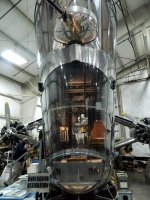
Tom, after looking inside the cabin, I realized that it's a little different than the ones we had. The floor under the observers seat in the back was clear thick plastic with a large azimuth scribed in it showing compass readings plus other readings which I forgot what they were. Kind of spooky at first walking over that floor in flight. You could see pretty far down in the water from that position, (Sub observation), Plus we had a regular grill instead of the frying pan shown in the Goodyear version, lots of steaks went across that grill! Some seating was also different, plus the pilots had a large wheel along side of their seats for elevator control. 
I guess Goodyear built quite a few of them, don't remember.
I guess Goodyear built quite a few of them, don't remember.
Attachments
Last edited:


Offline
Then we have the mystery of the "Ghost Blimp" https://www.youtube.com/watch?v=dR7TyYOPmMg

Offline
Early in the documentary a photo is shown taken at Ft. Sill of a burning balloon and men running from it. Since I live right next to Sill and am pretty familiar with Post airfield I did a quick search and found this article:

 www.army.mil
If you do not want to read the entire article here is a quote from the article from Towana Spivey, retired curator of the Ft.Sill National Historic Landmark Museum:
"In 1918 there was a tragic accident at Henry Post field. A balloon filled with hydrogen was getting ready to lift off and the ground crew was still holding the guide ropes hanging down. Static electricity caused a spark and the whole thing blew up," Spivey said. "Soldiers initially ran away from the fireball but were ordered to go back towards the fire, to keep the balloon from drifting toward the wooden barracks in the vicinity. At least six Soldiers were killed and another 30 were injured in that incident."
Fort Sill birthplace of Army combat aviation
FORT SILL, Okla. (19 Jan. 2012) -- Fort sill has the oldest continuously operating Army airfield, almost 100 years old, and is considered the birthplace of Army combat aviation.
www.army.mil
If you do not want to read the entire article here is a quote from the article from Towana Spivey, retired curator of the Ft.Sill National Historic Landmark Museum:
"In 1918 there was a tragic accident at Henry Post field. A balloon filled with hydrogen was getting ready to lift off and the ground crew was still holding the guide ropes hanging down. Static electricity caused a spark and the whole thing blew up," Spivey said. "Soldiers initially ran away from the fireball but were ordered to go back towards the fire, to keep the balloon from drifting toward the wooden barracks in the vicinity. At least six Soldiers were killed and another 30 were injured in that incident."