• Hey Guest!
    British Car Forum has been supporting enthusiasts for over 25 years by providing a great place to share our love for British cars. You can support our efforts by upgrading your membership for less than the dues of most car clubs. There are some perks with a member upgrade!

    **Upgrade Now**
    (PS: Upgraded members don't see this banner, nor will you see the Google ads that appear on the site.)
Tips
Tips

Hello and Transmission Question

doates

Senior Member
Offline
Hello All,

I have been lurking here for a few months but this is my 1st post. I have a 70 Spit that I am finally resuming work on. Getting ready to put the interior in after a 4 year long body off restoration.

I tried to take it out for a putt around the block to make sure that the transmission (that I rebuilt) actually worked. I am glad that I did because I can't get it to shift into second from either direction. 1st and 3rd work fine but when I push it to where 2nd should be nothing happens; it is like shifting to neutral.

I am assuming that I am going to pull the transmission but am hoping someone has a magic solution that I can do with the trans in the car.

I also have a carb/tune up question that I will post separately.

Thanks in Advance


Dennis
 
Thanks,

To the best of my memory I tested it on the bench and all was well, but that was 4 years ago.

Dennis
 
I took the trans cover off and found that 1st gear doesn't slide on the synchro hub properly. After some messing around (prying) I got it to slide up to 2nd and after further messing with it I got it so that it would slide into 2nd with the shift lever but it still takes some force. I guess I should pull the trans, take it apart and see exactly what is wrong. It is such a simple piece that I don't understand what could be binding; maybe the little spring loaded ball bearings? It wasn't touched for a couple of years; maybe some corrosion. Anyway, I am looking for some encouragement to pull the trans. I really don't want to - Tired of going backwards.

Thanks...Dennis
 
hey once you get going it goes fast just getting going is the hard part

I was going to say if you have done it once the second time is goes faster but since its been years might not go as fast

post some pics for us

hondo
 
Hi and welcome. It does sound like the transmission needs to get pulled - but if it is just a case of the transmission sitting too long, is there anyway for you to soak the gear train in gear oil for a while and see if it frees up better? It might as you say just be a case of some corrosion, or old grease etc gumming it up. And if it frees up after soaking you won't have the headache of the transmission pull!
 
Most transmissions like to turn and not sit still for four years. If it's not grinding going into gear, I would drive it and shift it often and see if it starts to get easier before I pulled it apart. Remember a lot of the transmission doesn't get lubricated unless it is in motion.
 
After soaking for a week in penetrant and oil for a week, I took it down the street because the shifter felt like it was going into 2nd. It wasn't. Since I had my son available we pulled the trans and took it apart. I don't know who said that that is a one man job - my son is 19, a work out nut and we still struggled getting it out (with overdrive).

On disassembly I found a couple of issues with my rebuild i.e. thrust washer in the wrong place, missing circlip. I don't know if these caused my 2nd gear problem but taken apart it is still difficult to push the 1st gear along its hub to 2nd. I am ordering a new 1st gear assembly and will install this coming week so hopefully this problem will be resolved.

Thanks Again....Dennis
 
While playing around with it I realized that the springs in the 1st/2nd and 3rd/4th synchronizer hubs are different lengths and that they could have been mixed up between the two. I ordered up new springs making sure to put them in the right place and now it shifts into all gears easily. I have hand tested it on the bench by turning the input shaft and making sure the output shaft changes speed with gear changes.

Now I would like to test the overdrive (D Type). I bought it on Ebay 3 or 4 years ago; supposedly working. Is there a reasonable way to bench test it? My best drill motor has a top speed of 850 RPM so I don't think that will do it. I know the solenoid works.

Any ideas greatly appreciated.

Thanks...Dennis
 
Dennis-

I don't you specifically need high revs on the drill motor, but it needs to be stout enough to drive the pressure up. At least it was that way on my A type overdrive. I doubt we were over 1000 rpms in the test.

Randy
 
Randy,

Did you just put the trans input shaft into the drill chuck? Did you protect it in any way?

Thanks
 
I've used an 850 rpm 1/2" drill motor to test both A-type & J-type; don't see any reason it wouldn't work just as well for a D-type. Arguably, using a lower rpm for testing gives you some margin to be sure it will still work when the oil gets hot (the higher rpm helps compensate for the oil getting thinner).

For my tests, I used a short length of straight radiator hose as a coupling between the drill & input shaft. It was a reasonably snug fit onto the nose of the chuck (where the holes for the chuck key are) and onto the splines of the shaft; but I used clamps on both ends to hold it there.

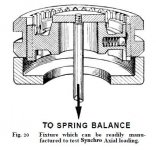
Since you have already had trouble, I would also suggest buying a digital fish scale and checking the actual force required to move the shift rings on the hubs. It's kind of important, since that is what makes the synchros work. If they move too easy, the gears will grind.

Don't have a Spit workshop manual handy, but I'm sure it's in there. Here's the diagram from the TR3 manual, though. I used a hardware store eye bolt and some big flat washers for my fixture, then held the outer ring with my other hand.
 

Attachments

  • 21762.jpg
    21762.jpg
    36.4 KB · Views: 302
I'm not sure if the A-type is different from your D-type, but on the A-type the pump is driven by the output shaft, so you can hook the drill via a large socket to the output shaft nut and drive away that way. A friend of mine in our local club helped me diagnose my trans that way and it worked fine.
 
Great information, Thank You. Tomorrow I will test and if all goes well and my family lets me - I will install on Sunday. It would be a great Father's day present to drive around the block.

Thanks....Dennis
 
Hi Again,

Well we didn't drive around the block. I hooked the transmission up to my drill using the rubber hose coupler - it worked great. Spun it for a bit, made sure the trans shifted and stayed in each gear, switched the over drive on and nothing. Cleaned every passage that I could find, checked the solenoid operation, checked the valve on top of the solenoid lever and still nothing. There was a lot of metallic gunk collected on the magnets under the filter but no large chunks anywhere. Everything turns smoothly and quietly. How long should it take to build enough pressure at 850 rpm? I am assuming that I will be able to see the speed of the output increase when the OD pulls in?

What an oily mess. This may be a dumb question but what keeps the oil out of the bell housing? I don't have the bell attached and oil drips out of the front bearing. Then there was the hole right below the front bearing that I didn't have plugged.

I couldn't bring myself to take the trans apart again to do the pull test. I have another working trans that I may put in until I can get the OD sorted out and while working on the OD I will take the trans apart and do the pull test.

Thanks for your support...Dennis
 
Tonight I am feeling like there is a differential between input and output rpms but don't have anyway to confirm it short of purchasing two digital tachometers. Is there another way? I do not feel any real difference between on and off. When I try to hold the actuator lever in with my thumb (no solenoid help) it becomes difficult so I think that I am making oil pressure.

Any advice is greatly appreciated

Thanks...Dennis
 
If the OD is kicking in, you should be able to hear and feel the extra load on your drill motor.

Personally, I would not install it in the car without doing a pressure test with a gauge. Low pressure may make it appear to shift on the bench, but let it slip under actual load in the car.

Being somewhat perverse, I bought a gauge and made my own adapter. But the easy way is to buy the package from:
https://webspace.webring.com/people/tj/jholekamp/
 
I got my gauge from Jim Holekamp (link above, nice guy and his gauge is well made), hooked up my 850 RPM drill and I am showing nearly 450 psi. Can I put my transmission in now?

Thanks...Dennis
 
Back
Top