• Hey Guest!
    British Car Forum has been supporting enthusiasts for over 25 years by providing a great place to share our love for British cars. You can support our efforts by upgrading your membership for less than the dues of most car clubs. There are some perks with a member upgrade!

    **Upgrade Now**
    (PS: Upgraded members don't see this banner, nor will you see the Google ads that appear on the site.)
Tips
Tips

Fuel concerns..

RynoBoy74tr6

Freshman Member
Offline
Rookie 74 tr-6 owner(73K miles)....I've been running 91 Octane and using the synthetic additive for leaded fueled engines...My Triumph parts guy told me I was crazy to use 91 as the valve seats aren't hardened and the 91 octane will be hard on them...What fuel should I be using, and should I continue with the additive every 1600 miles as per recommendation?
Thanks!
stan

https://picasaweb.google.com/RynoBoy74/20090621#
 
'Octane' refers to the fuel's ability to resist 'knock' or 'ping'. If it doesn't knock or ping on regular, then it's a waste of money to run premium. But it won't hurt to run higher octane than required.

There's been lots of debate on the need for "lead substitute". While the problem is real, it appears to affect only a small percentage of engines. There are also those who believe that Triumph was using induction-hardened seats by 1974. Plus independent tests seem to show that many of the additives on the market don't actually do anything to protect the valve seats.

My advice is to save the money you would have spent on additive and, if you do develop a problem with major valve seat recession, use that money to cover the cost of installing hardened seats.

Ironically, in perhaps 200,000 miles of Triumph driving, the only time I had valve seat recession was on a head that did have the hardened seats and valves installed. Not sure why, might have had something to do with the racing valve springs, or the excessively high compression ratio; but when I went back to a stock head (with stock seats), the problem disappeared.

 
The general view over here is to use regular unleaded and see what happens to the valves. Generally if you don't rev it over 3,000 for prolonged runs they should be fine. If they do eventually burn out then have the head converted for unleaded. You may find that the car runs better on higher octane fuel, but it won't make any difference to valve seat recession.
 
The 74 tr6 was not a high compression engine to say the least,and should burn 87oct with no trouble.It may also have a no-lead head too,which means the factoey flame hardened the seats, so why worry about nothing??? Just drive and enjoy.
MD(mad dog)
 
My 74 runs OK. infact you might say normally with 87 octane, but I do use 89 because some fuels have detergents in 89 that are lacking in 87 or at least that's been my observation.
I recently had a 74 cylinder head reconditioned that the machinist said showed no signs of valve recession or any other problems associated with unleaded gasoline.
Unless the engine has been run on a regular basis and spirited on ocassion, you may have some carbon build-up about the valves, so I would suggest using some gasoline detergent additives to help with the cleaning. Techtron is a good one to add to the gas in the tank.
 
NickMorgan said:
The general view over here is to use regular unleaded and see what happens to the valves. Generally if you don't rev it over 3,000 for prolonged runs they should be fine. If they do eventually burn out then have the head converted for unleaded. You may find that the car runs better on higher octane fuel, but it won't make any difference to valve seat recession.

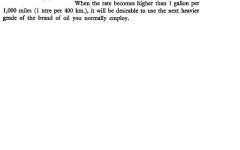
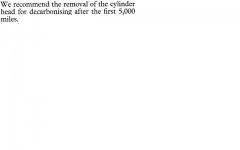
Nick: I was reading a copy of the TR3A owners manual the other night. I had to grin when I read the section for owners of new cars.

One gallon of oil in 1000 miles!

Can you imagine a de-coke after 5000 miles! :lol:
 

Attachments

  • 17685.jpg
    17685.jpg
    15 KB · Views: 211
  • 17686.jpg
    17686.jpg
    11.2 KB · Views: 215
NickMorgan said:
The general view over here is to use regular unleaded and see what happens to the valves. Generally if you don't rev it over 3,000 for prolonged runs they should be fine. If they do eventually burn out then have the head converted for unleaded. You may find that the car runs better on higher octane fuel, but it won't make any difference to valve seat recession.

but what about the 'holes in piston' stories caused by pre-ignition? isn't this a more onerous problem?
 
angelfj said:
NickMorgan said:
The general view over here is to use regular unleaded and see what happens to the valves. Generally if you don't rev it over 3,000 for prolonged runs they should be fine. If they do eventually burn out then have the head converted for unleaded. You may find that the car runs better on higher octane fuel, but it won't make any difference to valve seat recession.

but what about the 'holes in piston' stories caused by pre-ignition? isn't this a more onerous problem?
That's why you have to adjust the timing!
 
angelfj said:
Nick: I was reading a copy of the TR3A owners manual the other night. I had to grin when I read the section for owners of new cars.

One gallon of oil in 1000 miles!
Wow, imagine that - the sump would be empty!! :shocked:
 
That must be what the guy in the tv comercial was driving. "took a tank of gas and filled it with oil twice".
 
NickMorgan said:
Wow, imagine that - the sump would be empty!! :shocked:
Now you know why the marks on the dipstick are so far apart, and why you are supposed to check it every 400km!
:driving:

I once drove a pickup truck from Dallas, TX to Los Angeles that was burning a quart every 50 miles or so. When I stopped at the first intersection after picking it up, the cloud caught up to me and I literally could not see the traffic light! Bought a case of the cheapest oil I could find, and stopped every 100 miles to pour in a couple quarts.

When we got the engine apart later, all of the top rings were broken, and the cylinder ridges looked more like cliffs. But the owner (who is even crazier than I am) wanted to keep the original engine, and got it rebuilt. It's probably still on the road today.
 
I think I've told this story before....

Had a Mk3 Spitfire (back in the early 1970s) that got to the point of 30 mi/qt of oil! So bad that a: I was buying two-gallon cans of the cheapest nondetergent oil my local gas station had; and b: I'd often have to stop en route, remove the #2 spark plug, chisel off the burned-on gunk to provide a gap again, and then motor merrily on!

That crazy little engine ran for quite awhile like that and never did blow up. Nor did we have any mosquitos in the neighborhood. :wink:
 
RynoBoy74tr6 said:
My Triumph parts guy told me I was crazy to use 91 as the valve seats aren't hardened and the 91 octane will be hard on them...

I don't quite understand that comment. 91 is not more "powerful" than the lower octanes. It just burns with more control of the flame front allowing higher compression etc... without pre-ignition, which allows more power to be generated. In an engine that can burn any of the offered grades of fuel with out ill effect, like your stock TR6 engine, 91 would not be "harder" on your engine than 87.

There might be a difference on how clean and smooth the engine runs from the different additive levels in the different octanes. Such a difference might manifest as smoother idle or better fuel mileage.

I use my TR8 on a regular basis. I tried an experiment over a months time when I was doing about a 40 miles/day commute of mixed city and highway (no interstate but a highway with a 65mph stretch. The route was the same every day of the week during the test. I used a tank of 85 octane, 87 octane and 91 octane (high altitude octanes are lower overall than lower altitude octanes). While my TR8 showed no difference in starting, or idle smoothness from tank to tank, I did notice a mileage difference. The higher the octane, the better the fuel mileage. The difference was enough to justify using 87 over 85, but not 91 over 87.
 
Back
Top