Hey Guest!

sqbsprite
Jedi Trainee
Offline
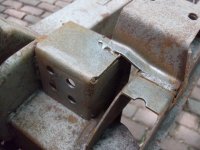
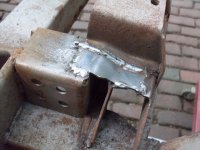
Being relatively new to the TR6, I am quickly learning some of its inherent dark secrets. First there was the differential mount cracking problem and the rear trailing arm bracket cracking issue. Now that I am rebuilding the front suspension, I learn about the need for additional braces required for the lower control arms. My frame was badly broken, not just cracked at the rear control arm mount on both sides. The right side had been somewhat welded, but without adding the additional support. I question if the use of shims behind the bushing mount might contribute to the stress. There were shims behind the brackets on the rear ward mounts where the fame was broken, but not the fronts. To me, the idea of putting shims here to make a small caster adjustment, was not a good one. The mis-alignment of the pivot points through the bushings, puts a lot of load on the bushing and bracket. It was obvious that the rubber bushing was being pushed more to one side. I could really see the alignment when I was re-assembling it with new bushings. The trunion pivot bolt did not want to align with the control arms which is what gives the caster adjustment. I would think that the caster angle is built in by the offset of the trunion to the upper arms. If so, then shins were required just to square things up. If that was the case, it should improve alignment between the arms and the trunion. Can someone explain this better to me?
![IMG_20150331_175236_578[1].jpg](https://www.britishcarforum.com/community/data/attachments/28/28253-63a915b7622264aea9eabb0c109ba964.jpg?hash=Y6kVt2IiZK "IMG_20150331_175236_578[1].jpg")
![20150425_133654[1].jpg](https://www.britishcarforum.com/community/data/attachments/28/28254-07320e4f676b4f859a3ddc8af7365ed1.jpg?hash=BzIOT2drT4 "20150425_133654[1].jpg")
![20150502_161507[1].jpg](https://www.britishcarforum.com/community/data/attachments/28/28255-b7d5ae8f591b3da1d41dd389dd33eede.jpg?hash=t9Wuj1kbPa "20150502_161507[1].jpg")