• Hey Guest!
    British Car Forum has been supporting enthusiasts for over 25 years by providing a great place to share our love for British cars. You can support our efforts by upgrading your membership for less than the dues of most car clubs. There are some perks with a member upgrade!

    **Upgrade Now**
    (PS: Upgraded members don't see this banner, nor will you see the Google ads that appear on the site.)
Tips
Tips

Failed sleeved thermostat

prb51

Luke Skywalker
Country flag
Offline
Need a common sence check.
If the TR3 original sleeved therm is working then you could remove the temp gauge bulb from the housing with little fluid escaping as it should be closed when cool? Yes?
I'm guessing it has failed in the open position as it is difficult to get to operating temp and the upper radiator wants to drain thru the temp gauge bulb opening (was going to check the gauge accuracy).
 
There is always a hole (usually small) in every thermostat to allow the air to rise and escape when refilling the radiator. This is to prevent an air lock. Therefore the fluid can drain through the small hole when you remove the bulb for the temperature gauge.
 

Attachments

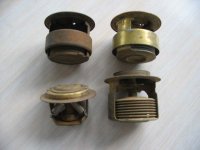
  • 9024.jpg
    9024.jpg
    30.9 KB · Views: 97
Thanks Don, better pull it out and check it.
It has been colder than normal, could be the new ally radiator just keeps it that much cooler.
 
I checked the temp gauge and ok (used laser and mechanical) but wonder about the thermostat.
It's colder today (40's now) and I let the car idle in the garage for 15 minutes and never got to 185 deg.
The temp peg slowly moved up in sinc with the laser temp.
I was wondering if the sleeved units are known to fail in the open position allowing cont. circulation?
I've the ally rad and a TR6 fan (shouldn't maka a dif).
It seems to me I should still get to op temp quick enough then drop off when therm opens.
Interesting, do the sleeved ones fail in the open position?
 
Another question.
The only sleeved therms I can find are 160 deg. That will be great come summer but will that affect proper operation in colder weather?
 
I do not use the sleeved version so I can't comment specifically but many tstats are designed to fail in the open position.

As the engine warms up (albeit slowly) you should be able to feel a difference in the temp of the tstat housing and the top of the radiator (which should remain quite cool until the tstat opens. If the top of the rad warms along with the housing then I would suspect the thermostat is stuck open.
 
Geo,
Good suggestion. What temp therm do you use and do you think a 160 would be ok year round (Wickenburg)?
Pat
 
The original sleeved Tstats (like the ones Don showed above) usually fail closed. That's because they are opened by the heated air inside the bellows expanding, and they usually fail when the bellows leaks and lets the air out.

However there are some reproduction sleeved Tstats that use modern "wax pellet" movements and usually fail open.

The bellows types open and close very slowly; so are more apt to cause lack of heat in the winter.

Like Geo, I've always used a non-sleeved Tstat and it works fine for me even in the desert. Some experiments when I was having trouble with overheating seemed to show no detectable difference in cooling even with the bypass totally blocked (which is not a good idea). But then, my problem did not seem to be lack of water flow, so it makes sense that losing a little flow to the bypass wouldn't make a difference. Other people have reported that it did make a difference for them, so obviously their water flow was marginal. YMMV.

BTW, Geo is right on the money about how to detect a thermostat that is stuck open. The radiator should stay cool enough to keep your hand on until after the Tstat housing is too hot to keep your hand on.

If you can find one, I prefer a Robertshaw model 330-180 (which is a 180F non-sleeved thermostat). Also sold under the Prestone name at least some times.
https://www.flowkooler.com/thermoover.html
 
Randall,
Pretty hot here in Wickenburg, Az. What set up did you use in your TR3? Bypass mods etc, what kind of plug in the housing/bore hole size.....
I'll need to do this so please be specific as the original sleeved unit has been in place for years.
 
It sorta evolved over time and some mods were done trying to compensate for other problems that were found later; so I certainly won't claim that anyone should duplicate exactly what I did. But here's what I did :

When I got the TR3A in 84, the original fan was in pretty bad shape. The rubber bushes were long gone and the fan had been banging back and forth on the sleeves so long that the holes were oblong. Plus, previous experience with other TR3s had shown that the cooling and charging systems were marginal for daily commuting and stop-n-go traffic. And, having read all the stories about how much power a stock fan (in general, not TR3 specifically) uses, I was hoping for some improvement in acceleration.

So, I removed the stock fan and converted to a 16" electric with a 60 amp Ford alternator to power it. That setup (with a common, 180F non-sleeved thermostat) actually worked just fine for many years. I did have some troubles with overheating during that time, but they all seemed to be due to things like bad water pumps and leaking head gaskets (another long story). Oh yeah, I also installed the cardboard air deflector between the front apron and the radiator (which was standard on later 3A's but not on mine).

Fast forward to around 96, when I gradually started having trouble with it getting hot on the freeway. Flushed the radiator, checked the timing, all the usual things; but it would still slowly creep up at speed. Wasn't too much of a problem for me, since I mostly only drove it to work; usually took the other car on longer trips. But I tried a lot of things to solve the problem; including modifying a radiator cap for about 7 psi. Eventually, I pulled the radiator and took it to the local radiator shop and asked them to check it. They did the ordinary tests and said it appeared to be OK, but after I told them of my woes and all the things I had tried, they ran a test for thermal efficiency and told me it was bad ! Apparently the tubes were no longer in good thermal contact with the fins, so even though it did not leak and flowed water just fine, the heat was not being conducted from the water to the air. So, they recored it with a modern Modine core (that fit perfectly). I declined to have the crank hole installed (which he said would cut effective area by about 10% because of the tubes it would block) but opted to keep the original fill neck (which in retrospect was probably a mistake). POOF ! No more problems !

So, to summarize, I have :

16" Hayden fan, as a puller
No stock fan or fan extension
60 amp Ford alternator (to power the fan)
7 psi radiator cap (no heater)
Open bypass
Robertshaw 330-180 thermostat
Cardboard air deflector between apron & radiator
Aftermarket 270 degree sweep mechanical temp gauge

Likely I don't need the 7 psi cap, but since I have it, might as well use it. It gives more margin before boil-over when I forget to turn the fan on (never did get around to building the custom fan control I had planned) and I also like the lever to vent pressure without taking the cap off.

In traffic, in 115F ambient, the temp gauge did creep up a bit. But at speed or in cooler air temps, it did just fine.

 
Interesting about the open bypass as I've always heard you must restrict that passage somewhat when using a non sleeve.
Did you ever use a plug/restrictor in the bypass hose?
I have a new ally rad with the TR6 fan an alternate pusher for stop/go driving and a delco alt for power (I believe the two fan deal to be overkill but that's what's there now). The car runs within temp guidelines except when really hot Az kicks in (110+ ambient) and then only a tad over normal so the block is not gunked up.
I have the stock 4lb. rad cap and it's a small mouth 3.
Seems to me (from responses/input) that I might restrict the bypass a bit and use a 180 degree TSTAT.
I was concerned about the size/port of the restriction but the more I hear (some totally blocked the bypass without issue and some left it totally open) it doesn't seem as critical as I originally thought.
 
The bypass is and was intended to provide a faster warm-up in colder weather. Most have blocked (or almost blocked) the bypass to prevent overheating during the hot summer. The bellows expand and move the sleeve to "block" the bypass once the coolant is hot.

For the condition you have, running too cool in winter, I wouldn't block the bypass till next spring. Leave it open for faster heat up. The 180° thermostat should help. It can be a modern flat one like the lower left in the photo above because you don't need to block the bypass in winter. I wouldn't worry too much if the engine runs a bit cool in winter. I can remember putting a stiff piece of cardboard in my grille to block the airflow to get it hotter faster when I used to drive my TR3A in the winter. If I got stuck in traffic and if it would start to get too hot, so I'd stop and pull off the cardboard.
 
I only drive during the summer, so I have a sleeved t/stat and I have blocked the bypass with a brass pipe plug. I threaded the hole at the top of the casting down below the bypass hose and the pipe plug is threaded in. Before I put it in, I drilled a 3/16" hole through the pipe plug to allow the air to rise out the system when I would be filling the whole system with coolant. I have heard that others have drilled a hole in a penny and wedge this into the hose near one end or the other.
 
Don Elliott said:
The bypass is and was intended to provide a faster warm-up in colder weather.
I disagree, Don. The main function of the bypass is to ensure that water can circulate even when the thermostat is closed. Otherwise, the water will heat to near (or past) boiling at the hot spots inside the head, before the water near the Tstat gets hot enough for the Tstat to open. Then when the Tstat does open, the rush of hot water through it will cause it to open fully, and then the cold water rushing into the head is apt to cause cracking.

Gee, these "Christmas" theme colors are hard to read !
 
prb51 said:
Interesting about the open bypass as I've always heard you must restrict that passage somewhat when using a non sleeve.
Did you ever use a plug/restrictor in the bypass hose?
Thought I mentioned that ... Yes, I experimented with both restricting and completely blocking the bypass. Made no appreciable difference to cooling (except it did seem to overheat a bit quicker with it totally blocked).
<div class="ubbcode-block"><div class="ubbcode-header">Quote:]
I have a new ally rad with the TR6 fan an alternate pusher for stop/go driving and a delco alt for power (I believe the two fan deal to be overkill but that's what's there now). The car runs within temp guidelines except when really hot Az kicks in (110+ ambient) and then only a tad over normal so the block is not gunked up.[/QUOTE]Sounds to me like you don't have any problem, then. Since it's not broke, I'd suggest not fixing it !<div class="ubbcode-block"><div class="ubbcode-header">Quote:](some totally blocked the bypass without issue[/QUOTE]I've always wondered if those are the same people that later find they have a cracked head; without associating it with the blocked bypass. If you do want to block it totally, I strongly suggest that you also modify the thermostat to allow some circulation through the radiator even when the engine is cold. That will slow down warmup somewhat, but give maximum cooling (since even the sleeved Tstat allows some water to flow through the bypass all the time).
 
Don/Randall,
Good information.
Randall the system worked perfectly until just lately. I believe it is the failed Tstat, so I'll have to do something as I had/have a 180 sleeved tstat and can't seem to find one other that the 160 (I didn't explain that well earlier).

So, can you leave the bypass open/unmodified and just use a normal tstat year round?

Basil, nice theme but my eyes are twirling
 
prb51 said:
...some totally blocked the bypass without issue...

That was probably me (in a separate discussion). For 20 years or so I drove with a hunk of broomstick jammed in the bypass hose with the flow totally blocked.

Head was fine (had it off for routine valve work about 2 years ago) but now I use a 3/4" copper cap with a 3/16" hole and would not suggest that anyone totally block the bypass.

I also add or assure there is a small hole in the tstat for ease of filling. Where I live fast warm-ups are much less of an issue than keeping cool.
 
prb51 said:
So, can you leave the bypass open/unmodified and just use a normal tstat year round?

Quite possibly, certainly nothing really bad will happen. I assume you are speaking of a Tstat you might pick up at the local parts store.

If, when summer arrives (around late April in Wicky), you find your cooling system can't quite keep up you might opt to experiment with blocking the bypass -- at least you'll have some data to perhaps assess if that mod actually helps.
 
Guys, thanks for the info regarding your experiments. I believe I'll go with a 180 conv. tstat and leave the bypass open til warmer weather and then see how things go.
Great info as always.
Pat
 
Back
Top