• Hey Guest!
    British Car Forum has been supporting enthusiasts for over 25 years by providing a great place to share our love for British cars. You can support our efforts by upgrading your membership for less than the dues of most car clubs. There are some perks with a member upgrade!

    **Upgrade Now**
    (PS: Upgraded members don't see this banner, nor will you see the Google ads that appear on the site.)
Tips
Tips

Engine Will Not Start

On actual TDC, you will play heck trying to see it. Make sure you've rotated it so as you come up on stroke, exhaust is just closing, and as you pass the mark, intake is just opening.
A little variation is okay, just look to see where the marks line up as you go back and forth when the exhaust just starts to open (reverse rotation), by pushrod tight, and how the marks line up in normal rotation as inlet starts to open (pushrod tight). The damper mark should be equidistant both sides of the pointer.
 
1. cranked with solinoid with rotor approaching TDC
exhaust open, intake closed

2. as approaching TDC exhaust closed, intake closed

3. past TDC exhaust opening

4. as approaching TDC exhaust closing and intake opening

5. At TDC intake and exhaust opened

6. past TDC exhaust still openedand intake opening further as rotate exhaust now closed and intake starting to close

7.At TDC both valves are closed and rotor pointing to numer one plug wire

I assume this is correct in relationship to TDC marking on pulley

Am now going to buy new spark plugs, since current ones are fouled.
 
Gerry,

Sounds exactly like the problem that I had when I was trying to start mine for the first time. I went through all the procedures for spark...changed out ditributors even...also changed to an electric pump. I was getting fuel to the carbs and the float bowls were full. The plugs were bone dry when I removed them and I could only get the car to fire once on ether...other than that, nothing worked. I was stumped.

The cause of my issue was a huge vaccuum leak. The carb intake was not seated on the head properly. It was hanging on the two locating studs. Is it possible that somehow, your intake has loosened or as someone else mentioned, your gasket is in bad condition?

Hope you find the problem, I know that it can be very frustrating.

Cheers,
Tush
 
GerryL said:
1. cranked with solinoid with rotor approaching TDC
exhaust open, intake closed

2. as approaching TDC exhaust closed, intake closed

3. past TDC exhaust opening

4. as approaching TDC exhaust closing and intake opening

5. At TDC intake and exhaust opened

6. past TDC exhaust still openedand intake opening further as rotate exhaust now closed and intake starting to close

7.At TDC both valves are closed and rotor pointing to numer one plug wire

I assume this is correct in relationship to TDC marking on pulley

Am now going to buy new spark plugs, since current ones are fouled.

Except.....you must have better eyes that I do. Trying to determine where the damper marks are, and the position of the valves exactly to the damper, whilst holding the solenoid button.

Do it by hand, even if you have to put it in 4th and roll it.
 
I only cranked it with the solinoid to place the rotor towards number spark whole two. After this I rotated it by hand and took noite of the valve movements on cylinder number one.
 
M_Pied_Lourd said:
Gerry,


The cause of my issue was a huge vaccuum leak. The carb intake was not seated on the head properly. It was hanging on the two locating studs. Is it possible that somehow, your intake has loosened or as someone else mentioned, your gasket is in bad condition?

Hope you find the problem, I know that it can be very frustrating.

Cheers,
Tush

This is what I was getting at in my last post. If the plugs are dry, where is that gasoline going? If you can't find traces of it around the intake...is it in the oil?
 
The rotor isn't 180* out of position is it ? I know it doesn't explain dry plugs, but it is something that even the best of us can mess up.
How about rotating the spark plug wires on the cap 180, just to see ?
 
Finally got it started. Had to retard timing significantly once started. It is running perfectly now. I wish I had a logical explanation. Yesterday it ran on either. Today it would not start. Today I replaced fuel filter and removed su pistons and sprayed carb cleaner down each jet. At this poit it still would not start. Kept on cranking multiple times until fired and set idle speed up until engine was warm and would not stall. Finally rotated distributer to retard the timing. I am currenly very happy and exhausted.
 
Significantly.

Don't drive it further than you can push it home. Still sounds like the timing sprocket is shifting.

I re-read your report.....some of it doesn't compute, but that may be the reader's fault. As long as at one point on #1, with piston coming up, the exhaust and intake open (or just begin to) and I'm going to say for this discussion "exactly" the same amount of movement of the damper mark either side of the pointer, you're okay. If right at the pointer for one, and 1/4 turn for the other, no.
 
GerryL said:
Finally got it started. Had to retard timing significantly once started... Finally rotated distributer to retard the timing...

If your centifugal weights were stuck in the extended position you would have full advance when things were at rest -- i.e. you would have to retard the timing a lot to get it where it needed to be to start and idle.

The simple test would be to remove the distributor cap and turn the rotor to simulate advance, then release it. I should turn easily (about 14°) and snap back when released.
 
The rotor can only be moved slightly right or left; at most aprox. two degrees. I can cause the plate to move by advancing oe retarding the veneer dial. The car starts instantly and has plenty of power.

Tt appears that Geo has found a logical explanation for my problem.
 
The rotor can only be moved slightly right or left; at most aprox. two degrees. I can cause the plate to move by advancing oe retarding the veneer dial. The car starts instantly and has plenty of power.

Tt appears that Geo has found a logical explanation for my problem.
 
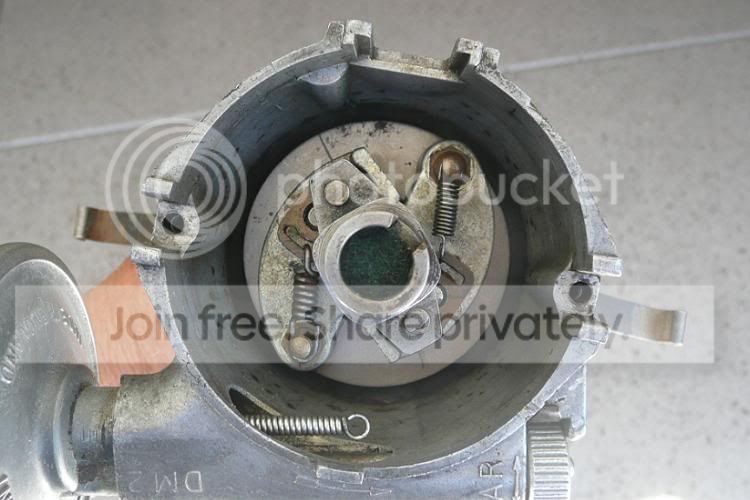
If you remove the rotor and then the 2 small phillips screws that hold the base plate it can be lifted away (you'll have to do a little wiggling to unhook it from the vacuum advance connection). I usually keep a magnet next to the screws as I undo them so they do not get away.

Once the base plate is off you can see the weights and directly observe their movement (or lack thereof).

40698AWeights.jpg


You can try some light lube/solvent like WD40 and see if that frees them up but possibly the best thing would be further disassembly. That is done by lifting that felt bit in the center (if yours is still there) and undoing the screw underneath it. Now the bits really come undone.

I don't recall ever doing this with the distributor in place, reassembly may be tricky that way -- I have always had the whole unit out and on the bench for clean & lube.

Either way, routine maintenance in the future should include a drop of light oil on that felt pad -- the oil will work its way down and help keep the parts moving freely.
 
Geo Hahn said:
Either way, routine maintenance in the future should include a drop of light oil on that felt pad -- the oil will work its way down and help keep the parts moving freely.

Hmm, haven't done that in a while, thanks for the reminder, Geo!
Glad Gerry is up and running!
 
Since the rotor can only be moved apeox. two degrees in each direction , it indicates that the advance weights in the distributor are stuck.
 
IMO, pull the dizzy and take the shaft out first. You don't want to stretch or damage the advance springs; but they will be holding the point cam in place once you've remove the screw under the felt.

And before you ask, yes, it is normal for the springs to be different, and for the heavy one to be slightly loose.
 
Back
Top