• Hey Guest!
    British Car Forum has been supporting enthusiasts for over 25 years by providing a great place to share our love for British cars. You can support our efforts by upgrading your membership for less than the dues of most car clubs. There are some perks with a member upgrade!

    **Upgrade Now**
    (PS: Upgraded members don't see this banner, nor will you see the Google ads that appear on the site.)
  • When posting a classified ad, you MUST select a prefix from the drop-down next to the subject line. If you don't you will get an error and your ad will not be posted!
Tips
Tips

Engine Balancing ?

RossL

Member
Country flag
Offline
I am have my 1973 TR6 engine rebuilt. I am interested in getting it balanced.

I bought an aluminum flywheel from a vendor on eBay (that had them in stock, "ready to ship") to find out that he does NOT have them.

My machine shop needs the flywheel to balance the crank, damper, rods/pistons, flywheel and clutch. If I have to wait 2 weeks (+) for the flywheel the machine shop is on hold because we can't assemble the block until the balancing is done. I've had to push them a bit and now they will be "waiting for me" which isn't fair to them.

Should I skip the ballance job completely?

Should I balance everything except the flywheel and clutch?
 
No, balance them all together. You went this far. Might as well wait a little longer. It's worth it.
 
Definitely, have it balanced. Don't even think about not balancing it. IMHO
Rob
 
Well, I go the other route, old racer deal, always balanced crank, flywheel and balancer separately, for the reason you may need to swap the flywheel or balancer a spare engine. Balancing each part separately is known as zero balancing. The only reson a machinist clumps it all together is to save time. If your flywheel is a Fidanza unit it's already zero balanced, we ran them right out the box on the race cars at 8500 rpms with zero problems.

On side note on any inline motor 4cyl, 6cyl, you don't have to use bob weights for mocking rod weight, that only comes to play with V motors.

To answer your question should I skip blancing altogether, it's coin toss on street motor. The factory balances all the components just not as tight as spec as the machine shop will do it, say a factory crank will be a 2-3 grams from end to end, when a good machine shop does it, they can get it under gram end to end. I like to compare tire balancing ot engine balancing, at normal around town speeds, say under 50 mph, if you never went any faster you would not even need to get your tires balanced, but when you hit the interstate at 70-80 mph a imbalance shows up and you get a vibration. Here's the deal factory spec blancing is fine and dandy for engine rpms say under 6000, but once you start to run higher rpms for substaned periods imblances can show up. It's not a bad deal to do it on street engine, but I doubt it will do anything, I had guy tell me when they wanted their street engine balanced, that they ran smoother, but to be honest, it's in their head. If you going to drive the wheels off this car, do it, if you're going to putt around, don't fool with it.
 
Hap Waldrop said:
Well, I go the other route, old racer deal, always balanced crank, flywheel and blancer separately, for the reason you may need to swap the flywheel to balancer a spare engine. Balancing each part separately is known as zero balancing...

My machinist balanced everything separately for exactly that reason. It does seem like a much more logical approach.
 
Hap Waldrop said:
The factory balances all the compnents
Dunno if this applies to the TR6, but on the TRactor motor the factory pistons were nearly twice the weight of most replacements.

Haven't been into it to see what is going on, but the engine in TS13571L has considerable vibration (enough to blur the rear view mirror) even at 3000 rpm (about 60 mph). It's replacement will definitely get balanced!
 
I think having your engine balanced, for street or race use is a good idea. It certainly can't hurt and it's not like it costs a fortune to do. But like Hap pointed out, if you have to replace any one of those components in the future, the balance of the entire engine will be compromised. The only way around this is to buy all zero balanced type components such as Carillo or Pauter Rods, forged J & E pistons, etc. If you use this stuff, you don't need to balance the entire assembly.

One thing you should seriously consider is getting a proper crank damper, especially for the 6 engine. Not one of those $295 all inclusive specials, but something like the ATI units Richard Good sells at his site. A worthwhile investment imho. I bought an ATI recently for my TR4 and these things are quality units. Worlds apart from anything else offered out there for TR's.
 
Hap Waldrop said:
The factory balances all the compnents just not as tight as spec as the machine shop will do it,

I will have to find the crank that came out of the original 1300cc engine in the Herald. It looks like the factory used an angle grinder to balance it!
 
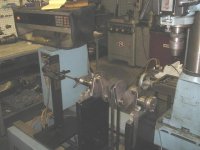
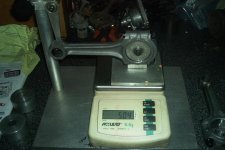
I think more is needing to said about this, most of you know, but I build race and street LBC engines for a living. First off, everything the factory in the way of rotatong mass installs in your engine is balanced, just not as tight a spec as you can get the machine shop to do it, if the compnents had grossly weihgts you know it at much lower rpm range, trust me they do balance it, this is a must. For exmaple the factory balances piston assmblies by simply weighing a lot of pistons and then grouping them to together in lots of 4, 6, 8 or whetever, now their factory piston spec might me +/-2 grams, but that is still balancing. Ok different things are balanced different ways, Piston are simply static balanced, meaning you simply weigh them and then make them all weigh as close as posible which require some simple drilling, milling or die grinder work normally inside the piston on the bottom in a non strength area, ok connecting rods are also static balanced, but that is a little more comlplicated, you need a rod trapese for this, you have to match the bottom weight, top weight and total weight of each rod, can this be done to a set of stock rods, you betcha. Now on to crankshaft, fylwheel, balancer, these items require a special balancing machine in which spins the part like a tire baalncer would spin a tire and wheel and then the machine tells you where the imbalance is and how much, anbd you remove weight in that area to achieve balacne. Here's a picture of one of my race prepped MG 1275 cranks on a Hines computer balancer being balanced. I also included a picture of a connecting rod on my rod trapese getting the bottom weight checked.
 

Attachments

  • 19703.jpg
    19703.jpg
    32.3 KB · Views: 250
  • 19704.jpg
    19704.jpg
    53.4 KB · Views: 249
70herald said:
I will have to find the crank that came out of the original 1300cc engine in the Herald. It looks like the factory used an angle grinder to balance it!

Could very well be, balancing marks on given component could be drilled holes, milled or grndings, very common, even in machine shop balancing. Hey it does not have to be pretty to be balanced :smile:

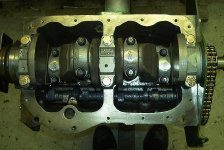
Here's a phot of a 125 perfoamcne street engine I built, it had stock connecting rods, they were blanced by me, I started by checking the weight on all the rods, top, bottom, and total, noticne you'll see the lightest rod of the bunch weighted 509 grams on the bottom, and the other three a wee bit lightening doen to them to mathc the benchmark rod (the lightest one of the bunch)it was done by simply using the bench grinder and removeing a bit of weight off the bottom of the rod until I got them all within +/- 1 gram.
 

Attachments

  • 19705.jpg
    19705.jpg
    64.5 KB · Views: 241
Just for the record, my engine parts were all balanced as Hap did above, as shown on the pictures on my site. The Fidanza flywheel was checked by the machine shop, but found to be in perfect balance when it came out of the box. I had heard from several others who had theirs checked and the result was always the same, perfect balance.

But that is not to imply that you shouldn't have it checked just to be safe.
 
You can noramlly trust a aluminum flywheel from a company like Fidanza to be nuts-on, balance wise. A flywheel out of balance would show up preety quickly, and you have to consider probably 80% of thier customers are bolting a aluminum flywheel to used engine, so balance right out of the box has to be right, or they would be out of business pretty quickly, same deal goes for clutches as well, they are factory zero balanced.
 
Back
Top