• Hey Guest!
    British Car Forum has been supporting enthusiasts for over 25 years by providing a great place to share our love for British cars. You can support our efforts by upgrading your membership for less than the dues of most car clubs. There are some perks with a member upgrade!

    **Upgrade Now**
    (PS: Upgraded members don't see this banner, nor will you see the Google ads that appear on the site.)
Tips
Tips

Electronic Ignition Tutorial please?

CuriousGeorge

Senior Member
Offline
Guys, with your help I've been succesful in diagnosing some ignition problems and improving my ride, I am grateful and give a heatfelt 'thank you'! Now though, I am curious as to how electronic ignition works. With electronic ignition, must you still rely on the old cap and rotor system to distribute the spark? Or do you need a new distributor?
 
I'm a little familar with the Pertronix.
First you have to think of either the points or the Pertronix as a switch. The switch regulates the amount of time that the coil is charged. Charging time determines how much voltage the coil can develop before it's adequate enough to create an arc across the electrode/ ground gap of the spark plug.
The pertronix uses a magnetic field created by a magnet around the lobes of the dizzy shaft or cam, if you prefer, and a pickup that is sensitive to the magnetic field in the approximate location of the original contact breaker points.
There's something called the "Hall Effect" that describes this type of a switch.
The magnet and the pickup can be installed in practically any conventional distributor.
That's about the extent of my knowledge of the subject.
 
In a traditional electronic ignitions you retain the cap and rotor. A triggering device is placed on the distributor shaft. As the distributor shaft turns the triggering device passes by a receiver mounted on the breaker plate in the distributor. The receiver is basically a switch and this switch in turn controls an electronic module (in effect a solid-state relay) turning it on and off to make and break the earth path from the coil's low tension circuit. Basically, you have an electronic relay that replaces the points and condenser.

The two most common triggering methods are magnetic and optical. In a magnetic system a non-magnetic ring containing magnets is slipped on the distributor shaft and this rotates in close proximity to a receiver that contains (typically) a Hall-Effect sensor. However, other magnetic sensor types have been used. In the optical method, an interrupter disk is mounted on the distributor shaft. The interrupter disk is a thin, flat disk (typically plastic) with slits cut from its perimeter in towards the center. The disk spins between an optical emitter and detector. The disk breaks a beam of light passed between the emitter and detector. In both methods the number of magnets or slits in the disk correspond to the number of cylinders of the engine.

Others can elaborate where I've abridged things.
 
tdskip said:
Great thread guys - thanks!--

-Thanks what! so what are you going to do?? No I am, not going to elaborate, Just get "U" a Pertronix and you will be happy too.--Keoke :banana:
 
If memory serves, the GM HEI system uses variable reluctance rather than Hall effect. Maybe Ford Duraspark does too.

Also, some systems use Capacitive Discharge instead of a simple switching transistor. The CD units basically generate a relatively high voltage pulse (like 400 volts) and use the original coil as a transformer to increase that to spark voltage.

Hmmm, wonder if anyone will pick up the old Piranha optical design, now that Crane Cams is no more?
 
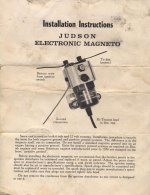
Anyone remember the Judson Electronic Magneto?? My father used them on his three cylinder Saabs that he turbo charged!

I don't know why they called it a magneto. As far as I know it's a capacitive discharge coil.
 

Attachments

  • 17035.jpg
    17035.jpg
    105.9 KB · Views: 319
3 cylinder Saab. I'll never forget the sound and the smell of their exhaust.
 
CuriousGeorge said:
Are there non-traditional systems that do NOT use the cap/rotor system, and if so, how do THEY work?
Yes, of course. Many, if not most modern cars are so equipped. Basically they use an ignition coil for every cylinder, or every pair of cylinders.

The coil-per-cylinder approach is obvious ... to use one coil for a pair of cylinders takes a special coil that has both ends of the secondary (high voltage) winding brought out to plug leads. In that case (known as a "waste spark" system), both plugs always fire together, but one of the cylinders is between intake and exhaust strokes where the spark has no effect.

Not sure offhand how long "waste spark" systems have been in common usage, but I owned a 1965 Honda motorcycle that used it. 2 cylinders, no distributor. Points rode right on the crankshaft.

There are even kits available to retrofit older motors with distributorless ignition, but they tend to be rather pricey and need to be custom-tuned to your engine. Without the distributor to determine the spark advance, they use electronics instead. Also require a crank position sensor so the electronics can figure out what's happening when.
 
I have switched between stock points and condensor to electronic and back and forth. Currently am back to using a Pertronix. I finally <span style="font-weight: bold">did</span> have my dizzy re-re-rebuilt by Jeff Schlemmer of Advanced Distributors fame and recurved this time. I would advise same. One thing to know about electronic ignition is you should not leave the ignition switch on in the the run mode for more than 2 minutes (+ or -) without the engine running because it will burn out.
 
TR6BILL said:
I have switched between stock points and condensor to electronic and back and forth. Currently am back to using a Pertronix. I finally <span style="font-weight: bold">did</span> have my dizzy re-re-rebuilt by Jeff Schlemmer of Advanced Distributors fame and recurved this time. I would advise same. One thing to know about electronic ignition is you should not leave the ignition switch on in the the run mode for more than 2 minutes (+ or -) without the engine running because it will burn out.

My dizzy was also sent on a pilgrimage to Jeff and this was well worth the effort.
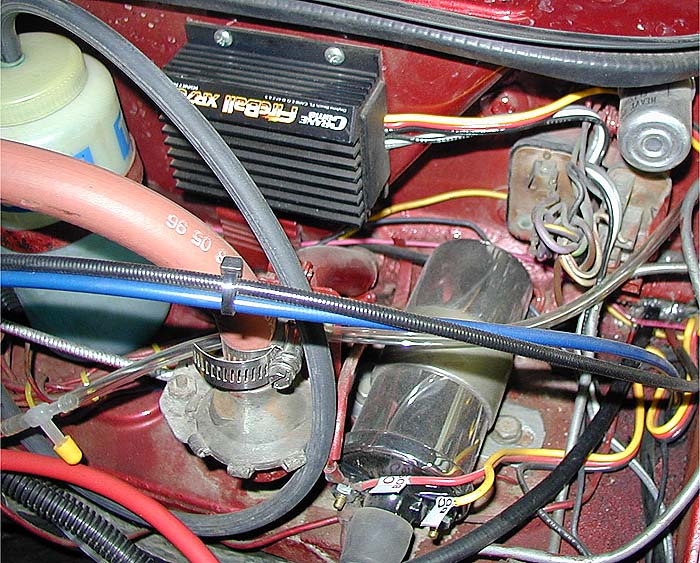
I like the Crane (at least the later ones with the LED) since they turn off the current if the engine isn't running. This is a MAJOR design flaw on the Pertronix.
 
70herald said:
This is a MAJOR design flaw on the Pertronix.
I agree. However, the other units with the external box at least appear to be able to handle the heat of constant on. AFAIK Pertronix is the only one with a problem being left on.
 
TR3driver said:
70herald said:
This is a MAJOR design flaw on the Pertronix.
I agree. However, the other units with the external box at least appear to be able to handle the heat of constant on. AFAIK Pertronix is the only one with a problem being left on.

The old Crane 750 will burn (I believe it was called the 750), I burned 3 of them. The Crane 3000 will not burn out. The only vendor that sold the 3000 was Vicky Brit. This was some time back.
 
That's interesting, Bill, first I've heard of it. BTW it was the XR700. And I bought my (pre-LED) XR3000 direct from Crane.

Never was really happy with it though, so I'm currently thinking of using a Pertronix to trigger a MSD on the 'new' TR3 (which should eliminate the concerns over leaving the key on, as the power dissipation in the Pertronix will be much smaller). Or maybe I'll cobble together the Crane optical pickup with an old Allison module I happen to have (I think the pickups will interchange).

For now though, it runs great with plain old points. I started it briefly yesterday after a 2 week hiatus, and it fired first crank. Maybe I won't mess with "improving" that area after all
grin.gif
 
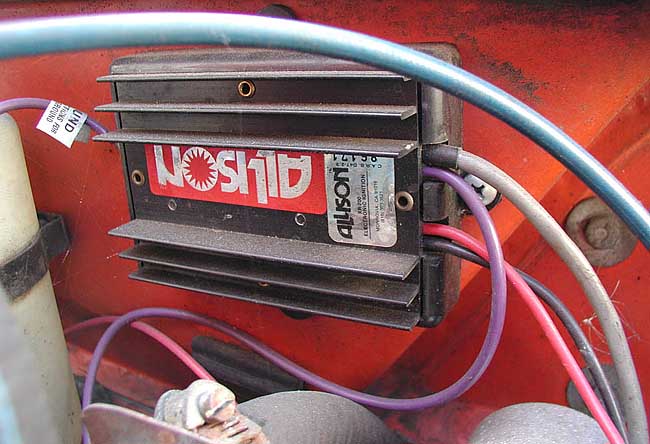
Randall, the Allison and Crane are one and the same. Used to be called Allison-Crane. Thanks for the heads up, 700.
 
TR6BILL said:
Used to be called Allison-Crane.
Yup, though mine dates from before that. As I recall, Crane bought the design and name; but redid the design several times (the last time was when they added the LED; made a single box work both positive and negative ground; and added the shutdown circuitry). And no one would mistake my Allison module for a Crane module, even without the sticker on it. The Crane boxes (even pre-LED) were better sealed and looked much more "business-like" than the old Allisons did.
allisonbox.jpg

crane3.jpg
 
TR3driver said:
The Crane boxes (even pre-LED) were better sealed and looked much more "business-like" than the old Allisons did.

That sure is the truth!

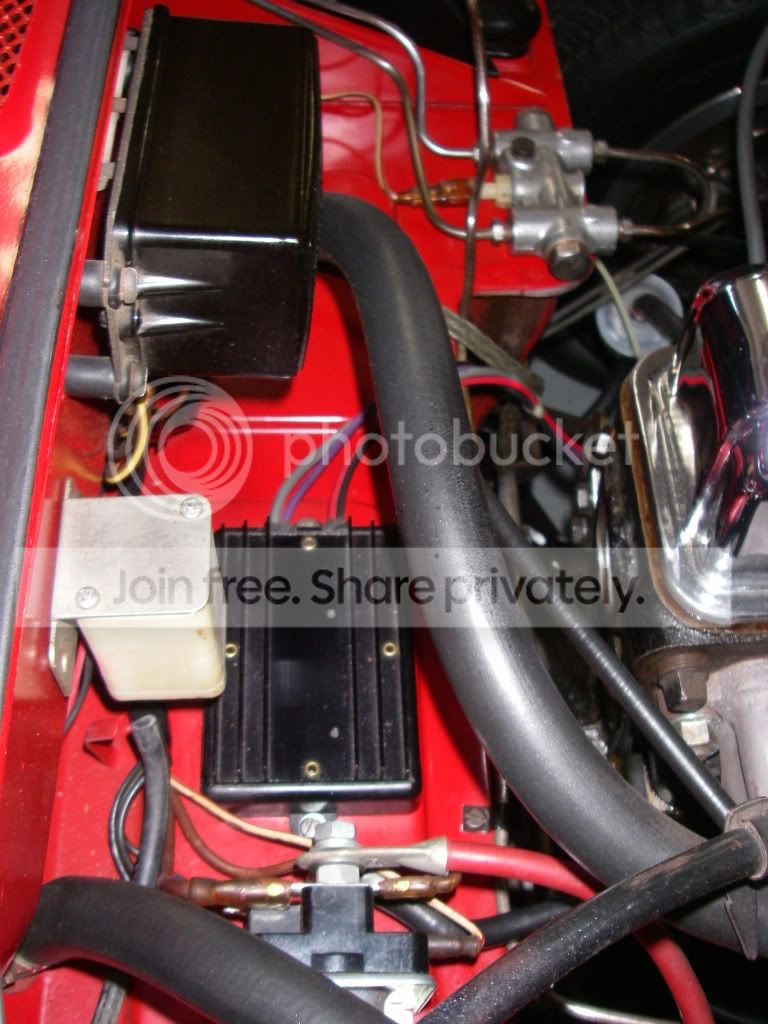
I had an Allison unit on the GT6 for years. One day I decided to wash the engine compartment. I covered the distributor but forgot all about the Allison control box. The unit never worked after the soaking it received that day.
 
I've had this one doing the job in the GT6 for more than 20 years (knock on wood)and consider it one of the better "upgrades" I've done.
IMGP1583.jpg
 
Back
Top