• Hey Guest!
    British Car Forum has been supporting enthusiasts for over 25 years by providing a great place to share our love for British cars. You can support our efforts by upgrading your membership for less than the dues of most car clubs. There are some perks with a member upgrade!

    **Upgrade Now**
    (PS: Upgraded members don't see this banner, nor will you see the Google ads that appear on the site.)
  • When posting a classified ad, you MUST select a prefix from the drop-down next to the subject line. If you don't you will get an error and your ad will not be posted!
Tips
Tips

Electrical fire

Will_Ringrose

Senior Member
Offline
Electrical fire on the side of MD 295, managed to get it home...
One of the leads to the anti run on valve had worked its way off and touched the side of the block. the wire had gotten so hot that it chard and melted the other wires in the bundle.

I am so lucky this didn't happen last week when I was over 100 miles from home.

looking for suggestions on a solution.
 
will,
sorry to hear about your fire,
not sure i have a "solution" for you but i am in MD as well and would be willing to lend a hand if you need it. i live in Bel Air and work in Columbia.
let me know if there is anything i can do.
 
Chances are, even though they are melted, the other wires are still functional.

IMO, if you disable the vacuum retard and readjust the idle rpm, you won't need the anti-runon solenoid. So, I would just disconnect/cut the NR wire near the ignition switch (which is power to the ARS), and snip away as much as possible near the ARS.

I would also add an in-line fuse to the brown wire that runs to the ignition switch, as far back as possible. I have no idea why Triumph felt it was better to have a running car on fire than have the engine die if there was an electrical short; but they seem to have always resisted the idea that the supply to the ignition switch should be fused.

Caveat: I don't have a GT6 diagram that shows the ARS, so I'm assuming it is wired the same as TR6 & Stag.
 
TR3driver said:
Chances are, even though they are melted, the other wires are still functional.

IMO, if you disable the vacuum retard and readjust the idle rpm, you won't need the anti-runon solenoid. So, I would just disconnect/cut the NR wire near the ignition switch (which is power to the ARS), and snip away as much as possible near the ARS.

I would also add an in-line fuse to the brown wire that runs to the ignition switch, as far back as possible. I have no idea why Triumph felt it was better to have a running car on fire than have the engine die if there was an electrical short; but they seem to have always resisted the idea that the supply to the ignition switch should be fused.

Caveat: I don't have a GT6 diagram that shows the ARS, so I'm assuming it is wired the same as TR6 & Stag.

I don't think i want to use the wires. they got so hot that a lot of the rubber melted off. I don't like the idea of something like this happening again just from the wires rubbing.

As far as i know its wired up the same. I had a wire running from the solenoid all the way to the ignition switch. but that became so brittle its just fell apart on me as soon as i pulled into the driveway. and that guy is what grounded out and fried the rest of the wiring.


As far has help, I am always looking for knowledge. I am rather knew to the British cars. (being 24 only years old I am new to the cars themselves). So yeah any and all help is welcome.
 
Will_Ringrose said:
I don't think i want to use the wires. they got so hot that a lot of the rubber melted off. I don't like the idea of something like this happening again just from the wires rubbing.
Well, in that case you will have to replace them somehow. The choices would basically be either replacing the entire wiring harness, which isn't such a bad idea for a 37 year old car but is kind of a lot of work; or else trying to only replace the wires that are damaged beyond redemption (which still isn't easy).

But I drove my TR3A for over 20 years with a partially melted wiring harness, and never had any further problem with it. If the wires aren't actually bare or already shorted, it's not likely they will short in the future.
 
I just did this after my starter fire. I had a section of wires that were wrapped together and the plastic sheathing of each wire - 7 in the bundle - had all melted together. I considered leaving it alone but could not shake the "what if" bug. I opted to splice in new wiring for the melted/burned section. I matched the gauge of wire and then soldered each connection and heat shrink tubing over each of the soldered connections. Everything is back in working order.....
 
You can buy butt splices with heat shrink on them, that seal the connection and actually glue themselves to the wire. You use a standard splice tool, then a paint stripper type heat gun to shrink the insulation.

They would be an acceptable alternative to twist and solder.
 
71MKIV said:
You can buy butt splices with heat shrink on them, that seal the connection and actually glue themselves to the wire. You use a standard splice tool, then a paint stripper type heat gun to shrink the insulation.

They would be an acceptable alternative to twist and solder.

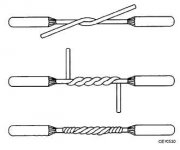
Having done electronics and auto electric for 40+ years, I would offer than crimp splices are NEVER as good as a WU splice and shrink tubing.
Mechanically, crimps will work loose with vibration.
BTDT.

ESPECIALLY on LBC's infested with Lucas, any joint done (or re-done) should be WU spliced and shrink tubed.

Yours is a little better than a stock crimp, as the shrink tubing will tend to keep moisture out a little better, but the crimp is still the crimp.

In a situation where there was no possibility of a WU splice, I have cut the plastic off crimps, crimped them on bare, soldered them, and srink-tubed them (or, if zero room, black taped them).

Those connections work 40+ years later.
 
<shrug>OK.
I am just speaking of the experience of having hundreds of these splices flying everyday without problems.
 

Attachments

  • 22694.jpg
    22694.jpg
    8.4 KB · Views: 267
Well I managed to find a spitfire at a junkyard someone already had there way with most of the wiring. But I managed to get enough to replace the melted wires. now its just time to separate the melted mass and soldering, heat shrinking and wrapping. I have a long few days in-front of me, and will be spending a lot of time under the dash.

Being on a very limited fixed income for the time being walking away with this wire for under $40 helps a lot.
 
I hear ya.
Try a "limited fixed income" with a Jag!

Steve- In the shops I ran, if a car came in with some part of the electrical dead, FIRST thing we looked for was a taped bulge hiding a crimp connector.
 
Gliderman8 said:
59triumphtr3a said:
What is a WU splice?

This is exactly what I did in my B. I've always joined two wires together this way just by instinct. Never realized it was a "formal" or "proper" way of doing it. :smile:
 
Will_Ringrose said:
Well I managed to find a spitfire at a junkyard someone already had there way with most of the wiring. But I managed to get enough to replace the melted wires. now its just time to separate the melted mass and soldering, heat shrinking and wrapping. I have a long few days in-front of me, and will be spending a lot of time under the dash.

Being on a very limited fixed income for the time being walking away with this wire for under $40 helps a lot.

It's not hard....just time consuming. Take one wire at a time to avoid mixing them up. I find it helps to get "Zen" about the whole thing...it'll take as long as it takes.....and when you're done you will indeed be that much closer to becoming one with your car! :smile:
 
Back
Top