• Hi Guest!
    If you appreciate British Car Forum and our 25 years of supporting British car enthusiasts with technical and anicdotal information, collected from our thousands of great members, please support us with a low-cost subscription. You can become a supporting member for less than the dues of most car clubs.

    There are some perks with a member upgrade!
    **Upgrade Now**
    (PS: Subscribers don't see this gawd-aweful banner
Tips
Tips

Electric oil pressure gauge

JimTR4

Senior Member
Country flag
Offline
Hi all,
Need some guidance here. 1964 TR4.
My mechanical oil gauge leaks ever so slightly and I have never been able to remedy it. I am fitting a new dash and don't want to chance getting oil all over it. I have got an electric gauge.
Question - where is the best location to install the pressure sensor/sender? Can it simply be placed where the mechanical gauge's capillary goes?
Many thanks

Jim
 
That should work fine, if there is clearance. If not, you can probably just bend the rigid tube away from the block a bit.
 
Yes. You should be able to remove the compression fitting from the block and screw the sending unit in its place. If the TR4 is like the Spitfire and GT6 blocks, a 1/8 NPT sending unit with a bit of Teflon tape on the threads will work fine.

Is the leak at the gauge head itself? The original Smiths arrangement had/has a fiber compression washer between the nipple on the back of the gauge and the inside of the fitting on the oil pressure line. Perhaps your gauge does not have the fiber washer or it has perished. I don't know if anyone stocks the fiber washer but you should be able to make one from heavy gasket paper or perhaps find a similar sized part at the local car parts store.
 
Meanwhile on another forum... there is a thread on converting a British car that came with an electric gauge to a mechanical gauge to have a more reliable unit. Certainly worth seeing if a washer will stop the leak. I was disremembering it was a leather washer but it's been a long time.
 
Yes. You should be able to remove the compression fitting from the block and screw the sending unit in its place. If the TR4 is like the Spitfire and GT6 blocks, a 1/8 NPT sending unit with a bit of Teflon tape on the threads will work fine.

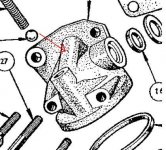
The wet liner block isn't like the Spitfire & GT6 blocks. The oil pressure comes off of a banjo fitting on the oil filter housing, a section of rigid tubing loops around and is secured by one of the fuel pump mounting studs. The flexible line takes over from there.
 
I noticed that Moss lists a leather sealing washer for the oil pressure gauge used on TR6s and some MGs. I would think it would probably fit a TR4. The part # is 435-515 and is .$65. If you are placing an order for other stuff, it might be worth a try. Or as others have said, make one from gasket material or leather. Berry
 
The oil pressure comes off of a banjo fitting on the oil filter housing,
I was wondering how many posts before someone thought of that :smile:
I believe that a TR4 is like a TR3 in that respect, the flex line is only about 8" long and then there is a hard line from there to the gauge.

As noted, there is supposed to be a sealing washer in that joint, which was originally leather. I substituted a nylon flat washer that seems to be working well but YMMV.

To add an electric oil pressure sender, I would probably drill and tap the oil filter head for it. The rounded ridge along the top is the feed to the oil galleries and there should be enough clearance there (electric senders tend to be on the large size). Have to be a bit careful though, to tap the hole deep enough for strength but not so deep that the end of the sender blocks the passage too much.

Oil Filter 2.JPG
 
I have tried replacing the washer before - although I "improvised" by using a fibre washer that was clearly not made for this gauge...
I'll try to get the correct washer and try again.
Thanks again for all the input.
 
Always possible that the gauge itself is leaking. But then I think you would see it filling with oil through the glass.
 
Had another closer look at it this morning. I may actually have 2 issues going on. Definitely a problem with the seal between the capillary and gauge but also I do see traces although not much oil inside.
I'd go for an electric version if I had an easy way to fit a sender - not keen on attempting the suggestion above but gratefully received. Looks like a New gauge and washer is needed.
 
Thank for the information on how the oil pressure gauge on the '4 is connected.

Out of curiosity, is your electrical pressure gauge a Smiths unit or something else?

I had another thought. Perhaps it is equally out of line since I am again thinking of the Spit and TR6 blocks. On those engines there are crossdrills off the main oil galley to the main bearings. The crossdrills are plugged with 1/8 NPT pipe plugs. If the TR4 block had those could you not remove one of those plugs and fit a sender there? If you could, it would be connected to the pressure in the main oil galley and that should be fairly close to what you see at the filter head.
 
Doug - the electric gauge i have is a Smiths unit. Although its not brand new its like the one in the link below (BP2404-00C). It looks very similar to the original oil gauge but marked Smiths not Jaeger (think they acquired Jaeger at some point?)

https://www.gaugeguys.com/Smiths/classic.htm

Jim
 
It's more interesting than an acquisition. Somewhere I have a printed Smiths history that explains (more or less) that there was an association between Jaeger (on the continent) and Smiths in the U.K. After a certain time the association was severed but Smiths continued to make and market its products under the Jaeger name. If you look closely on the face of a British car's Jaeger gauge it should say "British Jaeger" somewhere. The Jaeger gauges sold on the continent are/were very different.

I cannot think of any cars other than the MGB where an electric Smiths oil pressure gauge was ever installed as OEM equipment. That is not to say they are bad. However, I know that he ones used on MGBs have caused issues for some people and it's not unusual to see a person convert from electrical to mechanical.

Don't forget when you connect your Smiths electric gauge up that it needs to be powered from the voltage stabilizer and not a full 12V supply.
 
ah, that's interesting. Regarding my gauge situation, looks like i'll go mechanical even if it entails a new gauge. Can presumably get a new washer at same time.
 
I had another thought. Perhaps it is equally out of line since I am again thinking of the Spit and TR6 blocks. On those engines there are crossdrills off the main oil galley to the main bearings. The crossdrills are plugged with 1/8 NPT pipe plugs. If the TR4 block had those could you not remove one of those plugs and fit a sender there? If you could, it would be connected to the pressure in the main oil galley and that should be fairly close to what you see at the filter head.
The TR3/4 engine has the plugs, but they aren't NPT. I'm not sure of the threads offhand, but they are sealed with a special bolt and a copper flat washer (hence not tapered threads).

Not too hard to drill the bolt and braze a NPT bung to the head, but more work I think than just drilling & tapping the filter head. FWIW, I did something very similar on my Stag to add a mechanical oil gauge, and it worked out quite well. The Stag doesn't have an oil filter head like the TR does, but it does have an aluminum "transfer housing" so I drilled & tapped that, near where the sender for the idiot light goes.
 
Straight threads with a copper sealing washer might be G (BSPP) threads but I would be surprised if it were that.

It was just a wild thought anyway.
 
FYI, according to the Standard Triumph parts and spares catalogs, it seems the plug/bolt is 3/8" UNC 1/2" long.
Now is i could find a 3/8 UNC to 1/8" NPT reducing coupling I'd be set
 
That's an interesting product. Thanks for posting the link.
 
Back
Top