• Hey Guest!
    British Car Forum has been supporting enthusiasts for over 25 years by providing a great place to share our love for British cars. You can support our efforts by upgrading your membership for less than the dues of most car clubs. There are some perks with a member upgrade!

    **Upgrade Now**
    (PS: Upgraded members don't see this banner, nor will you see the Google ads that appear on the site.)
Tips
Tips

Elec. Pump -Part two

T

Tinster

Guest
Guest
Offline
So OK! I need some help.

The electric pump is NOT new, it was a gift from
a generous BCF member.

I attached the electric pump to fuel tank and carbs
and cranked the car. The pump made quite a clatter
and almost instantly filled the clear glass in-line
cylinder I use to monitor fuel flow. The car engine
started right up, warmed to a nice steady 800 rpms.
See photo below:

The clatter all of a sudden became a very quiet hummm,
the cylinder became empty and the car stalled.

I removed the new fuel filter (clean as a whistle) and ran
straight fuel lines. Banged the electric pump with a wrench
and cranked it over. Same results, Clatter got fuel,
hummm, no fuel engine died.

Reconnected the mechanical pump and still got only a trickle
of fuel into the glass cylinder. Enough fuel to hold 2000
rpms in the garage. Not enough to drive.
<<<<<<<<<<<<<<<<<<<<<<<<<<<<<<<<<<<<<<<<<<<<<<<,

Q: is this normal for an electric fuel pump?
Clatter or humm??

Q: Either type pump- should the glass cylinder be full?

Any suggestions as to my next step?

I DO HAVE a spare mechanical pump I've never used.

thanks,

dale
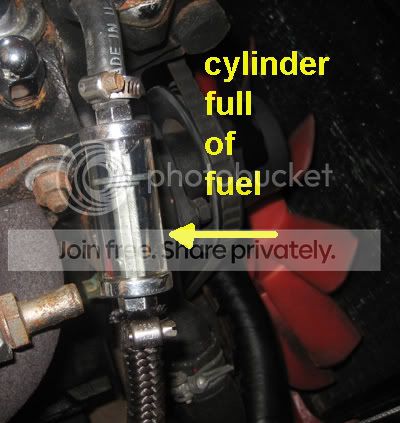
fuelCylinder.jpg
 
Dale,

The clatter is typical of an electric pump building pressure in a system. Nothing out of the ordinary there.

Its sounding more and more like a blocked line somewhere. If your pump didn't go back to being noisy when the fuel filter emptied, it could be in the line from the pump to the front of the car. If it were between the pump and the tank the pump should have gotten noisy again when it had less fuel running through it.

This of course assumes that the electric pump is in the rear of the car.
 
Dale

From what I have seen on electric low press pumps. When the pump is running (Moving fuel) the pump will make some nosie. When the press builds as when the engine is not running and the floats shut off the fuel pressure builds up and the pump will go quit untill pressure drops and fuel flows. Sound to me like the pump you have is not working right or something is restricing fuel flow.


Don
 
donbmw said:
and the pump will go quit untill pressure drops and fuel flows.
Many do work that way, but not all. The little rectangular Facet pump for example clicks all the time, even if no fuel is flowing. Can be annoying, if you don't take steps to muffle it (mine is soft mounted to a plate that in turn is soft mounted to the original pump mount).

Dale, your symptoms sure sound like something being sucked up against something else, and subsequently blocking the line. FOD in the tank or in the lines somewhere would be my guess. My best suggestion for finding it (since I know you've been through this multiple times) is to start disconnecting joints between the pump & tank, while the pump is running. If you hear a rush of air, then the blockage is between where you are and the tank.
 
You also should have a filter between the tank and the fuel pump inlet (as well as before the carburators.) Those small pumps can clog and stop working.
 
Dale,

The hum is caused when the pump draws a vacuum or is pumping with no discharge head. In your case I would bet on a partial blockage between the pump and tank as others have mentioned.

I believe you have installed a shutoff valve just below your tank, if so start at the tank (or pump), disconnect the fuel line, then open the valve and see if fuel flows freely, which it should. I would let it drain at least a quart each time.
 
OK- maybe a learning curve involved.

I reconnected the electric fuel pump, warmed the car up,
smooth 800 rpms, and took it around the block. (it figures today the new speedo cable would fail !!)

The pump makes a loud clatter I can hear from many feet
away with the hood closed.

Backed out the garage- no problem
Ian: I punched (3500 rpms) it up the hill where we sputtered.

No problem hitting 4K rpm in 1st gear
No problem hitting 3.5K in 2nd gear- ran out of road.

Whie driving I could hear the electric pump cycling thru
loud clatter, engine sound only, loud clatter, etc.

Back in the garage, engine running, hood open with about
3,000 rpms held- I could watch the clear glass cylinder cycle thru almost empty to a gush of fuel to almost empty, etc.

The clatter from my engine bay mounted electric pump is quite loud. It is a Purolator PRO-12S

A video of the sound follows

Q: Is this pump A-OK
Q: Is the car now streetable?

 
Tinster said:
It is a Purolator PRO-12S
that little square pump is actually the Facet pump, and they make allot of noise. You could mount it on a bit of foam so that the sheet metal it is mounted on doesn't amplify the noise quite as much.
 
Dale, I still think you have a partial blockage somewhere, I say this because you indicated the engine sputtered, ie starved of fuel.

Another way to eliminate the possibility of blockage in you fuel line is to disconnect the discharge side of your pump, then attach a hose long to reach a collection container. Next turn on the pump, you should see a steady flow of fuel. If not, you have a blockage somewhere.
 
And to check pump capability, you could provide fuel from a container that is NOT the fuel tank. That way you can isolate restrictions.. Hose to gas can(or some other container) then check volume and pressure at carburetors...
 
Tinster said:
Back in the garage, engine running, hood open with about 3,000 rpms held- I could watch the clear glass cylinder cycle thru almost empty to a gush of fuel to almost empty, etc.
That doesn't sound normal to me. Each tick of the pump should deliver a small shot of fuel, which you can see sometimes, but certainly not what I'd call a gush. And of course the little pulses happen quite quickly (which is why it sounds like a clatter instead of individual ticks). The change in pump sound also doesn't sound right.

Don't know what it is, but I wouldn't quit looking.

It sounds like you are saying that there is first less air in the glass cylinder and then more air ... wonder where that air is coming from ? Almost sounds like there is an air leak on the suction side of the pump that is opening and closing somehow.
 
Hey Dale,

These pumps have to have gas flow so mounting location is critical. If you mount it below the tank as a pusher, all is well. But since you've mounted yours up front as a puller, it need to be gravity fed gas, so it must be mounted low enough to avoid air bubbles. Might explain pulling air if your fuel level is low. Might not.

They're also designed with a screw in filter (that is not in your picture) to stop crud. And lastly (obvious), there's an arrow on the pump indicating fuel direction. Never hurts to check everything.
 
From looking at your video, I think that Peter may be on to something with the height of the pump. Is the fuel reaching the pump via gravity?
 
Brosky said:
From looking at your video, I think that Peter may be on to something with the height of the pump. Is the fuel reaching the pump via gravity?

<span style="color: #CC0000">No Paul, but the pump is rated to draw a 12" lift.

In any event, I swapped in my last mechanical spare fuel pump-
just as it got pitch black night down here. The engine
cranked, fired up and idled smoothly. By flashlight I could
see the glass cylinder almost filled with gasoline.

Tomorrow in daylight, I'll check thru the system and drive it.
If the car runs A-OK, I'll forward your pump to you to take it
apart and see what's up. It worked great one day (full glass cylinder)
2 days later barely a trickle and nothing over 2,000 rpms.
Stumbled down the street and barely got back into the Crypt.
(No, NOT electrical-Ian and I both checked)fuel starved.

Your pump is too beautiful for me to open!!

Mighty puzzled, I am.

d :wall:</span>
 
I'll be very curious to see what's going on inside. Or, what may not be inside, which will lead us to another set of circumstances for investigation.

I built yours after mine. Mine is running strong to three carbs (knock on wood!!), so I'll be very curious to see if that bad fuel did anything to the new valves or diaphragms.

TR6 fuel pumps are not rocket science. Why wait for me to get it and see what's wrong??

Why don't you remove the top cover of the pump and look at the mesh screen?

Gently remove the screen and then look down into the wells and see what is in there?

Then take off the six (6) screws around the top housing and look at the diaphragm?

Also look at the inlet and outlet valves to see if anything got the fouled up?
 
Paul,

That bad fuel never touched your pump.

I installed your pump AFTER the bad stuff.

Your pump has maybe 110 miles of high test,
pre-filtered fuel run thru it. Your pump was
a component of my total system replacement.

Only gas station gasoline- no bottled additives/

regards,

d
 
OK, so you still want to pull it apart and check the insides?

If it's OK and your new electrical pump is OK, you must have a restriction either before or after the pump.
 
Brosky said:
OK, so you still want to pull it apart and check the insides?

If it's OK and your new electrical pump is OK, you must have a restriction either before or after the pump.

<span style="color: #CC0000">Paul,

The electric pump is NOT new and I do not
think it is working properly.

I removed the spotlessly clean, pre-pump
fuel filter this morning.

No filters, straight shot from tank to pump.
Straight shot from pump to carbs.
All new lines, blown thru with carb cleaner
before I installed them.

Seems like a no brainer but something is amiss.

d</span>
 
Hi Dale. Do you have a flexible hose between the tank and the steel fuel line? Do you have another, between the fuel line and the fuel pump? Were they replaced when you re-built the fuel system? I am asking because the symptoms you have described could be caused by a hose that has walls that are collapsing. I can't remember. Is your TR6 gas tank vented? I remember years ago when I was a high school kid cutting lawns in the summer. I had an old mower that I picked up and rebuilt. One time I couldn't get it started no matter what I did and just about wore myself out. I didn't realize that my dad was watching all of this from behind a tree. Finally he appeared and told me to unscrew the gas cap and try again. It started on the first pull. The vent hole in the cap had been plugged with dirt and fuel could not flow to the carbs. This is an over simplification, but it's worth checking.

good luck
 
Back
Top