• Hi Guest!
    If you appreciate British Car Forum and our 25 years of supporting British car enthusiasts with technical and anicdotal information, collected from our thousands of great members, please support us with a low-cost subscription. You can become a supporting member for less than the dues of most car clubs.

    There are some perks with a member upgrade!
    **Upgrade Now**
    (PS: Subscribers don't see this gawd-aweful banner
Tips
Tips

Don’t get BURNED

RAC68

Darth Vader
Offline
A friend just called me to say that his LBC was just deep fried. He hypothesizes that a battery line running under the car must have been rubbing for quite a while and finally wore the insulation and dead shorted. Since the engine was running, he estimates that between 130Amps and 160 Amps (contributors Alternator = 60 Amps, Battery = 100Amps.) surged through the electrical system and started the fire.

Although I have installed fuses on all critical circuits, the one not protected is the main backbone from battery to alternator. I am interested in what and where to install some sort of power interruption protection on this electrical backbone. I am looking to interrupt, as well as protect, power coming from the alternator as well as the battery from fast frying my Healey.

What electrical components should be used?
Where should these components be installed to protect the alternator and battery?
What Amperage value should be passed before tripping?
How should they be installed?

I would appreciate your ideas.

Ray (64BJ8P1)
 
My initial thoughts:

  • I'm sorry to hear about your friend's fire.
  • In all cases, the battery cable goes directly to the starter solenoid, or to ground.
  • In the case of a Healey, the ground battery cable goes through the cut-off switch. I'll assume since you have an alternator, you have negative ground.
  • The reason for going directly to the starter solenoid is that the starter draws a LOT of current; much higher than your friend estimated caused his fire. Note, batteries are rated by cold cranking amps (CCA), with values being on the order of ~500 amps, although typical starting currents are about half of that. Although one can put 500-amp fuses in so you can still start the car, they won't protect against a dead short to ground. That's why the first fuse on a Healey is the 50-amp fuse at the fuse box.
  • The best protection is to periodically check that battery cable.
 
  • The best protection is to periodically check that battery cable.

I agree with that completely. Trying not to sound harsh, but I believe you have too many fuses installed already. To the point I believe it increases a chance of failure.
 
Thanks John/Greg. The car that burned was a real beauty and very well cared for. The fire did not totally destroy the car but damaged it to the point of requiring a considerable redo.

John, I understand the high amperage needed to start the car and I also am well aware of, and understand, the circuitry of my Healey. I have chosen not to depend upon the meager electrical protections common in British cars of the ’50s &’60s and to modernize in a discrete way (alternator, relays, sound system, fuses, etc.).

Since the ’70s fuse protections have been placed on critical circuits in most, if not all, cars and, when alternators were introduced, fuse links installed on alternator battery connections. I am sorry if I was unclear but I wanted to solicit ideas on what to use (fuse links, circuit breakers, fuses) as I already have mad a decision to install.

Example: Alternator Fuse Link
It is my understanding that the common approach to sizing an alternator fuse link is to choose a link with a 20% margin over the max output of the alternator. Based upon this criterion, I would choose a link rated at between 72 Amps and 80 Amps to cover my 60 Amp Delco (dependent upon availability). Another approach suggests a link 2 gauges below the alternator’s battery wire be chosen. Since I have installed a 10 gauge independent line to carry the charge, the fuse link should be 14 gauge.

Example: Battery Ceramic Fuse
I am aware of ceramic fuses used to protect long cable runs from a battery, however, I am not clear on what rating to choose for the reasons John presents. Since we are dependent upon quite a long cable run that is exposed to the elements, I anticipate installing something very close to the battery and, possibly, between the battery and cutoff switch. Although high amperage cold start battery rating would require as much as a 600 Amp fuse, I expect that something in the area of 1/3 that value (150 Amps – 200 Amps) would be more appropriate (based upon the Healey’s expected use).

Objective:
Should a cable, starter, alternator, or battery dead short occur, I expect:

  1. the (2) 20 amp circuit breakers leading to the cabin and lights will trip,
  2. the alternator fuse link will trip
  3. the battery ceramic fuse will fault
prior to causing the wires to glow orange with flames erupting from the harnesses.
I would appreciate hearing if anyone knows any reason for this would not happeni.

Again, thank you for the comments received as I appreciate and evaluate all inputs.

Sorry for being so verbose,
Ray (64BJ8P1)
 
RAC,

i had a FFR cobra kit car for a dozen years. A number of guys would use a 100 or 150 amp automotive circuit breaker for this purpose. Most chose ones with a manual reset. Here is a link to some choices. (Click on word "choices", not sure why its not showing up as a hyperlink)

Just for memory sake

582dbd10.jpg
 
Hi Ray
I have a circuit breaker on my sail boat windlass system 100A 12V 1000w , never experimented a cut out in the last 8 years
on my precedent boat, the protection system are one small diameter wire crop, 20cm long ( before the big wire of the system)
it work, during one **** anchor crossing with the neighbor boat in a Croatian bay - it burn as intended, with no damages at the anchor system
Difficult to suggest the diameter of the crops, it must be NOT so small and NOT so big,
musician composer sensibility CAN help
Cheers
 
The battery cable on my BT7 burned through where it goes through the wall of the boot and melted a lot of metal. This happened early on in the cars life. Apparently it came from the factory with no grommet installed and this was not obvious because it was behind the boot lining. A periodic inspection of the cable front to back might be in order. Having a major flash that near the gas tank was not fun. The cable runs underneath the car on the inside of the frame and can be subject to a lot of wear and tear
 
Ray,

Depending how you have your alternator connected, you can use a fuse, circuit breaker, or fusable link to protect it. Self-resetting or manually-reset DC circuit breakers are great for when you touch a screwdriver to ground. Don't have to buy a new fuse.

I do a lot of 12-volt wiring on my RV and I have a 200-amp marine fuse between my house batteries and my inverter which can draw up to ~170 amps when operating the microwave off the batteries. It's within 6 inches of the positive battery buss bar (neg ground). Yes, it protects against a catastrophic failure in the battery circuit, but It's not an engine starting circuit. If your friend's car burned with 100 amps coming from the battery, any fuse that will allow the car to start won't protect against that. You could start your Healey when it's cold and measure the starting current, and size a fuse to exceed that (20% sounds about right), but I don't think that will protect you from a fire if you get a dead short in the cable.

If you go that route, I would put it in the ungrounded cable rather than between the battery and cutoff switch. If the grounded cable touches ground, nothing happens. Also, you can put the fuse behind the fuel filler cover so it doesn't show.
 
Thanks All for your responses.

Healey_Z, thanks for the link. I like the manual reset circuit breakers referenced and, although I still want to check the starter amperage as I may have greatly underestimated the needed amperage, find a manually resettable breaker a major benefit.

Andrea, your thin wire sound like a wire “Fuse Link” and I’m considering the use of an 80 Amp version or a resetting circuit breaker. The wire fuse link is convenient as it would only require crimping it to the end of my 10 gauge line from the alternator. However, the resetting circuit breaker is reusable and that is nice if the issue hits you on the road and the problem can be rectified.

Thanks Richard. Your experience and cable risk evaluation is what I am looking to protect against. If this condition happens with the engine running, I would expect the alternator and battery will both try to satisfy the draw resulting in ???

Hi John, I like your reasoning behind the use of a self-resetting circuit breaker for the alternator and am in the process of identifying a good incognito location for the unit. As you suggest, I will be testing the draw of the starter to identify a reasonable amperage requirement (+ % margin). However, as you originally indicated, my estimate of 150 Amps may be way off. A conversation with a long time friend, who owns multiple LBCs and is a master mechanic, suggests that the starter draw of a modern 6 cylinder car is in the range of between 240 Amps and 300 Amps and expects the Healey to be to be greater. Amperage in this range would greatly reduce the choice protection device but is still doable.

I am now evaluating where to install a unit to protect the battery. Given, the unit should be installed as close to the battery as possible, would an installation on the ground line leading to the switch be effective. Since battery power requires a circuit, I would expect that a cable short will cause a massive draw that would be felt on both sides of the battery. If this assumption is true, then placing a fuse on either side of the battery would be equally effective? Am I correct?

Thanks for all the responses as they are appreciated.

Ray (64BJ8P1)
 
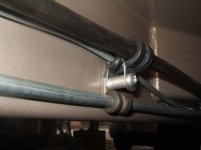
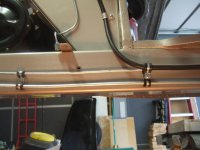
While doing my frame-up I decided to install "aircraft style Adel clamps" to insulate brake, fuel and battery cable better than the original metal P-clamps. I noticed during the dismantle that a few of the P-clamps had really rubbed the metal brake lines in a couple of places. I believe the Adel style clamps will best help protect against line and cable failure in the long run.
 

Attachments

  • DSCF6334.jpg
    DSCF6334.jpg
    88 KB · Views: 106
  • DSCF6314 - Copy.jpg
    DSCF6314 - Copy.jpg
    87.3 KB · Views: 112
Back
Top