• Hey Guest!
    British Car Forum has been supporting enthusiasts for over 25 years by providing a great place to share our love for British cars. You can support our efforts by upgrading your membership for less than the dues of most car clubs. There are some perks with a member upgrade!

    **Upgrade Now**
    (PS: Upgraded members don't see this banner, nor will you see the Google ads that appear on the site.)
Tips
Tips

Do I have the wrong rings?

Well mikespain, if you get right down to it. The best way was to do a cylinder leak down test before pulling the engine down. That said, internal mics. are somewhat hard to get an accurate reading with unless you use them for a living, same with snap gauges. The best way is to use a bore gauge, which is inexpensive, however, to do it right, one would need a set of mics. to set it up. Without the mic., you could check taper, which should work also, as there should be no wear at the bottom of the cylinder. If one checks the ring gap at 3" down, and the stroke is more than 3", then you still may have excessive gap, however, not as much as say 3/4" down. If the block has 3-4 thousands wear, or even less, ring gap will probably be at or over the limit in the specs. There has been nothing magical about AE parts, the problem is the other parts sometimes come up far short in the quality control deptment. My concern is that the block has be bored, or has excessive taper/wear, and Basil will get stuck with a set of rings he don't need. In my opinion, AE parts are the only ones worth 2 cents for British Cars.
 
Well,a leak down test wasn't done and the question now is why are the ring gaps larger than specified,and I still maintain(and was trying to explain) that the bore should be measured accurately(by basil or taken to a machine shop) before any new rings are purchased to ascertain whether the bore size is within specified limits or excessive which will then will give you out of spec ring gap whatever the make of rings that are purchased
 
I appreciate all comments - I bought a set of T-gauges and have measured the bores and they are standard 2.9" almost exactly. There does not appear to be any (or at least very little, if any) difference between measurements at the upper part of the bores and the middle and the lower part of the bores. This leads me to believe the bores are standard size and not bored over-size. There appears to be very little wear (there is no discernible ridge). The pistons are also standard size. I have no idea why the ring gaps are larger than they should be, but at this point, I have ordered a new set of Standard AE rings. We will see when they arrive how the gap looks then.

For the record - A leak-down test did not occur to me for a couple of reasons. First, the main reason I pulled the engine was not the oil leak, but that the head gasket blew and 2) I honestly thought the oil leak problem was related to the rear seal not being fit correctly. Since the engine had been rebuilt by a machine shop less than 2000 miles ago (and I assumed they knew what they were doing) an issue with the rings or pistons wasn't something that was high on my list of concerns. The pistons were brand new and came with the rings (they're AE by the way).

So as long as I had to do the head gasket anyway, I decided to just pull the motor and go though everything - check the bearings, mains, and make certain the rear seal was installed properly, etc. It was just dumb luck that I discovered the ring gaps were way too large. That is what then got me thinking that "might" have something to do with the oil leak problem. Hindsight is always 20/20, but improper ring gap really didn't seem likely.

Anyway, the new rings are on the way and I'll check the gaps when they arrive. Whether this is going to have any effect on the oil problem remains to be seen, but I'm hoping it does help.

Keeping my fingers crossed.
 
Searcher, I don't think that ANYONE is that much of a buddy........
 
Yea, you are probably right Brosky. Besides, he's probably the type guy who if he did loan it to me, it wouldn't have any gas in it when I got it.
 
<span style="color: #3333FF"><span style="font-size: 12pt"><span style="font-family: 'Century Gothic'">The new Standard (AE) rings arrived today! Preliminary test (on just one cyl) indicates the gap is MUCH better now. The gap measures about .010" and what is better, the gap is virtually the same at the top of the bore as it is at the bottom (I check it at three locations, top, middle, and bottom of travel).

I am really hoping this helps the car's rear seal oil leak problem too (I plan to install a new seal anyway)!

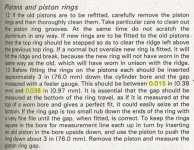
Now my book states the gap at 3" down the bore should be between .015 and .038 (max). Should I file a tad off the end to get at least .015 or just leave it at .010 as it is now since it is the same at the top of the bore?

Basil</span> </span></span>
 
In the TR6 specs, if I remember right, all 3 rings should have different gaps. What book are you looking at? It is unusual to have AE not right on spec. If you are measuring right, and the book is right, I would not go against the book. Triple check everything. Find out what the factory book says, and stick to it. Check the crankshaft where the rear seal rides for wear/rough spots, check the seal on the crank before you install it, should be a firm fit. Make sure the spring doesn't fall out when you install it, and put some lube on it. Also I use some sealer on the out side the seal. 3-4 thousands per inch of bore is a rule of thumb for ring gap, to tight is not a good thing. Thanks for your help.
 
TheSearcherMan said:
In the TR6 specs, if I remember right, all 3 rings should have different gaps. What book are you looking at? It is unusual to have AE not right on spec. If you are measuring right, and the book is right, I would not go against the book. Triple check everything. Find out what the factory book says, and stick to it. Check the crankshaft where the rear seal rides for wear/rough spots, check the seal on the crank before you install it, should be a firm fit. Make sure the spring doesn't fall out when you install it, and put some lube on it. Also I use some sealer on the out side the seal. 3-4 thousands per inch of bore is a rule of thumb for ring gap, to tight is not a good thing. Thanks for your help.

My book is a Haynes manual. It does not talk about 3 different gaps for different rings. If anyone has a factory manual handy for a 78-79 Spit 1500 I'd be interested in what it says.

TheSearcherMan said:
Thanks for your help.
No, thank YOU - and thanks to everyone for their help here.
 
I can't find any spec's in my Bentley reprint, which only covers through 1975 but includes the 1500 motor. Only spec. I can find at the moment is in a factory manual for the 1300 sedan, but the bore is the same size in that engine. Spec's there are: ring gaps in cylinders (new) are .012-.022; oil control ring gap is .019-.009 (yes, that's how it's given)!
 
The oil control ring gap is usually larger because it (they-two) have to retain and compress a spreader band. The other rings are individual.

Now Basil, don't take this wrong, but you do have a plan for "clocking" each row of rings in relation to the one above and/or the one below it?
 
Paul brought up the query that was in my mind, as I was scrolling down through this thread. Make sure you space the ring gaps around the piston, where none of the gaps are on a thrust surface... You should be able to find PLENTY of info on ring installation in an internal combustion 4 cycle engine. Even if it's not a Triumph this basic engineering principle applies to darn near every reciprocating piston, internal combustion 4 cycle engine..
 
Brosky said:
The oil control ring gap is usually larger because it (they-two) have to retain and compress a spreader band. The other rings are individual.

Now Basil, don't take this wrong, but you do have a plan for "clocking" each row of rings in relation to the one above and/or the one below it?


If by "clocking" you mean offsetting the gaps around the piston so the gaps don't line up - then yes, I had planned to do that for sure.

Ron - I had not thought about not having the gaps on the thrust side, but that makes sense! I'll be sure to observe that as well.

Thanks
 
Brosky said:
So far, so good............

I will be extremely happy camper if this happens to fix the oil leak that had been driving me nuts for so long!
 
A friend of mine looked at his Haynes book for the 1500 engine, he said it's .012-.022 for the top 2 rings, and .015-.055 for the oil control ring. What's the deal, 2 different Haynes manuals? I think if you put the ring in the cylinder, square it with a piston, you will find you have more than .010. Are you wearing your reading specs? You can buy them at the War-Mart for a couple bucks. Also, remember, them rings snap very easily....., and you have to buy a whole set to get just 1.
 
TheSearcherMan said:
A friend of mine looked at his Haynes book for the 1500 engine, he said it's .012-.022 for the top 2 rings, and .015-.055 for the oil control ring. What's the deal, 2 different Haynes manuals? I think if you put the ring in the cylinder, square it with a piston, you will find you have more than .010. Are you wearing your reading specs? You can buy them at the War-Mart for a couple bucks. Also, remember, them rings snap very easily....., and you have to buy a whole set to get just 1.

Well, this is interesting. My Haynes book has two different sets of numbers listed in two different parts of the book. The numbers you mentioned are indeed up in the front of the book listed in the specs section. However, in the engine rebuild section, under the <span style="font-style: italic">Pistons and Piston Rings</span> section, it lists .015 to .038 (this is with the rings 3 inches down the bore). And yes, I did use the piston to push the ring down to ensure it was square and I even went so far as to carefully measure the distance of the ring in several places to ensure it was a uniform distance. And the clearance is about .010 as stated before (I double checked). It's not that far off from the smaller number you mentioned, but .005 off from the smaller of the two numbers listed in the body of the book.
 

Attachments

  • 13701.jpg
    13701.jpg
    65.8 KB · Views: 107
So why does a 1500 require such huge gaps? A TRactor motor has a bigger bore (which would presumably require more gap to allow for thermal expansion), but the specified ring gap is only .003 - .010".
And my 1300 manual agrees with Andy's (likely the same manual) at .012 - .022"
 
Back
Top