• Hey Guest!
    British Car Forum has been supporting enthusiasts for over 25 years by providing a great place to share our love for British cars. You can support our efforts by upgrading your membership for less than the dues of most car clubs. There are some perks with a member upgrade!

    **Upgrade Now**
    (PS: Upgraded members don't see this banner, nor will you see the Google ads that appear on the site.)
Tips
Tips

TR2/3/3A Differential question

Philthytoo

Member
Country flag
Offline
From what I've read, the first step in re-assembling the differential is to set the pinion shaft front-to-back, using shims at the head bearing, then set pinion shaft bearing pre-load using shims between the tail bearing and the spacer. The shims at the head bearing fit between the case and the bearing race. Using a drift to remove the race to adjust the shims will damage the shims. Is there a reason why some of those shims could not be placed between the bearing cone and the pinion gear, at the other side of the bearing? Adjusting that shim pack thickness could then be done by removing the pinion shaft from the bearing, and with the race left pressed into the housing.
Thanks, Phil
 
There doesn't seem to be any reason; in fact they did it that way on later differentials (TR6 and Stag). However, it's still hard to pull the bearing off without damaging the shims, and you're more apt to damage the bearing as well.

ejVMFzn.jpg
 
If you plan to do differential work, you will need a bearing puller like Randall shows. Using a drift to remove bearings during the set-up is asking for trouble with your new bearings. I only have the lower, "scissors" looking part, and then I use a cheap press to replace the top parts in his pic. With the puller you will not damage the shims or bearings as you perform the repeated disassembling and assembling.
 
Thanks for the replies! I have a set of bearing pullers like the one pictured (I've always heard them called "splitters", since they begin to remove the bearing as the cross-bolts get tightened). My reference to the drift was about removing the race from the housing. The shims I removed were behind the race, and were destroyed while I was driving the race out. Removing the race every time a shim adjustment needed to be made could add up to needing a lot of shims, as well as potential damage to the race. With the puller pictured that bearing came off easily, almost without needing a wrench to turn it.
 
Great! When I bought the "splitter", in 10th grade, I did try to use it as you did, as a puller by tightening the bolts to "split" the bearing or race from the shoulder. I learned quickly that it doesn't work well that way! It is made to tighten snuggly below the race, and then pull on it to pull the race off the shaft. So the splitter does not have to fully reach the shaft, and thereby damage the shims.
 
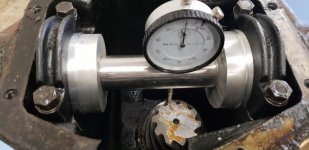
I agree about the splitter, it needs the other parts to fully remove the bearing. I have a friend who is a retired machinist. He doesn't know it yet, but I'm gonna be knocking on his door soon to make an indicator mount like the one pictured.
Thanks Everybody!
 
Back
Top