• Hey Guest!
    British Car Forum has been supporting enthusiasts for over 25 years by providing a great place to share our love for British cars. You can support our efforts by upgrading your membership for less than the dues of most car clubs. There are some perks with a member upgrade!

    **Upgrade Now**
    (PS: Upgraded members don't see this banner, nor will you see the Google ads that appear on the site.)
Tips
Tips

Crypt Car Won't Start. Advice?

T

Tinster

Guest
Guest
Offline
Mike Masters and I pretty much completed the install
of his Dad's Power Block wire harness today. Everything
checks out fine and everything functions properly.
Unbelievable how quickly Mike got things into working order. (Didn't hurt we had a direct line to Dad, either!!)
I'll post some good photos later .

Late last evening a mechanic friend of mine who owns
a 1962 MGA entered the Crypt and hooked up Jeff Paltech's
fantastic twin Stromberg carbs and new intake manifold
...but the car would not start.

I have installed a brand new alternator, new battery, new plugs gapped at 25 and new coil as well.

The engine cranks like a champ but will not kick over into
running mode. Spark plugs throw a bright white colored spark.

We sprayed some DW40 into the carb openings but still no ignition.

Good strong spark at the plugs but they seem dry of gasoline when we pulled them out. Gasoline pumps thru the fuel line to the carbs very well. Mechanical pump.

We took out two plugs and dripped a few drops of gasoline
into the cylinder heads. We replaced both plugs and the
engine fired both cylinders and then quit.

Any suggestions? We are kinda stumped. All hoses in place,
all nuts and bolts tight, all gaskets brand new. Fuel does not seem to be entering the cylinder heads.

No gasoline or DW40 smell at the tail pipe until fuel was dripped directly into the 2 spark plugs holes.

Thanks as always,

dale
 
If you are getting gas to the carbs but not into the cylinders, either the intake ports are blocked, not likely, but folks have left rags in them before, or the carbs are not flowing fuel. Check that the float valves are not stuck closed or plugged.
D
 
Dale, didn't you post a pic a while back that showed how nicely you blocked everything off after you removed the manifold to send out for rebuild of carbs? Maybe Dave is on to something. Also, have you notified Jeff? He is well renowned for his support after the sale.
 
[ QUOTE ]


Late last evening a mechanic friend of mine who owns
a 1962 MGA entered the Crypt and hooked up Jeff Paltech's
fantastic twin Stromberg carbs and new intake manifold
...but the car would not start.


[/ QUOTE ]


MG....entered crypt....PR....

Almost sounds VooDooesque. I think the MG guy put the gris-gris on your car.

Were the carbs sent to you with a kind of universal adjustment or were they possibly completely closed down by accident. I think the carb adjustment tool might be used to check the valve down in the dash pot. Gas in the float chamber? Knowing your obsession with detail, I know
you wouldn't have left anything blocking the intake....would you?


Bill
 
Now that I've read the previous posts again, make sure you check deep into the intake ports to insure that nothing is in there. If you had blocked it, and something did get sucked in, it may be in there even further if it fired over, even momentarily.

Also, as I mentioned earlier, don't hesitate to call Jeff.
 
This response may be considered as stupid but did you check the float bowls to see if they actually had gas in both of them?
CAREFULLY misting a small amount of gas into the throats of the carbs with a sacrificial plant mister (one spritz) should also work as a fire no fire test. An easier way to introduce fuel into the system compared to introduction via the plug ports. This will also eliminate some of the possible blockage points, seeing that you now know that the plug port introduction of fuel works.
Before anyone goes bananas, I cannot emphasize enough,that you should NOT /ubbthreads/images/graemlins/nonono.gif use more than one spritz. If you flood the port and you get ignition you will have a pair of flame throwers on your hands at a minimum, blown manifold and carb seals everywhere as a medium and of course a major fire risking your car, your building and possibly your life at the maximum. /ubbthreads/images/graemlins/nopity.gif
Ether is introduced into carborated gas engines, as well as heavy equipment diesel engines this way in order to start them during the extreme cold in the northern parts of /ubbthreads/images/graemlins/canpatriot.GIF during winter months.
Yes, I have seen many flame thrower "demonstrations" in the past /ubbthreads/images/graemlins/jester.gif
 
When I use starter fluid I spray one quick spritz on the air filter (not down the throat of the carb) and then try to start the car. Starter fluid will work MUCH better than the WD40.

My thoughts were similar to those above who suggested that there is no fuel in the float bowls. Remove the bowls to see if there is actually fuel in there. If there isn't, since you know the pump works, examine the float valves and the float height. Make sure you set the floats to the correct height as specified in your manual. It's easy to set this wrong and have the fuel in the bowl be too shallow.

Once you've done that, make sure you set the jets to their nominal "start my car" setting. Don't worry about final adjustments until after you've balanced them and warmed up the engine.
 
Dale, Jeff completely sets the carbs and flow tests them as well. Before you take apart everything that he's done you should at least call him to protect any warranty that he may have. I'm not saying the advice given is incorrect, just that you spent money to have them redone and everyone who has ever used him has said the car started right up after the installation with no problems.
 
So, does Carolina starting fluid smell like /ubbthreads/images/graemlins/canpatriot.GIF starting fluid?
Canuck fluid is pure ether. Don't inhale now !!!
 
One other thought... could the timing possibly be off by 180 degrees? Certainly not hard to do on a 4-cylinder and when done everything checks out fine... except no firing.
 
Sorry... I didn't mean to suggest anything that would invalidate a warranty. It just sounds to me like either the float valves are blocked or not set correctly. By all means, since you paid for a rebuild contact the supplier first.

If the timing were out 180 degrees... would the car have fired on the gas poured in through the spark plug holes?

I'd guess any N. American starting fluid would smell the same. Actually... I looked on a can recently and there was other stuff in there that I wasn't expecting. It wasn't 100% ether.
 
[ QUOTE ]


If the timing were out 180 degrees... would the car have fired on the gas poured in through the spark plug holes?


[/ QUOTE ]

I think it would have fired if only for the presence of gas in the chamber when a gasoline-dipped spark plug lights up.
Sure won't run right. Good way to mess up an engine, firing on the wrong stroke.

The kicker here seems that the engine has run for a number of miles (60+) before the breakdown, and now it doesn't run at all. Unless Dale took the dizzy out (did he?) and replaced it wrong, kinda hard to do with the offset drive dog.

Gotta be the carbs or intake. Set timing statically yet? Yeesh, this is an enigma.


Bill
 
Better an enigma, than an enema. Anyhow, Dale never said anything about removing distributor.

I've read at least 10 posts from different individuals who have bought the carbs from Jeff and they all said how pleased they were that the carbs only needed minor tweaking after the install. All said the cars started right up. I hope that Dale got to talk to him. He does offer free support after the rebuilds are done for installation and tuning.
 
Thanks to everyone. We finally got the Crypt Car
to fire up and run (sort of run).

Tomster was closest in solving the problem. Here is what
Mike and I came up with. A good learning experience for
anyone in the future who switches out carbs.

Mike and noticed the carbs did not seem to be sucking
in air. So we figured maybe since the system was dry
there was not enough RPMs from the starter motor to pull
air and fuel.

So we got out the Big Red in case of fire and spritzed
some gas directly into the intake manifold. Kinda like priming the swimming pool pump after repairs.

Engine kicked over a few RPMS with fire in the hole and
then died quickly. Another spritz and a longer duration
of fire in the hole.

After about 5 or 6 of these cycles, we managed to hold
power at the carbs but at fairly high RPMs (3000+).
We could restart in full choke with engine at high RPMs
and running very rough.

Could not resist. With Mike manually running the carbs,
Dale got inside, tried 2nd gear with a tad of clutch
and the Crypt Car moved 12 inches under it's own power before Dale hit the kill switch.

So now it looks like a matter of fine tuning, timing, etc.
Yes, the Crypt Car had a smooth idle at 700 RPMs when it died.

Oh yeah, the two dummies did all this engine start, testing
running ......with the oil pressure gauge mounted in the
new dash board sitting on the dining room table.

I now have two quarts of oil in the passenger foot well.
I guess the oil pressure is outstanding.

But the Crypt Car will now startand Dan Masters wires
look ever so awesome and everything now functions!

Thanks to Dan Masters, son Mike, Jeff Paltech and all the
good folks here, I think I have now officially graduated
from Crypt Car tinkering to rolling restoration novice.

A very good week indeed.

Dale
 

Attachments

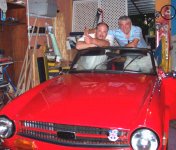
  • 262814-running.jpg
    262814-running.jpg
    151.7 KB · Views: 114
Whew! I was praying with bated breath. (Not really praying, Mickey, don't get excited.) Let's say I was holding my breath, and praying you had a good fire extinguisher nearby.


Bill
 
Keep us posted. After you bail out the interior, that is.
 
The oil will act as an excellent rust preventative if left in the pans, bit of a bitch on the pants though... /ubbthreads/images/graemlins/jester.gif
Glad my suggestion helped. I had a weak gasket in my rear carb which created a starved gas issue if the car hadn't been run for a week or so.
 
[ QUOTE ]
bit of a b.... on the pants though... /ubbthreads/images/graemlins/jester.gif


[/ QUOTE ]

Woops, I am sure in Canadianese, that means something else.


Bill /ubbthreads/images/graemlins/angel.gif
 
I recently resurrected a Stromberg for my '72 Spitfire. Same thing - would only run under full choke, and terribly.

I checked everything - float levels, fuel pump, freed up the slide etc.

Still terrible. Turned out to be what's called the "bypass" valve. If you are looking at the intake of your Stromberg, it is on the right-hand side, and is held in by three screws. There is a tiny diaphragm inside. It was in good shape, but seized. I freed it up, and INSTANTLY the car barked to life like nothing happened. This is with a carb that hadn't been used in three years.

Hope that helps,

Adam Hendrickson.
 
Back
Top