• Hey Guest!
    British Car Forum has been supporting enthusiasts for over 25 years by providing a great place to share our love for British cars. You can support our efforts by upgrading your membership for less than the dues of most car clubs. There are some perks with a member upgrade!

    **Upgrade Now**
    (PS: Upgraded members don't see this banner, nor will you see the Google ads that appear on the site.)
Tips
Tips

Crypt Car diagnostics-step 3

Tinster said:
<span style="color: #000099">Edit: I pulled the fat, center wire out of the coil.
I stuck a screwdiver in the hole and touched another screwdriver
to the first and pushed the assembly close to the valve cover.

The Mrs cranked the engine several times with no sparks anywhere.
I'll install a spare coil and see what develops. </span>

dale[/color]
This won't work. The valve cover has a gasket between it and the cylinder head. That is electrically insulating the valve cover from the engine ground. And if you have rubber oil seals under the valve cover washer and nut, that insulates the stud from the valve cover.
Best way is stick a spare spark plug in the coil to dizzy wire and ground the threads to the engine block or cylinder head.
 
poolboy said:
This won't work. The valve cover has a gasket between it and the cylinder head. That is electrically insulating the valve cover from the engine ground. And if you have rubber oil seals under the valve cover washer and nut, that insulates the stud from the valve cover.
Best way is stick a spare spark plug in the coil to dizzy wire and ground the threads to the engine block or cylinder head.
... being very careful not to earth it through yourself!!!
 
NickMorgan said:
... being very careful not to earth it through yourself!!!

He'll only do that once! :wink:
 
Doug - following your excellent flow chart
I replaced the Lucas coil and the Lucas
rotor. I now get a spark at the test plug
when the points are open and I short circuit them.

I also pulled the tops off both carbs and
inspected the diaphrams for tears- both A-OK.

All my ignition wires are new within 60 days.
I cleaned all connections.

The engine cranks rapidly but shows no indication
of ignition. Battery now charging. Fuel flow good.

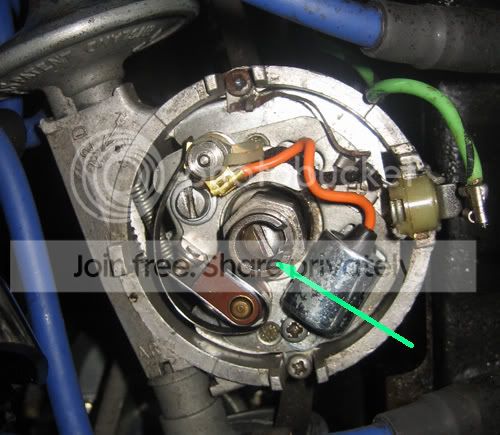
Photo of dizzy head

rotorGrease.jpg
 
Dale,

I've said it before and I'll say it again. I don't like the looks of that ground wire inside the distributor. This is what all of mine look like and yours looks like it could be trouble, now or later.

It is probably not the issue now, but a small piece of 12 gauge wire soldered in place will be much better than those few strands that you have left there.
 

Attachments

  • 12687.jpg
    12687.jpg
    65.7 KB · Views: 327
  • 12688.jpg
    12688.jpg
    60.1 KB · Views: 328
Dale,

Make sure the wire going from the plastic feed through block to your points is not shorted to ground through the grounding wire at the area where they cross near the plastic feed through block inside the distributor.

Also, are the points clean and touching when the rubbing block is not on the lobe of the cam and open when the rubbing block is on the lobe of the cam.

Phil
 
I agree that the earth wire inside the dizzy should be kept away from the points and the lug passing through the housing. However, 12 AWG is a bit large and stiff. If you use a wire that large and one with "normal" stranding, you stand a good chance of restricting the operation of the vacuum advance unit. Wire with normal stranding is going to fatigue and break sooner if the vacuum advance works. The original Lucas earth lead will be of very fine stranding and covered with a very thin fiberglass insulating sleeve. The fine braided wire is very similar to motor brush leads. That's what I've used for repairs when necessary (re-using the old fiberglass sleeve).

Dale, since you now have spark with the static tests, pull a spark plug and rest it on the block with its lead attached. Use a jumper wire on the solenoid so you can crank the engine while you watch the plug resting on the block. That will tell you if you have a spark while cranking. Once you know you have a spark while cranking, check the static timing, then if necessary... move on to checking the fuel system.
 
OK, then go with softer 14 gauge. I can see your point.
 
Hey Phil et al !!

This is all sounding waaaay over my electrical
skill level.

The dizzy was rebuilt by Advanced Distributors
and has about 1700 miles of use on it. The coil
is new, the rotor is new, the condenser has 75 miles
the points have maybe 1300 miles on them. Spark plugs
less than 100 miles. Dizzy cap is almost new.

It is sounding more and more like the dizzy
needs another rebuild by Jeff. Should I send
it off to Jeff for another rebuild?

Are there aftermarket distributors available?
Perhaps mine is too far gone to rebuild again?

<span style="color: #000099">Thinking outside the box here-
Could the innards of the exhaust muffler be
deteriorated and causing a restriction to the
exhaust flow? Could that condition account for
the sudden black, black plugs and my present problems?

regards,

dale </span>

<span style="color: #006600">Battery now charged and choke
cables hooked up. Everything back together.

Cranked the engine until the battery quit.
Twice the engine almost caught but didn't
quite make it. That's it for today until the
battery charges back up.

I am still amazed how these cars can be running great
when pulled into the garage and then the very next
morning be broke and require extensive diagnostics
and repairs.</span>

thanks,

dale
 
Tinster said:
...The dizzy was rebuilt by Advanced Distributors
and has about 1700 miles of use on it. The coil
is new, the rotor is new, the condenser has 75 miles
the points have maybe 1300 miles on them. Spark plugs
less than 100 miles. Dizzy cap is almost new.

It is sounding more and more like the dizzy
needs another rebuild by Jeff. Should I send
it off to Jeff for another rebuild?
Dale, are the cap, rotor, condensor and points the ones Jeff supplied with the rebuilt distributor. I'm assuming he supplies those bits with a rebuild. I have it on good authority not only that Jeff does quality work (thus, I'm sure the dizzy itself is fine), but he also uses the best available components, particularly rotors, which we all know were and may still be a problem from some sources!

If in doubt and/or if you've replaced any items that Jeff had supplied with the rebuilt dizzy, revert to known good parts that came off.

Surely, this will end up being something so simple that you'll want to :wall: when you spot and correct it! And it's not rocket science, rather just a simple process of elimination.
 
<span style="color: #660000">A confusing response.

A BCF car expert viewed my cap and rotor that Jeff supplied and told
me they were worn out and needed replacing. The points are Jeff's,
Jeff's condenser failed and I replaced it.

I bought a new cap and rotor from Jeff's supplier. The rotor broke
in pieces almost at once and I replaced it with a Lucas.

I replaced my Lucas Sport coil yesterday with a Western Auto coil.
I replaced my new rotor with another new Lucas rotor.

All this trouble becasue I cleaned the sooty spark plugs.

d</span>
 
Tinster said:
All this trouble becasue I cleaned the sooty spark plugs.

Dale, I apologize for not following the threads discussing the advent of this problem. However, when you cleaned the plugs, how did you clean them? Please don't say it was with a wire brush.
 
dklawson said:
Tinster said:
All this trouble becasue I cleaned the sooty spark plugs.

Dale, I apologize for not following the threads discussing the advent of this problem. However, when you cleaned the plugs, how did you clean them? Please don't say it was with a wire brush.

<span style="color: #000099">Nope, I learned my lesson on that.

I used carb cleaner and a soft rag. 800 grit wet
paper on the electrode metal.

d</span>
 
OK! So nothing attempted seems to give me a firing engine.

I've ordered the parts (in duplicate ) to tear out the entire
ignition side and replace it with new. I'll keep my new alternator since I think it works and it cost me $250.

We've been thru the fuel delivery side twice now, so
I'm fairly satisfied the problem is electric or in my
muffler. New fuel tank due any day.

I still cannot fathom how many man hours of repair work
and new parts it requires to drive one hour in a TR6!!

blargh!!!!!!!!!!!!!!

d
 
dklawson said:
Dale, I apologize for not following the threads discussing the advent of this problem. However, when you cleaned the plugs, how did you clean them? Please don't say it was with a wire brush.

Take me to school here - what is wrong with a wire brush?
 
It leaves metal tracks on the ceramic insulator and the current runs down the tracks instead of across the gap. Therefore, the gas wil not ignite.

Dale,

It is unlikely anything is wrong with the distributor other than possibly the points, condenser, rotor, cap, ground wire, and the wire to the points.

Do you have a volt meter? If so I can outline some very simple tests.

Phil
 
Dale: When it suddenly fails to run, have you ever immediately checked for a spark at the plugs? It sure sounds like an intermittent electrical problem to me.

Tom
 
Hey Cuz, what parameters are you using to flunk the rotors?

These rotors are really very simple devices. Easy to visual check to see failures, or excess wear.

First, let's start with the rotor body. It sits down on the distributor shaft. When pushed fully down on the shaft, there should be no movement of the rotor on the shaft, no lateral(turning) movement, no rocking, then check the rotor body for cracks, at our age a strong light and good glasses help. No cracks then check the metal(usually brass) connector on the top of the rotor. That should be riveted firmly in place, if you can move the metal on the rotor, toss it. If it is strong and firm, then take an ohmmeter and check for abnormal resistance between where the center cap contact touches it and the end of the rotor where it comes near the cylinder wire contacts inside the cap. Then check the rotor end for roughness and erosion, pitting of the contact, minor roughness can be abraded off with an emory board..

The reason why I say to check the rotor's impedance is, that some Bosch rotors sold as LBC rotors do include an internal resistor there. Usually easy enough to identify as the contact strip on the rotor will be "Glued" over near the center of the rotor
 
Back
Top