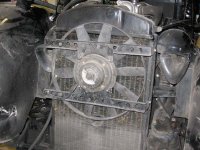
It goes behind the radiator (attached to the radiator) extending to the fan, with the fan just entering the shroud.
This is a typical modern fan shroud:
Yours will be deeper, because the fan is farther from the radiator, but the construction is similar & a little easier because the function is the same: isolation of the path of the air from the back of the radiator to the fan. The area at the radiator end must include all, & not obstruct any, area of the core at the back of the radiator.
If you look at it, & OEM fan installations in modern cars, you can see why many retrofit electric fan installations in cars that had mechanical fans originally are not much better: they only use part of the radiator. The ones that just wire straight to the back of the radiator only pull air through that section when stopped in traffic.
<div class="ubbcode-block"><div class="ubbcode-header">Quote:]I've always been impressed by how efficient forced-air cooling can be, as long as you force the air though the right places. [/QUOTE]
I was amazed too. We have a room full of servers at work with their own A/C, in which twice the dedicated A/C died. They were blowing the A/C'd air from the hall in w/a box fan propping open the door, but the temp was still heading over 90. Shrouded the fan by taping up some garbage bags to seal the open area in the propped door above the fan, then experimented with how far to crack the other door for maximum exhaust velocity, & the temp in the room went down to the hallway level in about 15 minutes. Specialized knowledge learned from figuring out how to make an XK-140 stop running hot transferred to the "real" world!


 Hey Guest!

 Hey - did you know if you click on the title of a thread it will take you to the first unread post since you last visited that thread?
 but were afraid to ask:
  STOP!! Never post your email address in open forums. Bots can "harvest" your email! If you must share your email use a Private Message or use the
  smilie in place of the real @
 Pretty Please - add it to our Events forum(s) and add to the calendar! >>