

-
 Hey Guest!
British Car Forum has been supporting enthusiasts for over 25 years by providing a great place to share our love for British cars. You can support our efforts by upgrading your membership for less than the dues of most car clubs. There are some perks with a member upgrade!**Upgrade Now**
(PS: Upgraded members don't see this banner, nor will you see the Google ads that appear on the site.)
You are using an out of date browser. It may not display this or other websites correctly.
You should upgrade or use an alternative browser.
You should upgrade or use an alternative browser.
TR2/3/3A Cooling System Flush
- Thread starter mgedit
- Start date

GTP1960
Jedi Knight
Offline
Hi, I have a TR2 that had been sitting for decades and I got back on the road a few years ago. My block drain was completely sealed with sediment, I had to dig out the opening to get the coolant to drain. I filled the cooling system with Evaporust and let it sit overnight, I think I did this a few times, like once a year. During the summer, I would drain the anti-freeze and run water for a little while so I could do a few quick and easy drains back to back. I figured driving the car would start to shock the sediment in the bottom of the block, loosening it up due to vibration and heating/cooling. "
My engine block drain is completely sealed with sediment also. I tried using a Phillips head, a coat hanger, even a drill bit.(as someone suggested in a previous thread) Though I removed or displaced a lot of crud, still no luck on getting a flow.
I then tried the evaporust radiator flush( though I didn't let it sit overnight). It came back black as tar, but didn't un seat the blockage.
Tim, think I'll try the regular evaporust & let it sit in the block, undiluted, for a few days, just to see what happens.
the muratic acid treatment is my last resort, though it sounds like the stuff that always works.
GP

TR3driver
Great Pumpkin - R.I.P
Offline
Even with the drain open, though, there can be an awful lot of crud piled up on the other sides of #4; which can lead to overheating. I've always been able to open the drain with some determined probing, but I was amazed at how much was still in there when I pulled the liners.
Not necessarily a good idea (all that crud rains down on the crank journals), but it is possible to remove the liners and wire-brush the water jacket with the engine (and apron) still in the car.
Not necessarily a good idea (all that crud rains down on the crank journals), but it is possible to remove the liners and wire-brush the water jacket with the engine (and apron) still in the car.
GTP1960
Jedi Knight
Offline
Thanks Randall,
wish i I had something like a waterpik with a long flexible tube to frac that crud with.
on a different topic.
I wanted to ask you: do you think the old dash mounted heater fan rheostat switch could operate a rad. pusher fan (without burning up)?
if not , I can always just remove the old switch (mothball it with the heater) & replace it with a newer one.
Guy
wish i I had something like a waterpik with a long flexible tube to frac that crud with.
on a different topic.
I wanted to ask you: do you think the old dash mounted heater fan rheostat switch could operate a rad. pusher fan (without burning up)?
if not , I can always just remove the old switch (mothball it with the heater) & replace it with a newer one.
Guy
TimK1955tr2
Senior Member
Offline
Hi GP,
I would keep poking around, using a coat hanger or something similar by hand, you are not going to hurt anything. It is either the cast iron block or metal liners. I would try to poke up and to the right, feeding and bending the wire until it breaks through.
Are you unscrewing the drain completely, for more room and angle? It would probably be very hard to clear with drain in place.
I don't think the Evaporust will work on hard water deposits, which may be the main culprit.
I would keep poking around, using a coat hanger or something similar by hand, you are not going to hurt anything. It is either the cast iron block or metal liners. I would try to poke up and to the right, feeding and bending the wire until it breaks through.
Are you unscrewing the drain completely, for more room and angle? It would probably be very hard to clear with drain in place.
I don't think the Evaporust will work on hard water deposits, which may be the main culprit.
GTP1960
Jedi Knight
Offline
Thanks Tim,
maybe I'll remove the #2 carb. for better access, to pick around in there.
My engine does not have a petcock, only a plug.
the crud I've removed so far is black, feathery and magnetic ( sticks to the tip of the Phillips very well) so I think it's metal in origin.
Hopefully I can remove enough, for now, to postpone removing the liners until I 'm ready for a complete rebuild.
thx again.
maybe I'll remove the #2 carb. for better access, to pick around in there.
My engine does not have a petcock, only a plug.
the crud I've removed so far is black, feathery and magnetic ( sticks to the tip of the Phillips very well) so I think it's metal in origin.
Hopefully I can remove enough, for now, to postpone removing the liners until I 'm ready for a complete rebuild.
thx again.
TimK1955tr2
Senior Member
Offline
Hi GP,
I didn't notice in your other posts... is the engine running? If so, are you overheating? Unless you have ruled out the other causes of overheating, usually an older radiator not working to its best ability, I wouldn't tear apart the engine if it running fine otherwise. Just my thoughts, if compression is good, I would use and enjoy the car.
Also, the sediment is affecting the cooling of the lower part of the cylinder liners, not the hottest part of the engine.
I didn't notice in your other posts... is the engine running? If so, are you overheating? Unless you have ruled out the other causes of overheating, usually an older radiator not working to its best ability, I wouldn't tear apart the engine if it running fine otherwise. Just my thoughts, if compression is good, I would use and enjoy the car.
Also, the sediment is affecting the cooling of the lower part of the cylinder liners, not the hottest part of the engine.
GTP1960
Jedi Knight
Offline
Yes, she is running quite well.
However, she does run hot (at idle) & will diesel due to hot spots.
my winter project is to remove the apron & do about everything you can do up front:
including an installing a aluminum radiator w/ el. pusher, replacing the 4 blade paddle fan w/a 8 blade GT6 poly fan & new water pump & bellows thermostat. Probably in over my head, but these forums give me confidence!
that's a good point about the "lower part of the cylinder liners, not the hottest part"
but I'm pretty sure my dieseling originates in #4, as that spark plug is always charred black.
However, she does run hot (at idle) & will diesel due to hot spots.
my winter project is to remove the apron & do about everything you can do up front:
including an installing a aluminum radiator w/ el. pusher, replacing the 4 blade paddle fan w/a 8 blade GT6 poly fan & new water pump & bellows thermostat. Probably in over my head, but these forums give me confidence!
that's a good point about the "lower part of the cylinder liners, not the hottest part"
but I'm pretty sure my dieseling originates in #4, as that spark plug is always charred black.
TR3driver
Great Pumpkin - R.I.P
Offline
Might be OK, if you are careful to always move quickly between full off and full on. But even a relatively weak radiator fan draws 8 amps, while the stock heater motor only draws 3 or 4 amps, so the resistance element will get much hotter (roughly 4 times since power is resistance times current squared).I wanted to ask you: do you think the old dash mounted heater fan rheostat switch could operate a rad. pusher fan (without burning up)?
The way to do it safely would be to use a relay to control the fan motor (which IMO is a good idea anyway), then you can safely use the rheostat to override the switch that controls the relay.
Or, what I did was to just mount a wiper switch in the hole where the heater control goes. Seems like I used a big flat washer behind the panel, but the chome bezel covered the hole in front (so no extra washer shows). Looks very period-correct

TR3driver
Great Pumpkin - R.I.P
Offline
True, but the coolant flow to the back of the head (which generally is the hottest part of a TR motor) goes through the cylinder block and up around the #4 liner. Anything that reduces flow around the liner is also going to reduce flow through the head back there. Some people have even modified the head gasket for more flow past #4 (by restricting flow around the other cylinders).Also, the sediment is affecting the cooling of the lower part of the cylinder liners, not the hottest part of the engine.

TRopic6
Jedi Warrior
Offline
Aloha Guy,
I had a similar problem with an earlier TR6 and used this rig after digging around like you with a bent wire. I just pulled it out to use on my current TR6 project. Just screw on your garden hose and stick the flex tube in the block plug hole. Turning the water on should erode the buildup away, and you can direct in different directions inside the block. Watch the pressure - water will back-blast everywhere, so cover up the starter, carbs, etc. Better wait for a warm day though!
Jeff
74.5 TR6
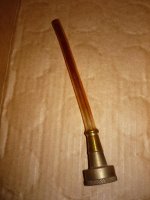
I had a similar problem with an earlier TR6 and used this rig after digging around like you with a bent wire. I just pulled it out to use on my current TR6 project. Just screw on your garden hose and stick the flex tube in the block plug hole. Turning the water on should erode the buildup away, and you can direct in different directions inside the block. Watch the pressure - water will back-blast everywhere, so cover up the starter, carbs, etc. Better wait for a warm day though!
Jeff
74.5 TR6
TRopic6
Jedi Warrior
Offline
Yep - I end up there every time I visit my mom's for something or another. Keep heading in to Farm Boys for some mustard BBQ.
There are some good ideas in this thread, and I see Randall mentioned using the block heater port as another flush point (post #2). Don't pressureize the heater core.
Merry Christmas to all!
Jeff
There are some good ideas in this thread, and I see Randall mentioned using the block heater port as another flush point (post #2). Don't pressureize the heater core.
Merry Christmas to all!
Jeff